
GPU Rental Prices Keep Rising, Yet Neocloud Stocks Fell 30% to 47%: The Surprising Debt Problem
GPU rental prices keep rising, but IREN, CoreWeave and Nebius fell 30% to 47% in a month. The 1-month drop vs the drop from the high, the CoreWeave bond and CDS numbers, and why higher rent doesn't fix the debt worry. Not investment advice.
 bufferAbout the author6 min read

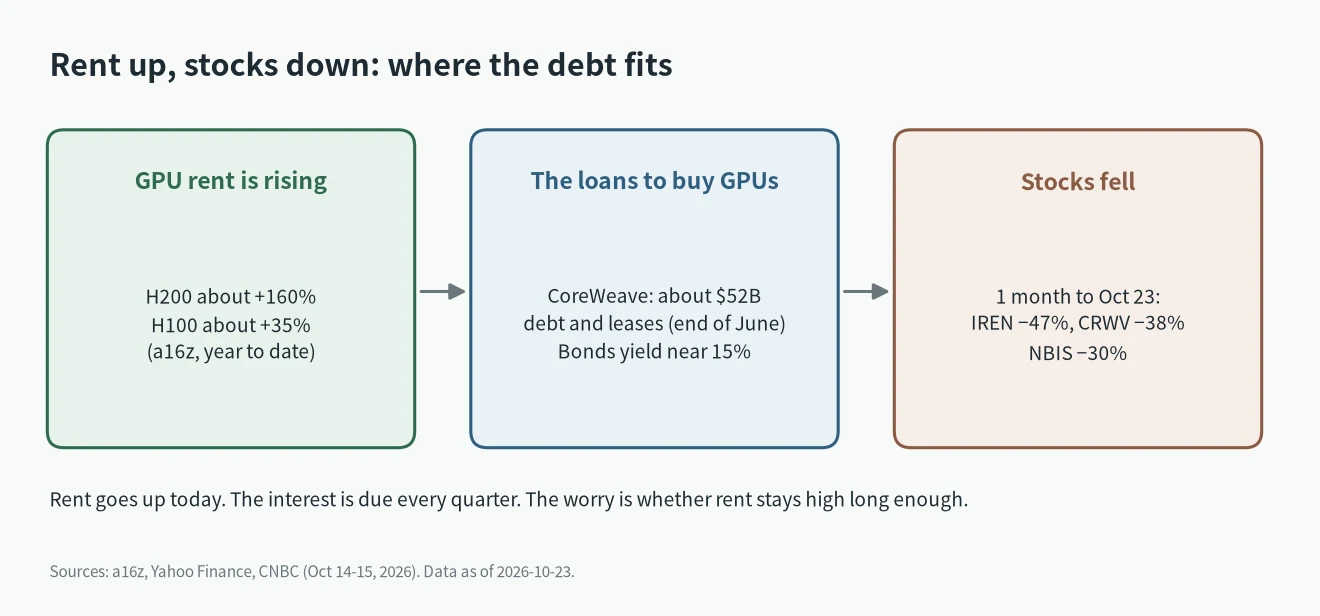
GPU rental prices keep going up, but the companies that rent out GPUs just watched their stocks drop hard. That felt odd to me, so I dug in. In the month to October 23, IREN fell about 47%, CoreWeave about 38% and Nebius about 30%. The short reason: investors are worried about the debt these companies took on to buy the chips.
One plain line before anything else: this is not investment advice. I’m not telling anyone to buy or sell.
How much GPU rental prices went up
On October 23 (US time), a16z posted a chart of rental rates since January 1. Their approximate year-to-date changes:
- H200: about +160%
- B200: about +120%
- RTX PRO 6000: about +65%
- H100: about +35%
They also said the A100, which is six years old, now rents for more than it did at the start of the year.
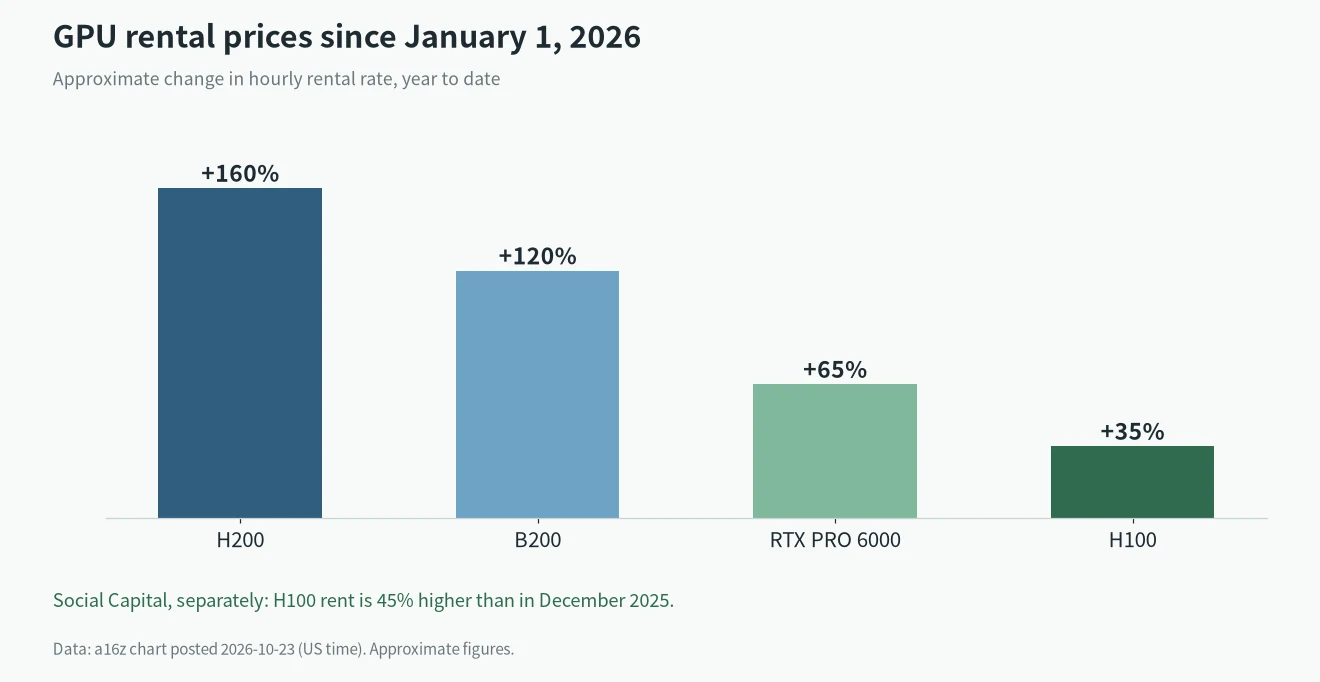
Social Capital posted a different H100 number a day later: renting an H100 costs 45% more than in December. That’s a different start date and a different data set from a16z, so the two numbers don’t match exactly. They point the same way.
The H100 went on sale in 2022. Two newer generations have come out since. It still costs more to rent than last winter.
Why? Chamath Palihapitiya quoted that post: “Power is the binding constraint.” In his view that’s why prices keep climbing. That’s his opinion, not a measurement.
Musk: compute stranded in unfinished data centers
I noticed Musk weighed in on this on the morning of October 25, Beijing time, and it fits the power point above. At 09:29 he quoted a list another account had posted of what limits power, including land, permits, grid access, transformers and switchgear, and community political power. He called it “a fuller list of the limitations of supercomputer buildout” and said that if anything is missing, “the compute doesn’t work.” Three minutes later he replied to Yuchen Jin: “I think we’re going to see a lot of stranded compute in partially complete data centers.”
How much the stocks fell: 1 month vs from the high
These are two different numbers. People keep mixing them up.
| Company | Close Oct 23 | Close Sep 23 | 1-month change | 52-week high | From the high |
|---|---|---|---|---|---|
| IREN | $24.91 | $47.05 | −47% | $76.87 (Nov 5, 2025) | −68% |
| CoreWeave (CRWV) | $54.24 | $86.90 | −38% | $141.79 (Oct 28, 2025) | −62% |
| Nebius (NBIS) | $158.74 | $226.61 | −30% | $299.86 (Jun 22, 2026) | −47% |
Source: Yahoo Finance daily prices. Highs are intraday.
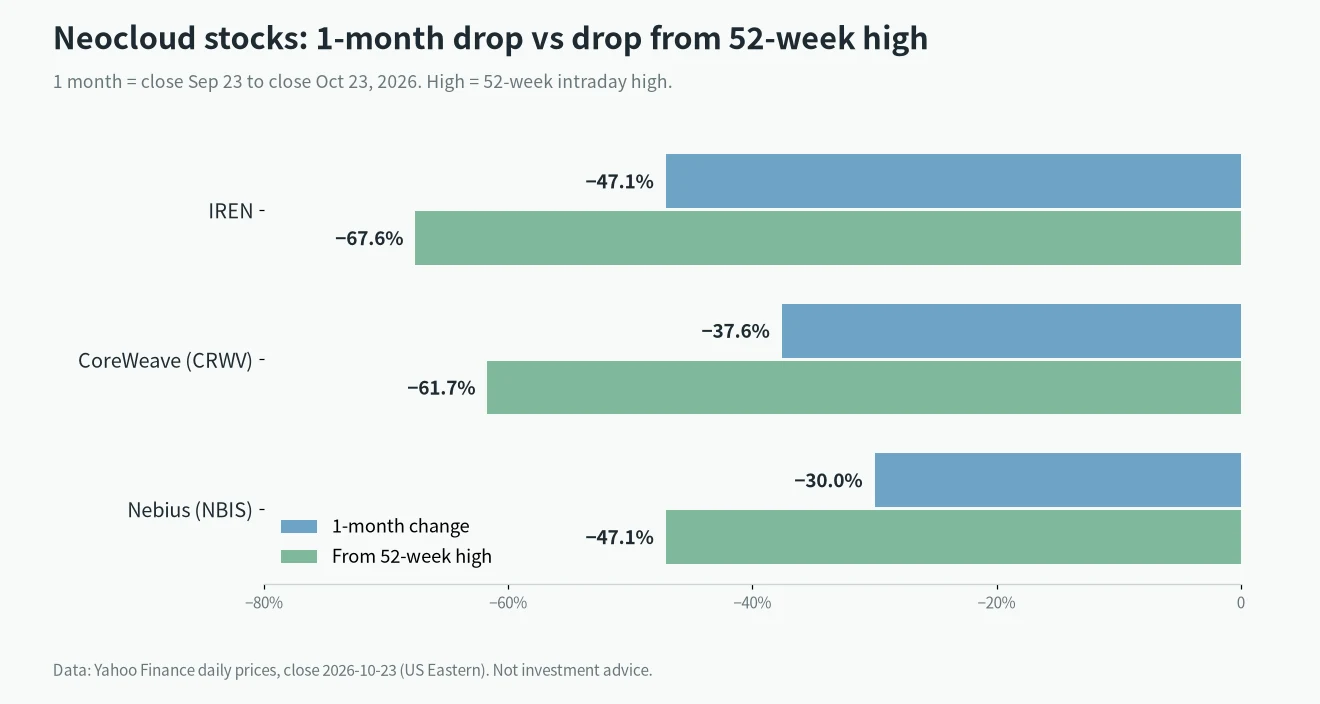
I’ve seen posts saying CoreWeave fell 68% in one month. That’s not right. Its one-month drop is about 38%. The 68% figure matches IREN’s drop from its 52-week high, and that took almost a year.
The real problem: the debt
The worst day was October 14. By the close, CoreWeave was down 15.5%, Nebius 10.1% and IREN 12.2%. Nothing went wrong with CoreWeave’s business that day. The trouble started in its bonds.
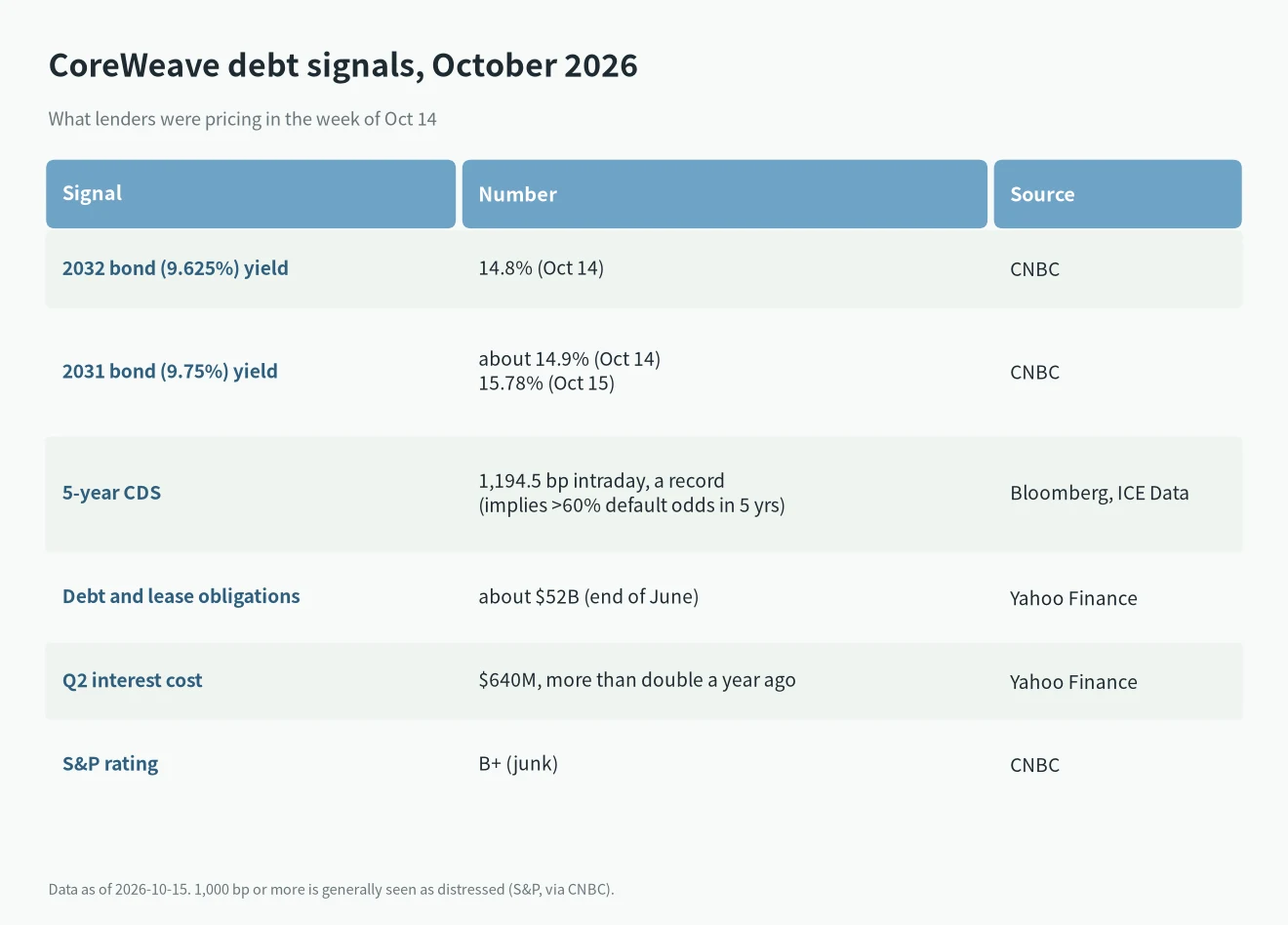
CNBC reported that CoreWeave’s 9.625% bond due 2032 was yielding 14.8%. Its 9.75% bond due 2031 was at about 14.9%. When bonds yield close to 15%, lenders think there’s real risk.
The next day it got worse. Bloomberg reported CoreWeave’s five-year credit default swaps hit a record 1,194.5 basis points intraday, citing ICE Data. Bloomberg said that price implies more than a 60% chance of default within five years. CNBC added that the 2031 bond yield reached 15.78%. An S&P analyst told CNBC that 1,000 basis points or more is generally seen as distressed.
How big is the debt? Yahoo Finance reported:
- CoreWeave raised more than $35 billion this year through chip-backed loans, high-yield bonds, convertibles and share sales.
- Debt and lease obligations were about $52 billion at the end of June.
- Interest cost $640 million in the second quarter. That’s more than double a year earlier.
S&P rates CoreWeave B+, which is junk. S&P’s analyst told CNBC its spending is “almost hyperscaler-like” but it doesn’t have “the hyperscaler balance sheet.”
CoreWeave’s CEO Michael Intrator pushed back in a memo: “We are confident in our backlog which more than supports all of our debt obligations.” The stock rose 5.9% on October 15. Then it fell 11.9% on October 16.
What about Nebius and IREN?
They borrowed too, but more of it is cheap convertible debt. Nebius closed $5.75 billion of convertible notes in August, at 0.50% (due 2030) and 4.50% (due 2034). It said the money goes to data centers and GPUs, among other things. CoreWeave’s bonds carry coupons above 9%. The market sold all three anyway. CoreWeave is just the one where you can see the fear in bond and CDS prices.
Why higher rent doesn’t fix it
This part confused me at first. If rent goes up, shouldn’t these companies make more money?
They can. The problem is timing.
- They borrowed now to buy chips. The interest is due every quarter, no matter what.
- The chips age. New generations keep coming, and the H100 already has two newer ones.
- A CreditSights analyst told the Financial Times the worry is a mismatch. CoreWeave’s data center leases are long. Its customer contracts are shorter. If too much gets built, why would customers renew?
- Analysts expect CoreWeave’s free cash flow to be about negative $25 billion this year (Visible Alpha, via Yahoo Finance).
So high rent today doesn’t tell you what rent will be when those contracts come up for renewal.
Two bigger-picture items came out the same week. On October 14, Gartner said over 80% of neocloud providers will cease independent operations by 2030. Gartner’s words are “cease independent operations”, under a heading about the market consolidating. That’s not the same as saying 80% go bankrupt. Gartner also said more than $3.5 trillion of AI infrastructure spending could be exposed to impairment by the end of 2030, if spending keeps its current pace. One line from that release matches the timing problem above: spending growth will be “too low for most AI compute providers to recover their AI investments before the current generation of AI semiconductors is replaced.”
And Apollo’s chief economist Torsten Slok has pointed out no signs of AI payoff outside the tech sector yet. Revenue per worker and profit margins are rising at the seven biggest tech companies. For the other 493 companies in the S&P 500 they’re flat. In the end, someone has to make money from AI for the rent to keep getting paid.
If you just rent a GPU
For people who rent a GPU by the hour, the short-term news is simple: it costs more this year than it did in January.
If you run models a lot, owning a card might be worth pricing out. I looked at that in my RTX 5090 for AI guide. If you want to try a model at home first, here’s how to run DeepSeek locally. And the wider money picture, Apple’s AI spending next to Nvidia’s data center revenue, is in the AI section of my iPhone Duo vs iPhone 18 Pro Max post.
What I’m watching next
- CoreWeave’s third-quarter results on November 11.
- Whether CoreWeave’s bond yields and CDS come back down.
- Whether rental rates keep rising or level off.
Prices in this post are closes as of October 23, 2026. Again, this is not investment advice.