

iPhone Duo vs iPhone 18 Pro Max: 7 Honest Reasons to Pick One Before Oct 23
Written three days before launch: the $700 folding premium, what the EU label says about drops and repairs, and who should buy, skip or wait.
 bufferAbout the author8 min read
iPhone Duo vs iPhone 18 Pro Max is the question I keep getting this week, and it’s a slightly weird one, because one is Apple’s first folding phone at $1,999 and the other is just a very good big iPhone at $1,299. Quick disclaimer up front: I’m writing this on October 20, three days before the Duo goes on sale on October 23. I haven’t held one. So this is a pre-launch buying guide, not a review. Everything comes from Apple’s own spec and store pages, the EU energy label database, and a few hands-on reports from the launch event, and I’ll say which is which.
The short answer
If you only read one paragraph of this iPhone Duo vs iPhone 18 Pro Max guide, make it this one. If you want the best iPhone for the money, get the 18 Pro Max. If you really want a 7.6-inch screen in your pocket and $700 extra doesn’t hurt, the Duo makes sense. But I’d still wait for proper reviews before ordering. That’s basically it. The rest of this post is me explaining why, with numbers.
iPhone Duo vs iPhone 18 Pro Max: the specs that matter
I skipped what’s identical. And a lot is identical: both run the A20 Pro chip, both are rated IP68 (6 meters, 30 minutes), both do MagSafe and Qi2 wireless charging up to 25W in the US, and both are eSIM-only here.
| iPhone Duo | iPhone 18 Pro Max | |
|---|---|---|
| Screen | 7.6″ inner + 5.4″ outer, both 120Hz | 6.9″, 120Hz |
| Thickness | 5.2 mm open / 11.3 mm closed | 8.75 mm |
| Weight | 254 g | 249 g |
| Unlock | Touch ID (side button) | Face ID |
| Rear cameras | 48MP Main (2x optical-quality) + 48MP Ultra Wide | 48MP Main + 48MP Ultra Wide + 48MP 4x Telephoto (8x optical-quality) |
| Battery, Apple “typical use” | up to 24 hours | up to 30 hours |
| EU rated battery (EU model only) | 4,883 mAh (A3720) | 5,391 mAh (A3717) |
| US price, 256GB | $1,999 | $1,299 |
Two things jump out. First, the Pro Max is actually lighter. A foldable that weighs 5 grams more than the biggest slab iPhone… fine, hinges are heavy, but still. Second, the camera. The Duo has no dedicated telephoto lens. TechRadar’s Lance Ulanoff wrote after his hands-on that he’s “not thrilled that I get just 2x zoom”. Same, honestly. If you shoot your kid’s football game from the stands, that 4x and 8x on the Pro Max is the whole point.
Face ID is also gone on the Duo. Gizmodo’s Raymond Wong called it “a step backward”. Touch ID on the side button isn’t bad (I lived with it on iPads for years), but coming from a Pro Max you’ll notice it every single unlock.
About those mAh numbers, because people will quote them wrong: Apple doesn’t print battery capacity on its US pages. The 4,883 mAh for the Duo is from the EU EPREL entry for model A3720, the European Duo. The 5,391 mAh for the Pro Max is from Apple’s own product sheet for EU model A3717. The US Duo is a different model (A3447), and I couldn’t find a primary source for its capacity. So treat 4,883 as the European number, not necessarily the one in an American Apple Store.
Durability: what the “35 drops” thing really means
You’ve probably seen the Duo’s drop-test number floating around. Here’s what the EU label actually says. Foldables are tested twice, closed and open. Closed, the Duo survived at least 140 drops without damage. Open, 35. Together that’s a B on the A-to-E scale. 35 open happens to be exactly the floor for a foldable B, so it passes, just without much margin.
For context, Samsung’s Galaxy Z Fold8 did 45 open and 210 closed and got an A, so the Duo is about 10 fewer than Samsung when open. Huawei’s Mate X7 (EU version) managed 15 open and got a D. The 18 Pro Max doesn’t open, obviously. It got at least 180 drops and also a B.
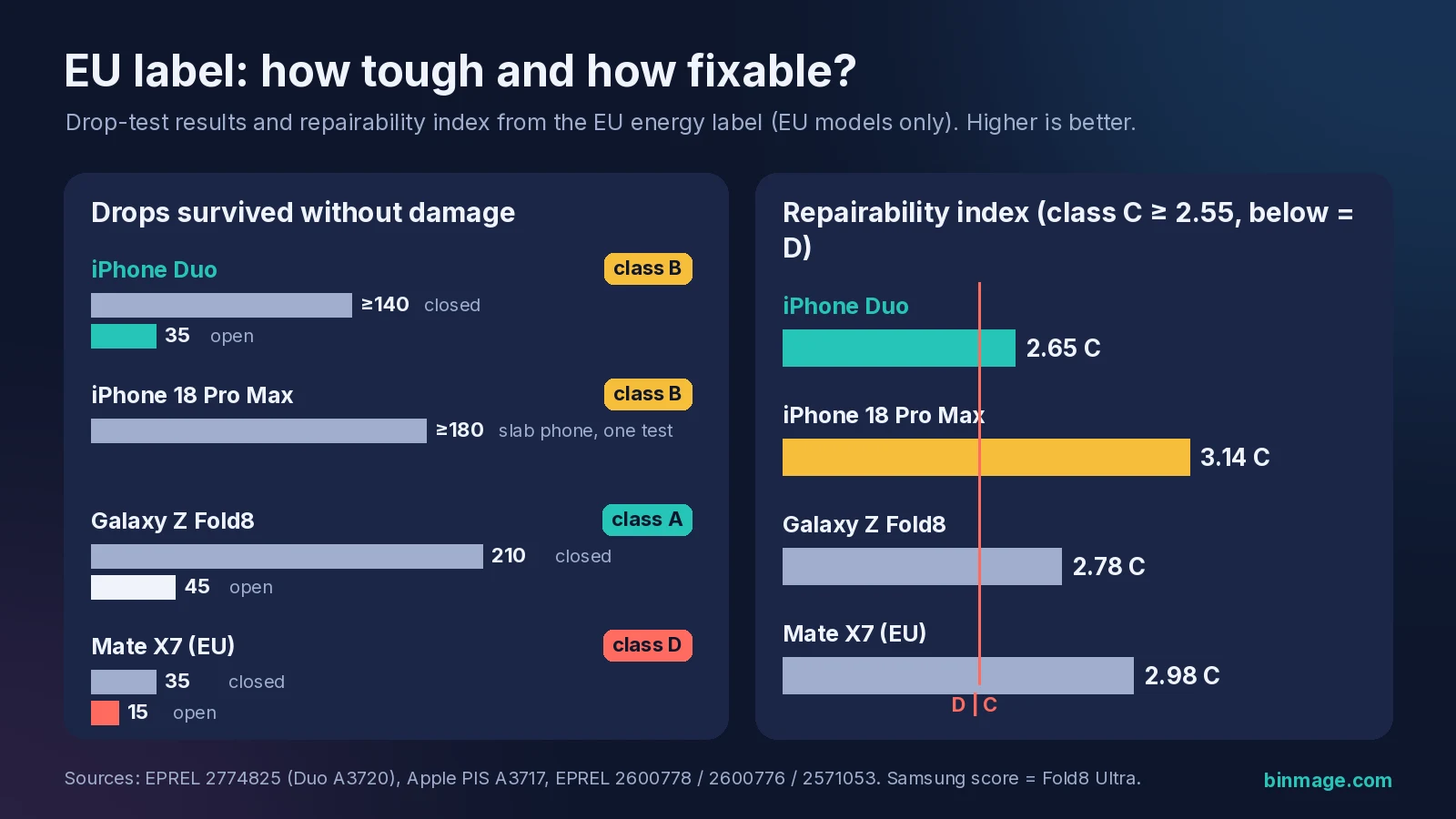
Repairability is where I wince a little. The Duo’s EU repairability class is C with an index of 2.65. Class C starts at 2.55, so it’s only 0.10 above a D. All three big foldables are C, but Apple’s is the lowest: Samsung’s Fold8 Ultra scores 2.78 and Huawei’s Mate X7 2.98. The 18 Pro Max gets 3.14. Apple’s white paper on the EU label says it doesn’t think the score reflects real-world repairability. Maybe so. I’d still budget for AppleCare+.
Why I’d budget for it: 9to5Mac reported Apple’s out-of-warranty prices on October 14, $999 for the inner display and $1,499 for other damage, or $99 for the inner screen with AppleCare+. Apple’s support page loads its prices dynamically and I couldn’t read it directly, so that’s reported, not checked by me.
Price: what the fold costs you in the US
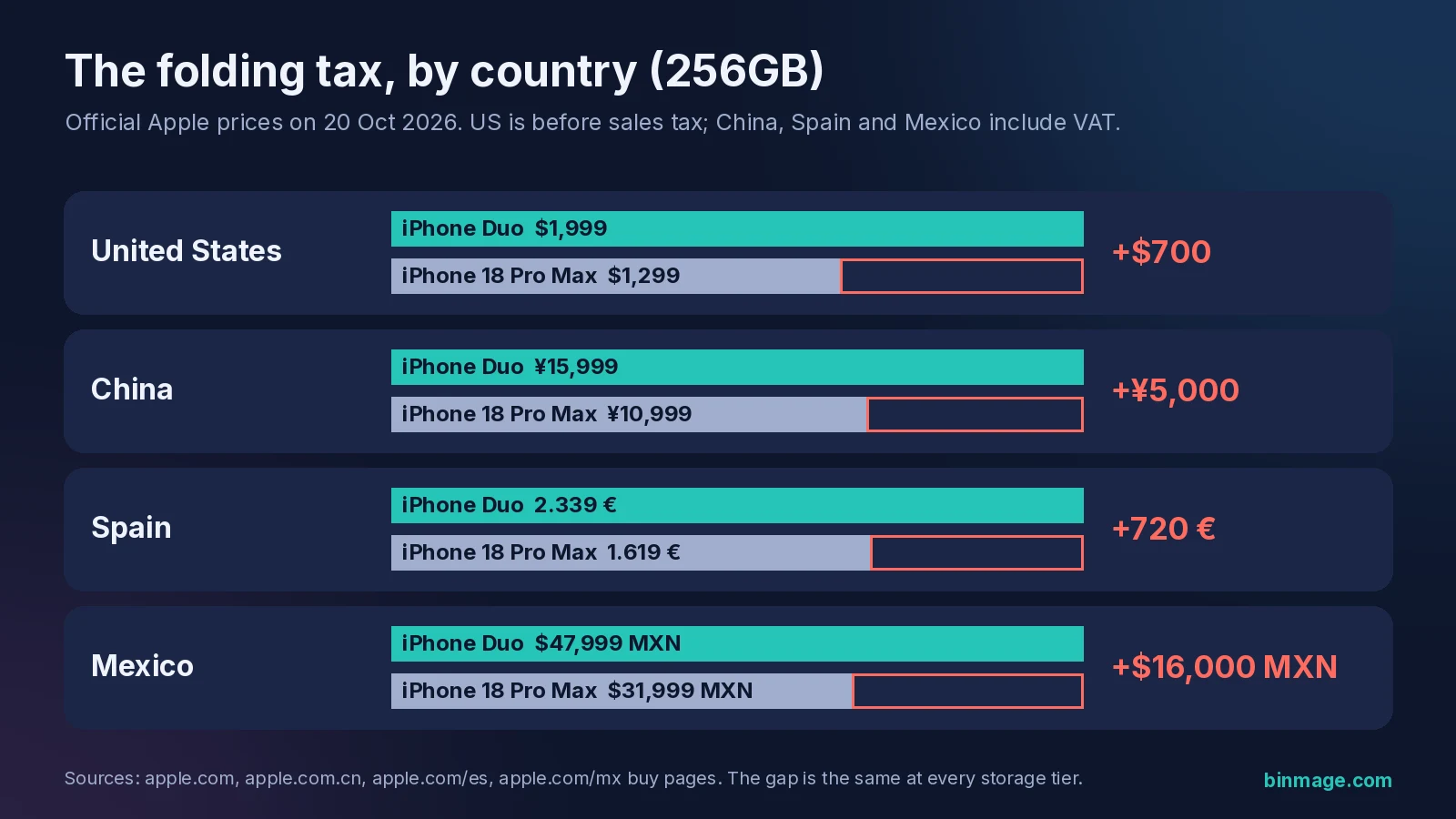
Every Duo tier costs exactly $700 more than the Pro Max with the same storage. Prices before sales tax, straight from apple.com:
| Storage | iPhone Duo | iPhone 18 Pro Max | Gap |
|---|---|---|---|
| 256GB | $1,999 | $1,299 | +$700 |
| 512GB | $2,199 | $1,499 | +$700 |
| 1TB | $2,599 | $1,899 | +$700 |
| 2TB | $3,199 | $2,499 | +$700 |
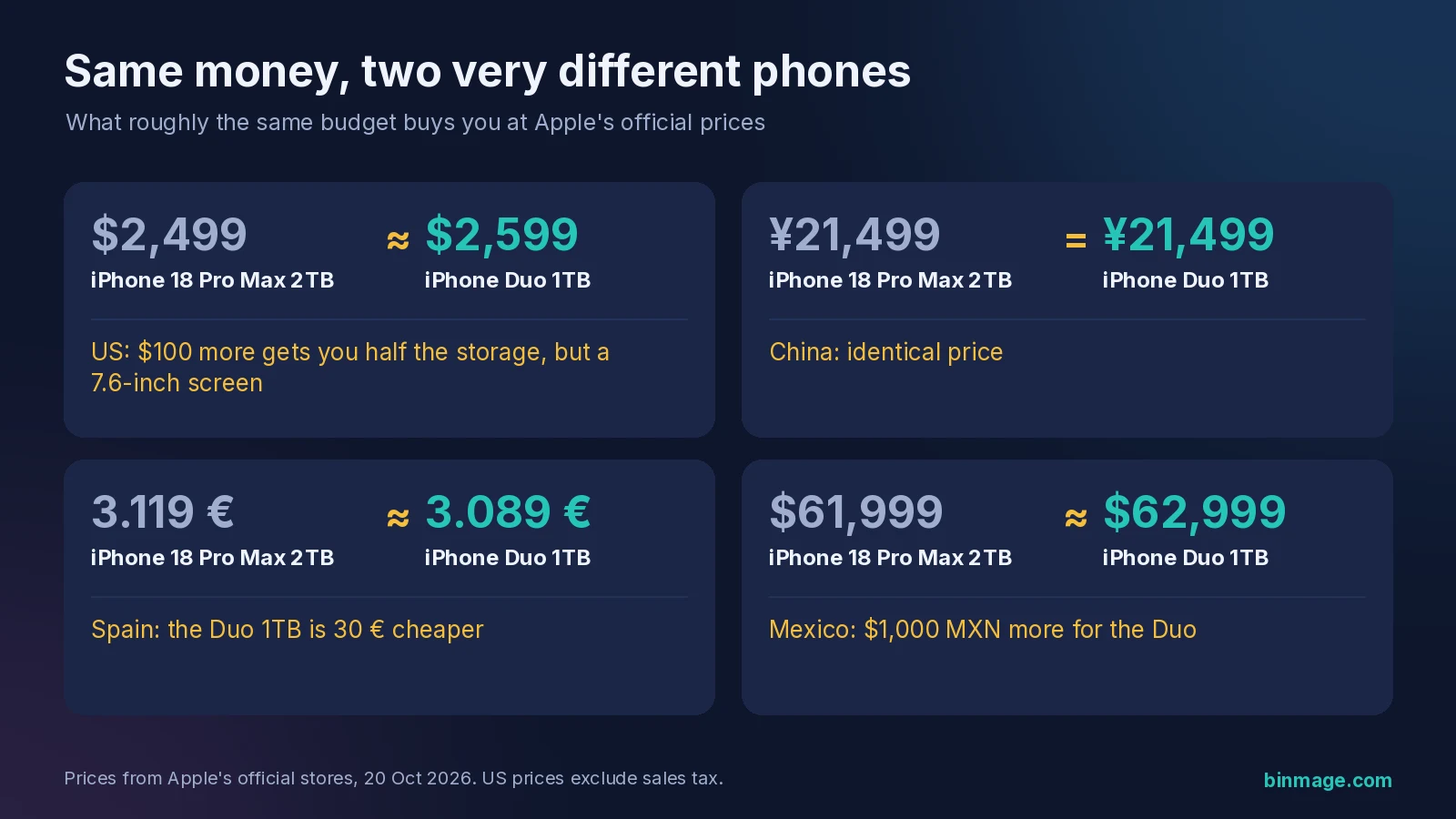
Here’s the iPhone Duo vs iPhone 18 Pro Max comparison that usually settles it for people: $2,499 gets you a 2TB Pro Max. $2,599 gets you a 1TB Duo. A hundred dollars more for half the storage and one extra screen.
Thinking of buying abroad? Don’t. By our own rough estimate (removing VAT and converting at the ECB reference rate of October 19), a 256GB Duo costs about 6% more in China than in the US before tax, and about 10% more at 2TB. Spain and Mexico come out higher still. For once the US is close to the cheapest place to buy an iPhone.
The AI angle: no reason to pick either one
Since this is an AI-and-hardware blog: on AI, these two are twins. Same A20 Pro, same Neural Engine, same Apple Intelligence. Siri AI is in beta and English-only to start on both. Apple doesn’t list RAM on either spec page, and I’m not going to guess. The Duo’s big inner screen may make some AI tools nicer to use side by side, but that’s a screen thing, not a smarts thing.
One footnote on both spec pages is worth reading, though. Server-side Apple Intelligence features like Siri AI and Image Playground have daily usage limits, and Apple writes that “expanded access to such features will be available for a fee in the future”. So the AI on either phone might turn into yet another subscription. If you already pay for ChatGPT or Claude, I compared those AI subscription prices here.
Who should buy which, and who should wait
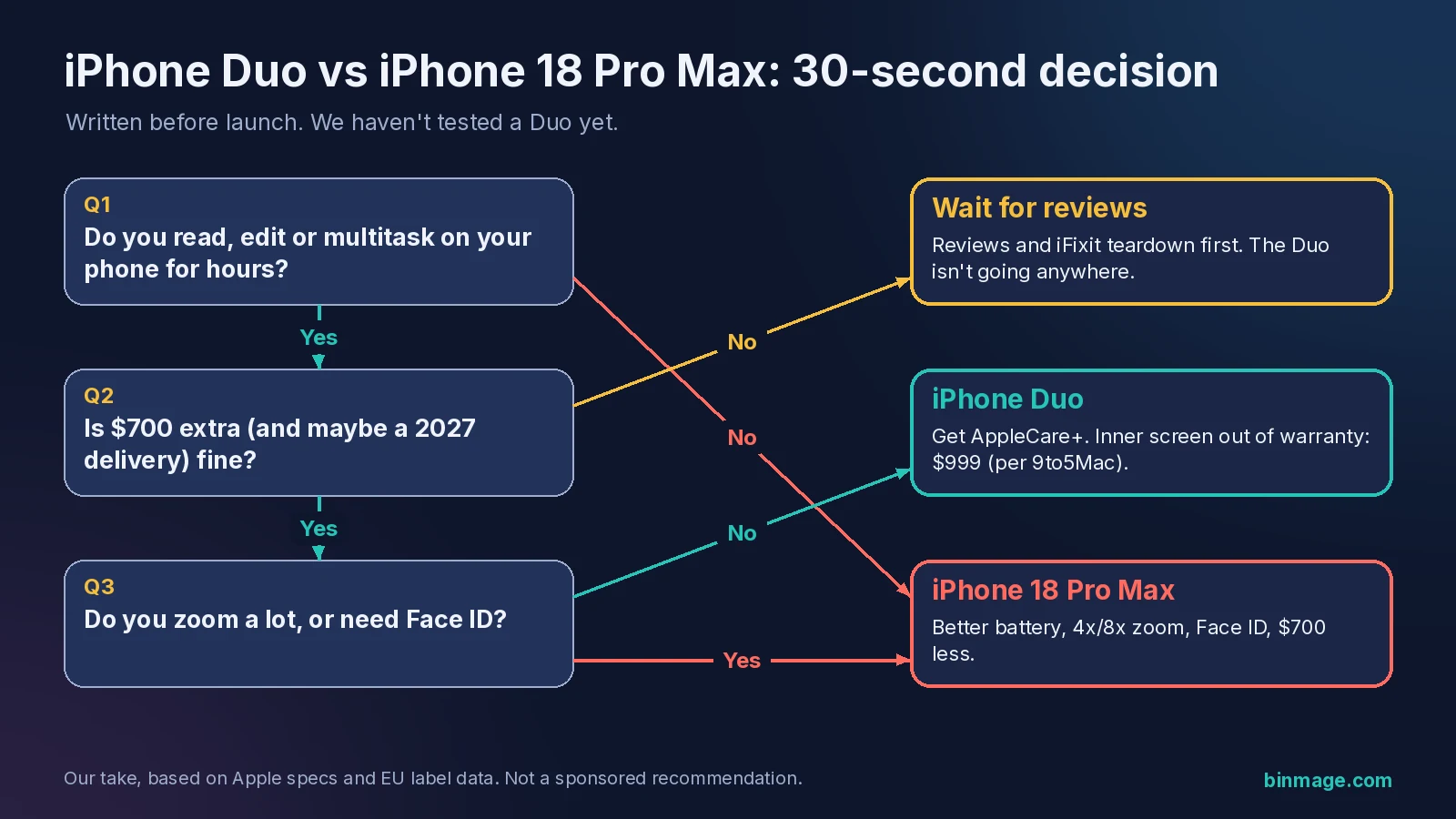
Boiled down, iPhone Duo vs iPhone 18 Pro Max comes down to how you use a phone, not which one is “better”. Here’s how I’d split it.
Buy the Duo if you read a lot, edit docs or spreadsheets on the go, or genuinely want one device that’s half phone, half small tablet. And you’re fine with $1,999 and up, no telephoto, Touch ID, and being an early adopter of Apple’s first hinge.
Buy the 18 Pro Max if you take a lot of photos, want the longest battery life (Apple quotes up to 30 hours of typical use vs 24), or just want the safest $1,299 you can spend on an iPhone this year.
Wait if you’re curious about the Duo but not desperate. Full reviews aren’t out, iFixit hasn’t opened one, and getting one is a mess anyway: Macworld’s pre-order live blog said new orders were slipping into 2027. The crease isn’t settled either. Gizmodo said it could still see it “at various angles”. I want to see that myself before spending two grand.
If a new Mac is also on your list this fall, I wrote a separate buy-now-or-wait guide for the Mac ahead of Apple’s October 28 event. Same idea: don’t pay launch-week prices for something you don’t need yet.
My take on iPhone Duo vs iPhone 18 Pro Max
For most people, iPhone Duo vs iPhone 18 Pro Max isn’t a close call. The Pro Max is $700 cheaper, lasts longer, zooms further and keeps Face ID. The Duo is the more exciting phone, no question, and part of me wants one. But wanting and needing aren’t the same thing, and a first-generation hinge is a first-generation hinge. I’ll update this once I’ve actually used a Duo after October 23.
Sources: Apple spec pages for iPhone Duo and iPhone 18 Pro / Pro Max; Apple online store; EPREL 2774825 (Duo A3720); Apple PIS A3717 (18 Pro Max, EU); EPREL entries for Galaxy Z Fold8 / Fold8 Ultra and Huawei Mate X7. Hands-on quotes from TechRadar and Gizmodo; repair prices and shipping delays as reported by 9to5Mac and Macworld. Pre-launch article, not a review.
More on this: more AI hardware guides.