

Best Value GPU for LLM Inference (2026): Price per GB and Tokens per Dollar
The best value GPU for LLM inference depends on how much VRAM you need: the RTX 5060 Ti gives the most speed per dollar, a used RTX 3090 is the cheapest 24GB, and the RTX 5090 is the 32GB pick. Checked October 28, 2026.
 bufferAbout the author8 min read

The best value GPU for LLM inference depends on one number: how much VRAM the models you want need. For models up to 14B, the RTX 5060 Ti 16GB at $429 gives the most tokens per second per dollar of any card I compared. For 24GB, a used RTX 3090 at about $800 is still the cheapest way in, and it runs 32B models at about 30 tokens per second. For 32GB, buy the RTX 5090 at $1,999; it is the fastest card here and costs about the same per GB as the 5080. Skip the RTX 5080 and a new RTX 4090 at today’s prices. Only buy an RTX Pro 6000 if you need 70B models or gpt-oss-120b on one card. Prices below are NVIDIA launch prices or market prices listed by Hardware Corner, and the speeds come from Hardware Corner’s llama.cpp tests. I checked all of them on October 28, 2026.
Short answer
- Under $500: RTX 5060 Ti 16GB. 12 tokens per second for every $100 on Qwen3 8B, the best ratio in this list.
- About $800: a used RTX 3090. 24GB at about $33 per GB, enough for 32B models.
- About $2,000: RTX 5090. 32GB, 145 tokens per second on Qwen3 8B and 51 on Qwen3 32B.
- About $8,000: RTX Pro 6000. 96GB, the only single card here that runs Llama 70B and gpt-oss-120b.
- Skip: the RTX 5080 (same 16GB as the 5070 Ti for $250 more) and the RTX 4090 at about $2,574, which now costs more than a 5090.
How to judge the best value GPU for LLM inference
Two numbers decide the best value GPU for LLM inference. The first is price per GB of VRAM. The whole model has to sit in VRAM to run at full speed, so VRAM decides which models you can use at all. At 4-bit, an 8B model needs about 6GB, a 14B model about 10GB and a 32B model about 20GB, plus room for the context. My VRAM calculator does this math for any model.
The second is speed per dollar. When a model fits, generation speed mostly follows memory bandwidth, because the card reads the weights once for every token. I use tokens per second on Qwen3 8B at 16K context from Hardware Corner’s GPU ranking, which tests every card with the same llama.cpp setup, and divide by price.
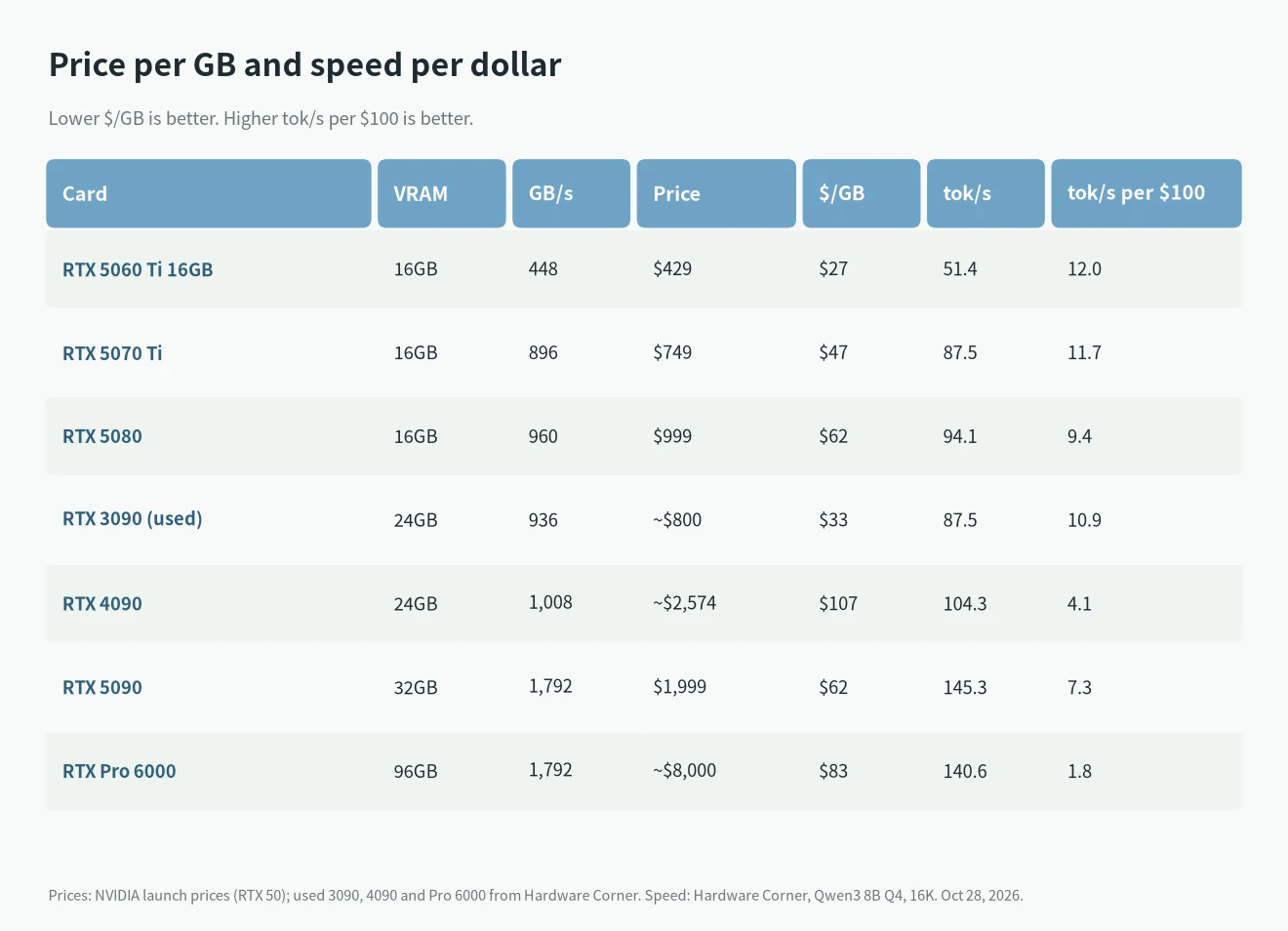
For the RTX 50 series I use NVIDIA’s launch prices: $1,999 for the RTX 5090 and $999 for the RTX 5080 (NVIDIA, January 2025), $749 for the RTX 5070 Ti, and $429 for the RTX 5060 Ti 16GB (NVIDIA, April 2025). The RTX 3090 and 4090 are no longer made, and the RTX Pro 6000 has no public list price, so for those I use the market prices on Hardware Corner. Street prices change every week, so the best value GPU for LLM inference can change too. Redo the division with the price you actually see.
Real speed on each card
Speed is the other half of the best value GPU for LLM inference. Here is generation speed in tokens per second for three common models at 16K context, all from the same Hardware Corner test.
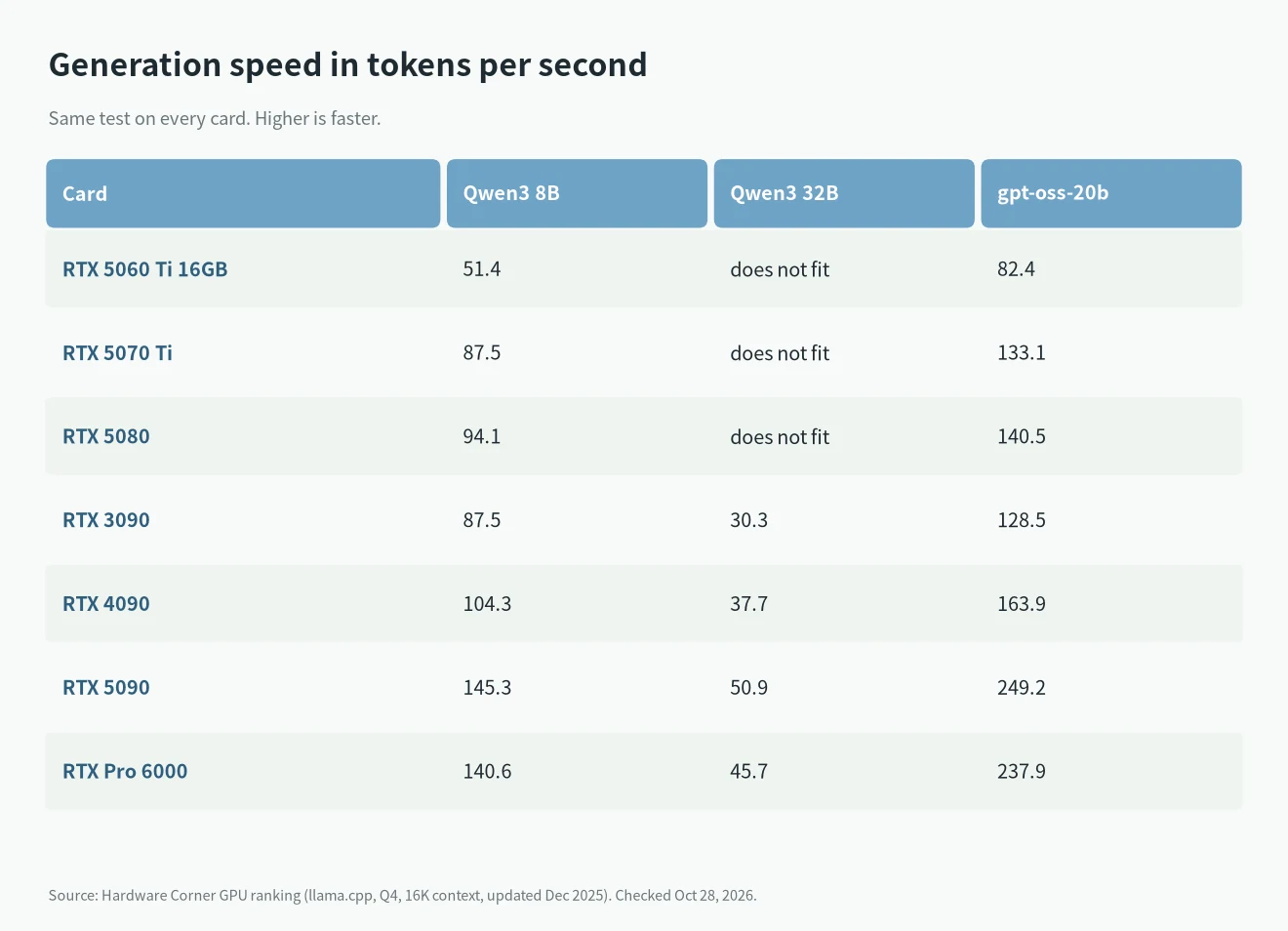
Three things stand out. First, the 16GB cards cannot run 32B models at all, however fast they are. Second, the RTX 3090 writes Qwen3 8B as fast as the RTX 5070 Ti (87.5 tokens per second on both), because their bandwidth is close: 936 vs 896 GB/s. Third, the RTX Pro 6000 is no faster than the RTX 5090 on models that fit both cards. It has the same 1,792 GB/s of bandwidth. You pay for the extra 64GB of VRAM, not for speed. For a closer look at the 5090 against the 4090, see my RTX 5090 for AI post.
Best value GPU for LLM inference by budget
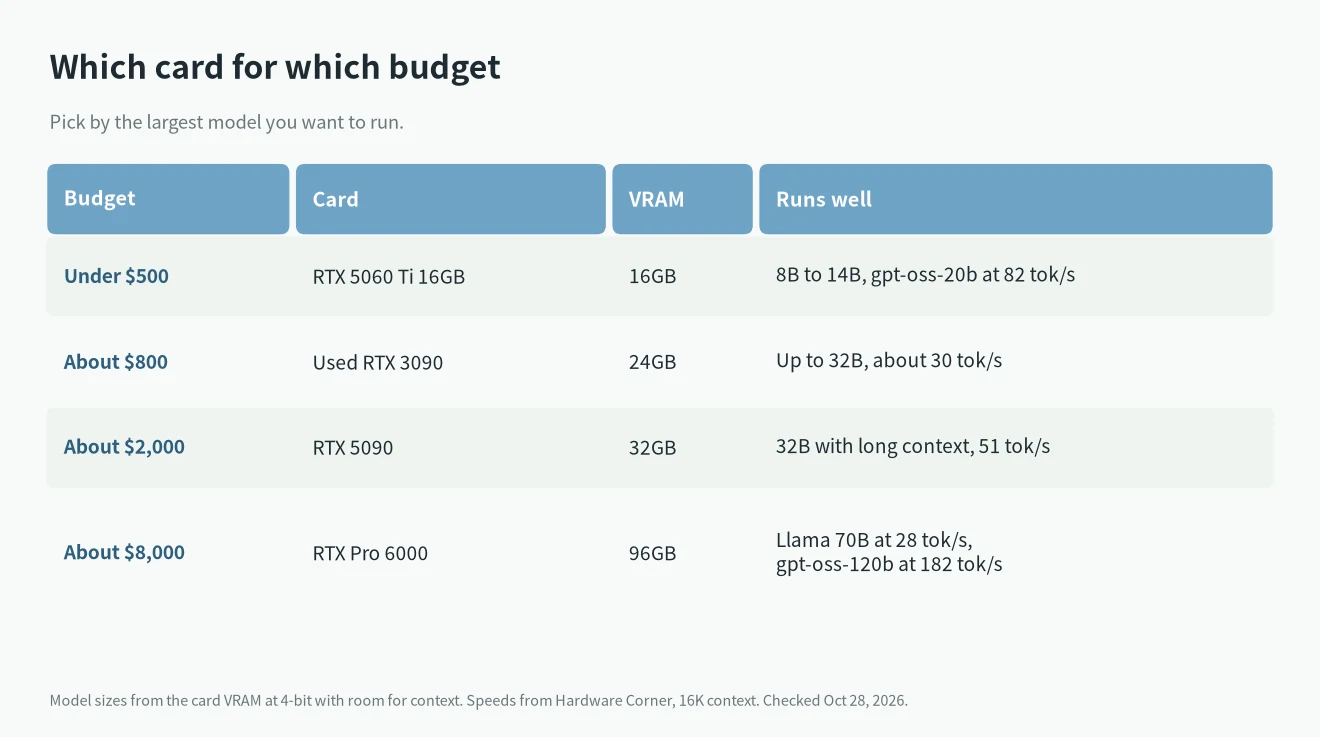
Under $500: RTX 5060 Ti 16GB
At $429, the RTX 5060 Ti 16GB writes 51.4 tokens per second on Qwen3 8B and 82.4 on gpt-oss-20b. That is 12 tokens per second per $100, the best ratio here. Its weak point is bandwidth: 448 GB/s, half that of the 5070 Ti, so long prompts and long contexts slow it down more. It is a new card with a warranty and draws much less power than a 3090. If you only run 8B to 14B models, this is the best value GPU for LLM inference you can buy new.
About $800: a used RTX 3090
Hardware Corner puts a used RTX 3090 at about $800. That is about $33 per GB, and no new card gives you 24GB for less. 24GB is the step that matters: Qwen3 32B at 4-bit runs on it at about 30 tokens per second, and no 16GB card can load it. The costs are a used card with no warranty, high power draw (350W) and a large cooler. Test it before you pay and check the fans and the memory temperature. To see what 24GB holds, read my guide to what models an RTX 4090 can run; the 3090 fits the same models, just more slowly.
If you want new and 16GB: RTX 5070 Ti
The RTX 5070 Ti at $749 has twice the bandwidth of the 5060 Ti and writes Qwen3 8B 70% faster, at 87.5 tokens per second. Per dollar it is close to the 5060 Ti. Pick it if speed on small models matters more to you than the price. The RTX 5080 at $999 is only about 8% faster than the 5070 Ti and has the same 16GB, so it is not the best value GPU for LLM inference.
About $2,000: RTX 5090
The RTX 5090 is the fastest card I compared. It writes Qwen3 32B at 50.9 tokens per second, against 37.7 on a 4090 and 30.3 on a 3090, and its 32GB leaves room for long contexts on 32B models. At the $1,999 launch price it costs $62 per GB, the same as the 5080 with twice the VRAM. Hardware Corner lists it at $2,499 on the street. Even at that price, it is a better buy than an RTX 4090 at about $2,574. Retail in 2026 can be far worse, though. NeoTeo reports a US retail listing for the RTX 5090 at $4,999 in September 2026, about 2.5 times its $1,999 MSRP, and says RTX 50 prices have moved well above MSRP in general. So divide the price you actually see by the GB before you buy.
About $8,000: RTX Pro 6000
The RTX Pro 6000 has 96GB on one card. It is the only card in this list that runs Llama 3.3 70B (28.2 tokens per second) and gpt-oss-120b (182.2 tokens per second) without splitting the model. Per GB, at about $83, it is cheaper than a 4090. If you mainly need a lot of memory and do not need CUDA speed, also compare it with a Mac or a DGX Spark in my DGX Spark vs Mac Studio comparison.
What about two cheaper cards?
Two RTX 5060 Ti 16GB cards cost $858 at launch prices and give you 32GB, more than one 3090. llama.cpp and Ollama can split a model across both cards. Speed does not add up, though: for a single user, the cards take turns, so you get roughly the speed of one card on a model twice as large. You also need a motherboard with two PCIe x16 slots and a bigger power supply. Two used 3090s (48GB) are the usual budget path to 70B at 4-bit, but this is a project, not a plug-in upgrade.
What I would not buy for LLMs
- 8GB cards: they only hold models up to about 7B at 4-bit. Spend the extra $50 on the 16GB 5060 Ti.
- The RTX 5080: 16GB at $999. The 5070 Ti does almost the same for $250 less.
- A new RTX 4090 at $2,500 or more: 24GB for more than a 32GB RTX 5090 costs at launch price.
If you are not sure which models you will run, start with my list of the best local LLMs for each VRAM size, then pick the card.
FAQ
What is the best value GPU for LLM inference in 2026?
For models up to 14B, the RTX 5060 Ti 16GB at $429. For 24GB, a used RTX 3090 at about $800. For 32GB, the RTX 5090 at $1,999.
Is a used RTX 3090 still worth it for LLMs?
Yes, if you need 24GB on a budget. At about $800 it is the cheapest 24GB card, and it runs Qwen3 32B at about 30 tokens per second. Test it before buying, since there is no warranty.
Is the RTX 5090 better value than the RTX 4090 for LLMs?
At current prices, yes. The 5090 has 32GB instead of 24GB, writes tokens about 1.35 to 1.5 times faster, and its $1,999 launch price is lower than the roughly $2,574 a 4090 sells for.
How much VRAM do I need for local LLM inference?
16GB for 8B to 14B models, 24GB for 32B models, and 48GB or more for 70B models, all at 4-bit. Long contexts need more.