
AI Max 395 vs DGX Spark: Which Is Best for Local LLMs? (Oct 2026)
AI Max 395 vs DGX Spark compared with real llama.cpp numbers: similar writing speed, Spark reads prompts 2 to 5 times faster, and the AMD boxes cost about half as much per GB. Prices checked October 2026.
 bufferAbout the author10 min read

AI Max 395 vs DGX Spark comes down to one question: will you mostly chat with a local model, or will you feed it long prompts and CUDA software? Both have 128GB of unified memory and almost the same memory bandwidth, 256 GB/s against 273 GB/s. So they write tokens at similar speeds. The DGX Spark reads prompts 2 to 5 times faster and runs NVIDIA’s CUDA stack. A 128GB Ryzen AI Max+ 395 mini PC costs about half as much: $3,500 for a GMKtec EVO-X2 versus $6,950 for a DGX Spark on NVIDIA’s store in October 2026.
My pick is simple. If you run llama.cpp, Ollama or LM Studio for chat and coding help, and you are paying with your own money, buy an AI Max+ 395 box. If your work depends on CUDA, vLLM or TensorRT-LLM, if you process long documents all day, or if you want to link two machines, buy the DGX Spark.
I’m writing this on October 27, 2026. Prices for both machines have gone up several times this year because of the memory shortage, so every price below has a date and a source. In this post, “AI Max 395” means the Ryzen AI Max+ 395 chip, code name Strix Halo, in its 128GB configuration.
AI Max 395 vs DGX Spark specs side by side
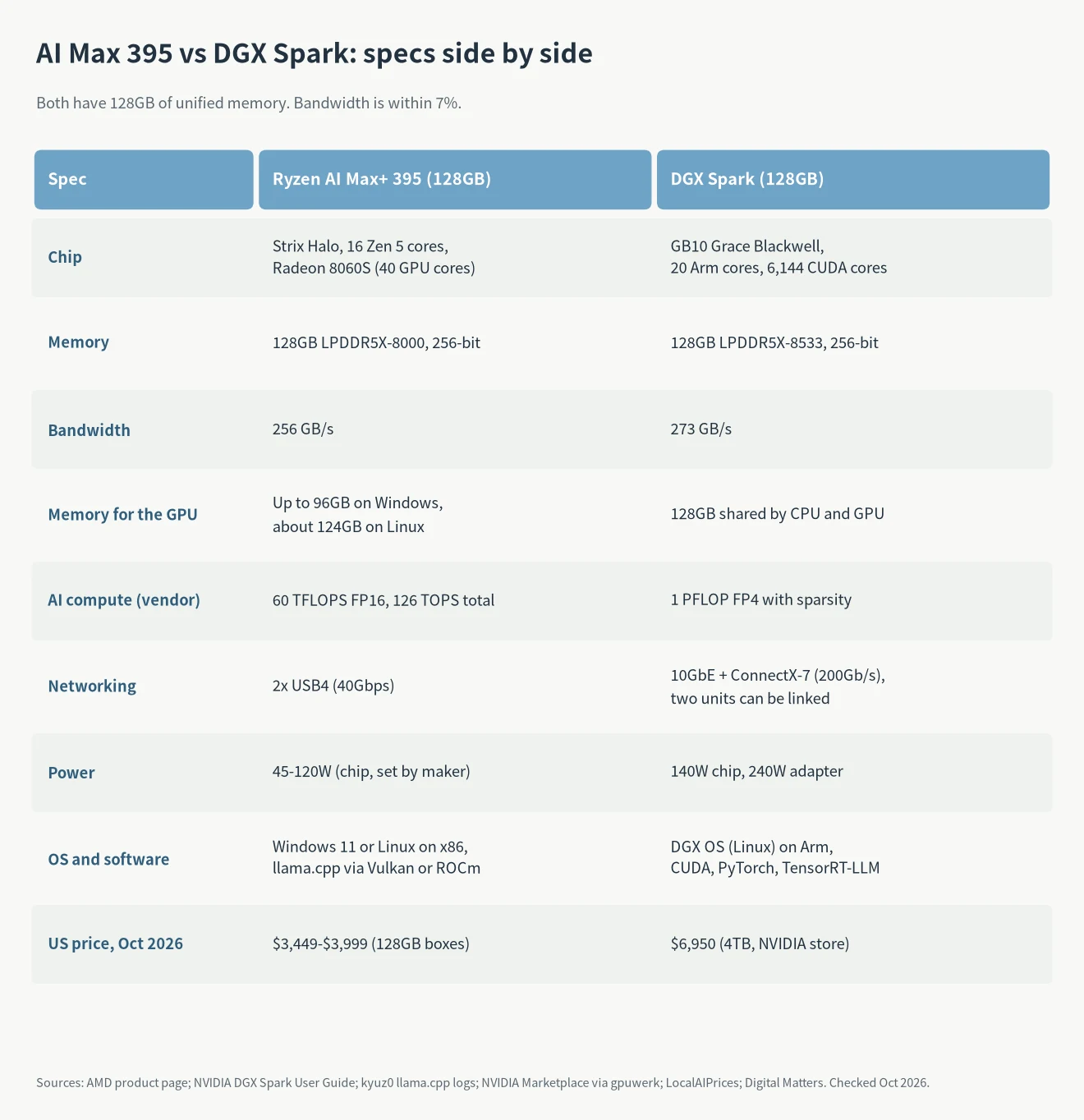
The two machines look alike on paper. Both use 128GB of LPDDR5X on a 256-bit bus, shared by the CPU and GPU. NVIDIA lists 273 GB/s for the DGX Spark (NVIDIA DGX Spark User Guide). AMD lists LPDDR5X-8000 on a 256-bit bus for the Ryzen AI Max+ 395 (AMD product page), which works out to 256 GB/s. That is a 7% gap.
The bigger differences are elsewhere:
- Compute. NVIDIA rates the GB10 chip at 1 PFLOP of FP4 with sparsity. AMD rates the AI Max+ 395 at 60 TFLOPS FP16 and 126 TOPS in total. The two figures use different formats, so don’t divide one by the other. What matters is that the Spark has far more compute for reading prompts.
- Memory the GPU can use. On Windows, AMD’s driver lets the GPU take up to 96GB of the 128GB (AMD, July 29, 2025). On Linux, the GPU can see about 124GB; one Strix Halo benchmark log shows 126,976 MiB of VRAM (kyuz0 log). On the Spark, all 128GB is one pool shared with the operating system.
- Networking. The Spark has a ConnectX-7 card with two QSFP ports at up to 200Gb/s, so two units can work as one. The AMD chip has two USB4 ports at 40Gbps.
- Power. The GB10 chip has a 140W TDP and the Spark ships with a 240W adapter. The AI Max+ 395 runs between 45W and 120W, depending on what the PC maker picks.
Prices in October 2026 and price per GB
DGX Spark: $3,999 at launch, $6,950 now
The DGX Spark launched at $3,999 on October 15, 2025. NVIDIA raised it to $4,699 on February 23, 2026, citing memory supply. NVIDIA’s own store now lists the 128GB, 4TB Founders Edition at $6,950, according to gpuwerk‘s price tracker, checked October 11, 2026. Tech Insider reports the same $6,950 figure.
There is now a 64GB DGX Spark too. NVIDIA announced it on October 2, 2026, starting at $4,999 from partner PC makers from October 23 (NVIDIA blog). NVIDIA says it handles models up to 100 billion parameters. That is $78 per GB of memory, the most expensive option in this comparison.
AI Max+ 395 boxes: $3,449 to $3,999
Many brands sell 128GB Ryzen AI Max+ 395 mini PCs. The GMKtec EVO-X2 with 128GB and a 1TB SSD costs $3,500 in the US, checked October 27, 2026 (LocalAIPrices). Digital Matters lists the Minisforum MS-S1 Max 128GB at $3,799 and AMD’s own Ryzen AI Halo 128GB, launched in June 2026, at $3,999 (Digital Matters).
The Framework Desktop is a good example of how fast these prices moved. It was announced at $1,999 for 128GB. Framework raised it to $2,459 in January 2026 because of memory costs (The Verge). Digital Matters now lists it at $3,449, and it is out of stock. I wrote about why memory keeps getting more expensive in my DDR4 vs DDR5 price post.
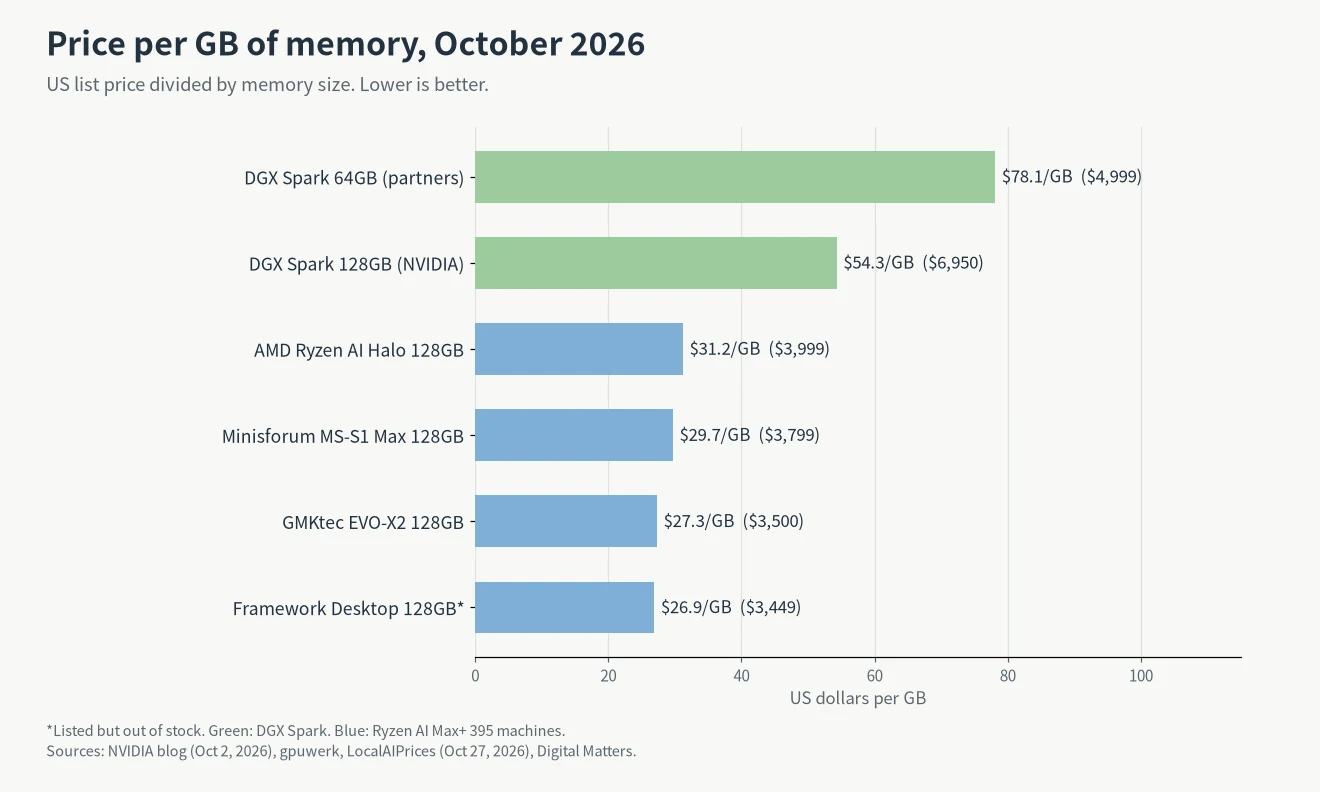
On price per GB, the AI Max 395 vs DGX Spark gap is large. A 128GB AI Max+ 395 box costs $27 to $31. The 128GB DGX Spark costs $54. If memory size is what you are paying for, the AMD machines give you about twice as much per dollar.
Real tok/s: AI Max 395 vs DGX Spark on gpt-oss-120b
The cleanest comparison I found uses gpt-oss-120b, a 117-billion-parameter mixture-of-experts model that takes 59 GiB in MXFP4. Both machines can hold it with room left for context. All numbers below come from llama.cpp’s llama-bench tool. pp2048 is how fast the machine reads a 2,048-token prompt. tg32 is how fast it writes new tokens.
Writing speed is close
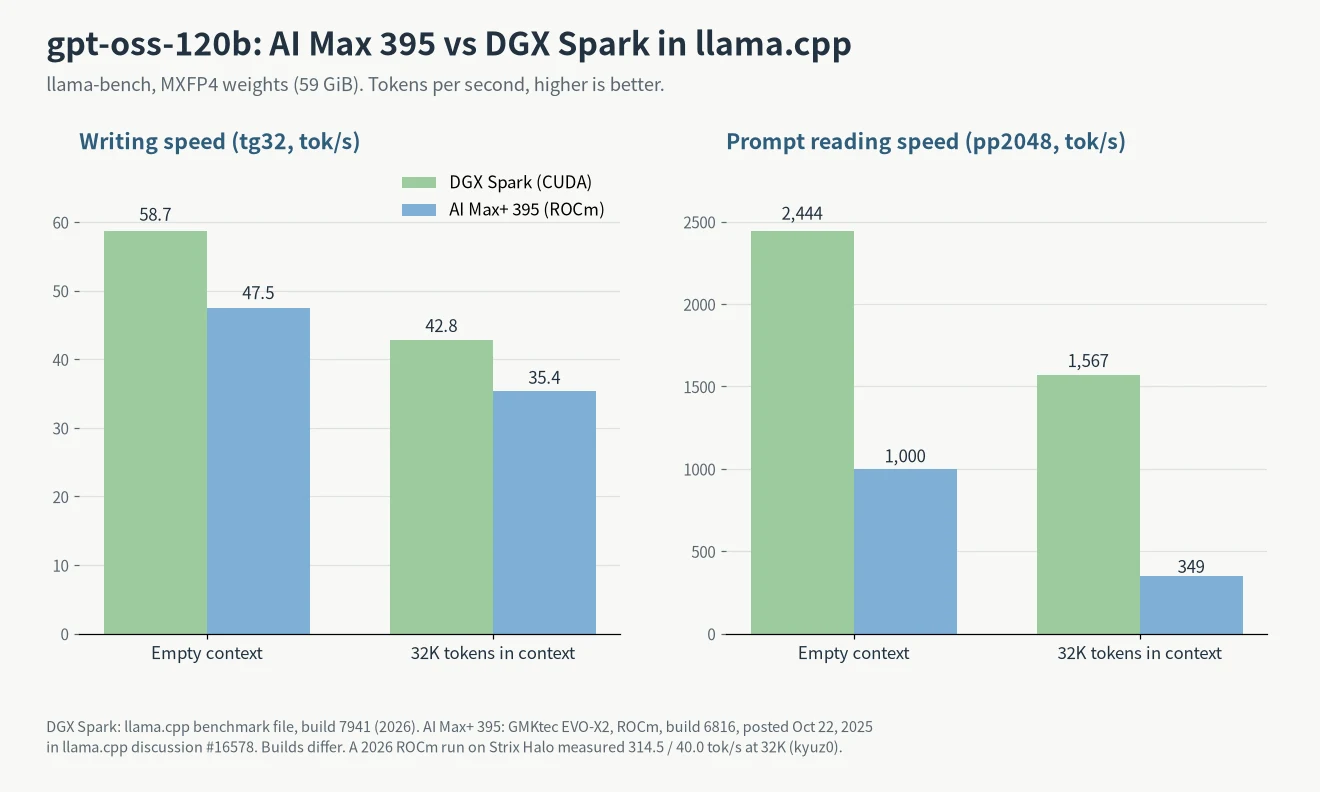
On an empty context, the DGX Spark writes 58.7 tok/s in llama.cpp’s official benchmark file (llama.cpp DGX Spark benchmarks). A GMKtec EVO-X2 with the AI Max+ 395 wrote 47.5 tok/s using ROCm, posted on October 22, 2025 in llama.cpp discussion #16578 (GitHub). With 32K tokens already in context, the numbers are 42.8 and 35.4 tok/s.
Those two runs used different llama.cpp builds. In the same October 2025 post, the author also ran the DGX Spark on the same build as the AMD box. That Spark run wrote 45.9 tok/s, slightly slower than the AMD box. Software updates since then moved the Spark ahead. Either way, the AI Max 395 vs DGX Spark gap in writing speed is 25% or less, which matches the small gap in bandwidth.
Prompt reading is where the DGX Spark wins
Reading the prompt depends on compute, not just bandwidth, and here the Spark is far ahead. It reads 2,444 tok/s on an empty context and 1,567 tok/s at 32K. The AMD box read 1,000 tok/s and 349 tok/s in the October 2025 post. A newer 2026 ROCm run on Strix Halo measured 314.5 tok/s at 32K (kyuz0). So the Spark is about 2.4 times faster on short prompts and 4 to 5 times faster on long ones.
In practice, this shows up as waiting time. A 30,000-token prompt takes roughly 20 seconds to read on the Spark and well over a minute on the AMD box, before the first word appears. For short chats you won’t notice. For pasting in a whole codebase or a long PDF, you will.
Dense models are slow on both
Both machines are fast with mixture-of-experts models because only a small part of the model is read for each token. Dense models are a different story. LMSYS measured Llama 3.1 70B in FP8 on the DGX Spark at 2.7 tok/s (LMSYS, Oct 13, 2025). I didn’t find a matching dense 70B run on the AI Max+ 395 that I trust, so I won’t give a number. With 7% less bandwidth, I would not expect it to be faster.
Model size limits: what fits in 128GB
For model size, AI Max 395 vs DGX Spark is closer than the prices suggest. NVIDIA says one DGX Spark handles models up to 200 billion parameters and two linked units up to 405 billion, both at FP4 (NVIDIA). AMD says the AI Max+ 395 can run models up to 128 billion parameters on Windows with its 96GB GPU memory limit (AMD). On Linux, the AMD GPU can use more memory, so the practical limit is close to the Spark’s.
Here are real examples. gpt-oss-120b at 59 GiB runs on both, as shown above. Qwen3.5-122B-A10B at Q4 also fits, and an AI Max+ 395 writes it at 21 to 23 tok/s (Strix Halo benchmarks). Remember that the context also needs memory. A model that takes 110GB leaves very little room for a long conversation on either machine.
If you are thinking about DeepSeek, the full model does not fit in 128GB on either box. I covered which DeepSeek versions fit on which hardware in my guide to running DeepSeek locally.
Software stack: ROCm and Vulkan vs CUDA
DGX Spark: CUDA out of the box
Software is the biggest practical difference in AI Max 395 vs DGX Spark. The Spark ships with DGX OS, NVIDIA’s Ubuntu-based Linux, with CUDA, Docker and NVIDIA’s AI software installed. NVIDIA lists PyTorch and TensorRT-LLM support. LMSYS ran SGLang on it from a ready-made Docker image (LMSYS). Most AI tutorials and research code assume CUDA, so most of them just work.
Two caveats. The CPU is Arm, not x86, so some Python packages and Docker images need Arm builds. And it is a Linux box. You won’t run Windows apps or games on it.
AI Max+ 395: llama.cpp with Vulkan or ROCm
The AMD machines are normal x86 PCs. They run Windows 11 or Linux, and you can game on them. For local LLMs, most people use llama.cpp or tools built on it, such as LM Studio and Ollama. llama.cpp can run on the GPU through Vulkan or through AMD’s ROCm.
Which one is faster depends on the model. In one large set of tests across both backends, Vulkan won most token-generation tests, while ROCm and AMD’s Vulkan driver split the prompt-processing wins (kyuz0 benchmarks). Expect to try both. There is no CUDA, so code that calls CUDA directly will not run, and tools like vLLM and TensorRT-LLM are built for NVIDIA first.
AI Max 395 vs DGX Spark: who should buy which
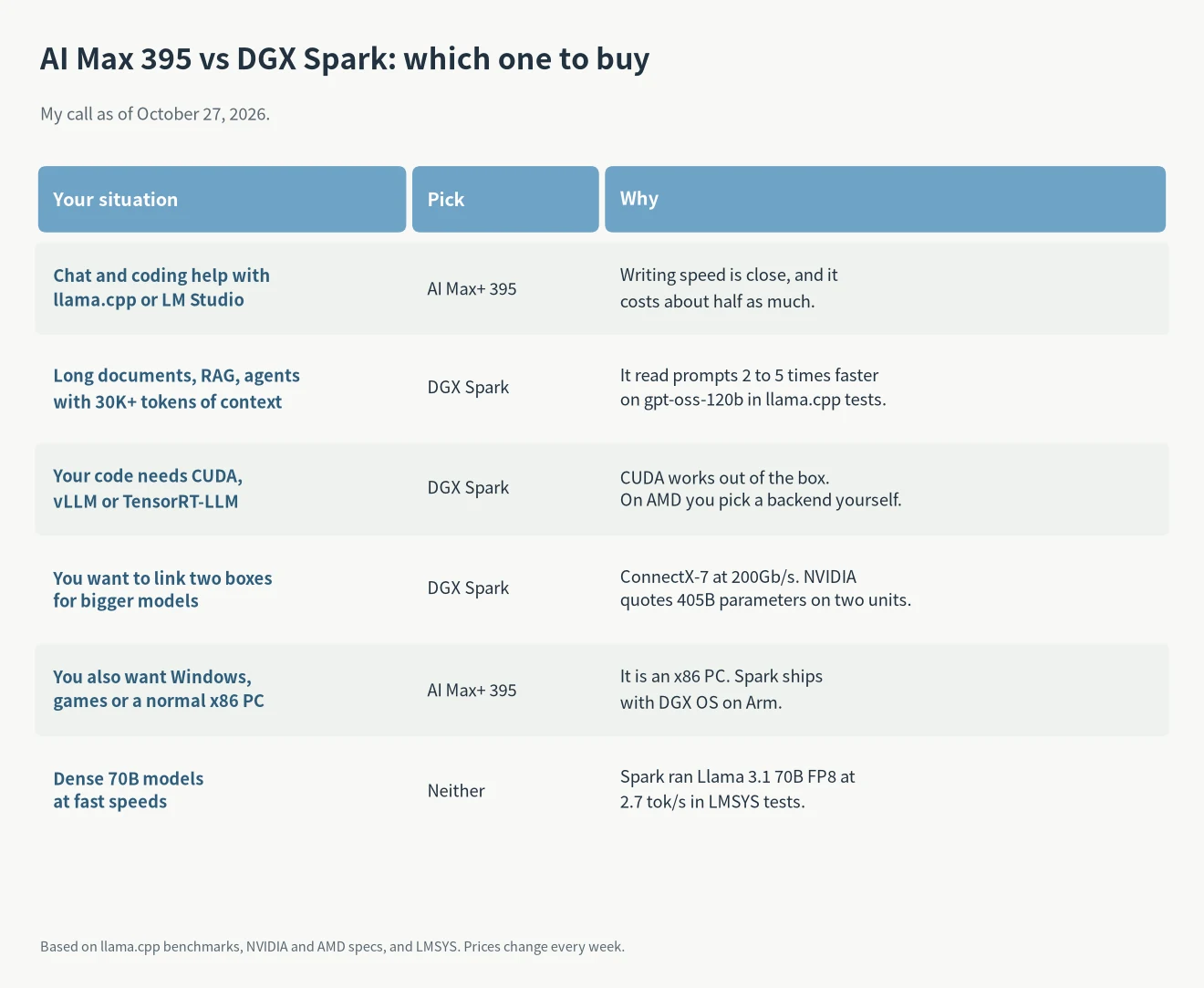
Buy an AI Max+ 395 box if
- You mostly chat with models or use them for coding help, with prompts of a few thousand tokens.
- You use llama.cpp, LM Studio or Ollama and don’t need CUDA.
- You want one PC that also runs Windows and games.
- You care most about memory per dollar. At $27 to $31 per GB, it costs about half as much as a DGX Spark.
Buy a DGX Spark if
- You process long documents, run RAG, or use coding agents that send 30,000 tokens or more at a time.
- Your work uses CUDA, vLLM, SGLang or TensorRT-LLM, or you develop code that will later run on NVIDIA servers.
- You plan to link two units for models above 200 billion parameters.
Consider something else if
You want dense 70B models at fast speeds. Neither machine is quick at that. A discrete GPU has several times more bandwidth; I looked at what fits in 32GB in my RTX 5090 for AI post. If you are also comparing a Mac with lots of unified memory, read my post on buying a Mac now or waiting first.
FAQ
Is the DGX Spark faster than the AI Max 395?
For reading prompts, yes, by 2 to 5 times in llama.cpp tests with gpt-oss-120b. For writing tokens, the gap is 25% or less, and in one same-build test from October 2025 the AMD box was slightly ahead.
Can the AI Max 395 run 120B models?
Yes. gpt-oss-120b runs at about 47 tok/s and Qwen3.5-122B-A10B at Q4 at about 21 to 23 tok/s in published benchmarks. On Windows the GPU can use up to 96GB, so large models work better on Linux.
Is the DGX Spark worth $6,950?
Only if you need CUDA, fast prompt reading or two-unit clustering. For chat and coding help with llama.cpp, an AI Max+ 395 box gives similar writing speed for about half the price.
What is the main difference in AI Max 395 vs DGX Spark?
Prompt reading speed and software. Both have 128GB and similar bandwidth, so they write tokens at similar speeds. The DGX Spark reads prompts much faster and runs CUDA. The AMD boxes cost about half as much and run Windows.
Should I buy the 64GB DGX Spark?
At $4,999 for 64GB, it costs $78 per GB, more than the 128GB model. It makes sense only if you need the Spark’s software and your models stay under 100 billion parameters.
I’ll update this AI Max 395 vs DGX Spark comparison when new benchmarks or price changes come out.