
Is DDR4 More Expensive Than DDR5 Now? The Surprising Answer (October 2026)
DDR4 chips now cost more than DDR5 chips on the spot market, but DDR4 sticks are still cheaper in stores. Dated prices from TrendForce, CCTV and RamRadar, why it happened, and whether to buy RAM now or wait.
 bufferAbout the author9 min read
Is DDR4 more expensive than DDR5 now? At the chip level, yes. On the store shelf, not yet. On October 27, 2026, a mainstream 16Gb DDR4-3200 memory chip averaged $82.623 on TrendForce’s spot market, while the same-size DDR5 chip averaged $61.333. But a finished desktop kit in the US still costs about $7.81 per GB for DDR4 and $18.12 per GB for DDR5, going by RamRadar’s median asking prices on the same day.
My advice is simple. If you already own a DDR4 PC and need more RAM, buy it now and don’t wait for a drop. If you’re building a new PC, go with DDR5. If you’re buying a Mac or an AI workstation, buy all the memory you’ll need up front, because none of the research firms I read expects prices to fall in the next few months.
I’m writing this on October 27, 2026. Every number below has a date next to it, because memory prices are changing every week. I keep the newest numbers on my RAM price trend tracker, which I update as new figures come out.
Is DDR4 more expensive than DDR5 now? It depends which price you look at
Memory has three price layers, and right now they tell different stories.
- Contract price: what PC makers and module brands pay Samsung, SK hynix and Micron under monthly or quarterly deals. You never see it directly.
- Spot price: what traders pay for chips and modules on the open market, day to day. TrendForce publishes these on its DRAMeXchange board.
- Retail price: what you pay at Newegg, on eBay or at a market stall in Shenzhen.
The “price inversion” headlines are about the first two. A Barclays report said DDR4 chip contract prices rose 4% in October 2026 and 24% over three months, faster than DDR5’s 20% over the same period (IT Home, Oct 13, 2026). DigiTimes reported the same reversal on October 14, tying it to memory makers moving capacity to HBM (DigiTimes).
On TrendForce’s DRAM spot price board, mainstream DDR4 chips are now clearly the expensive ones: a session average of $82.623 for a 16Gb DDR4-3200 chip against $61.333 for a 16Gb DDR5 chip on October 27. The cheaper “eTT” grade chips haven’t flipped. DDR4 eTT averaged $13.825 that day and DDR5 eTT $29.30. Finished modules haven’t flipped either. TrendForce’s module spot table on October 19 listed a 16GB DDR4-3200 desktop stick at $165.60 and a 16GB DDR5 stick at $240.
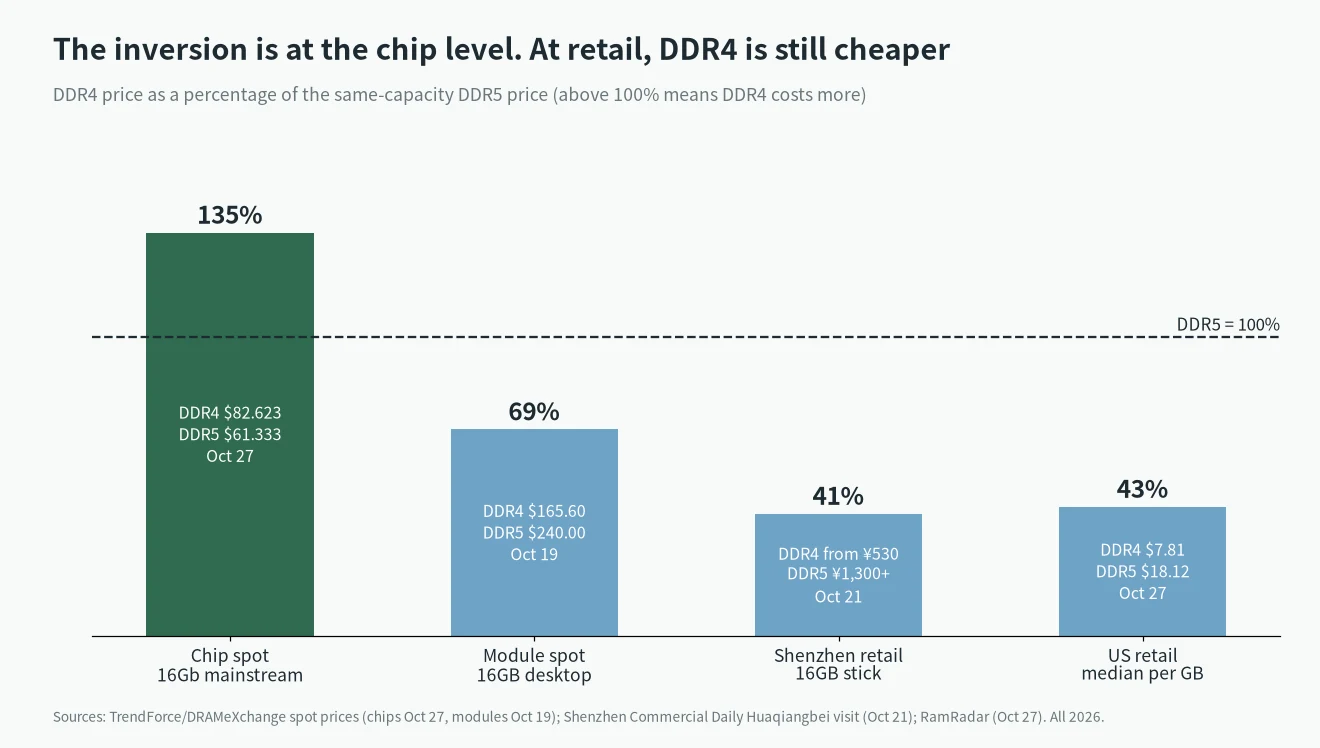
So does DDR4 cost more for a regular buyer? Per gigabyte, usually not. What changed is the direction. DDR4 used to get cheaper every year as it aged. Now it’s rising, and the gap to DDR5 is closing from the bottom.
Why DDR4 costs more than DDR5 for chip buyers
Three things are happening at the same time.
The big three memory makers are phasing out DDR4
Samsung, SK hynix and Micron all planned to wind down DDR4 by 2026. TrendForce wrote in January that Samsung is sticking to its end-of-life plan, and that DDR4 supply is set to drop sharply in 2026, pushing per-gigabit prices to record highs. SK hynix moved most of its Wuxi fab in China from the older 1z process to 1a. Micron announced in December 2025 that it would exit the consumer memory business and wind down its Crucial brand (TrendForce, Jan 19, 2026).
People still need DDR4
Millions of desktops, servers, routers and factory machines run on DDR4. DDR4 and DDR5 sticks have the notch in a different place, so you can’t put one in the other’s slot. Anyone keeping those machines running has to keep buying DDR4, whatever it costs.
AI servers are taking the factory capacity
HBM, the stacked memory on Nvidia and AMD AI chips, and big DDR5 server modules earn memory makers far more per wafer than PC memory does. TrendForce’s September 30 report says suppliers “continue to prioritize advanced-process capacity for high-performance server products,” and warns that PC DRAM supply could decline in 2027 as more capacity shifts to servers (TrendForce, Sep 30, 2026).
What CCTV reported from Shenzhen’s Huaqiangbei market
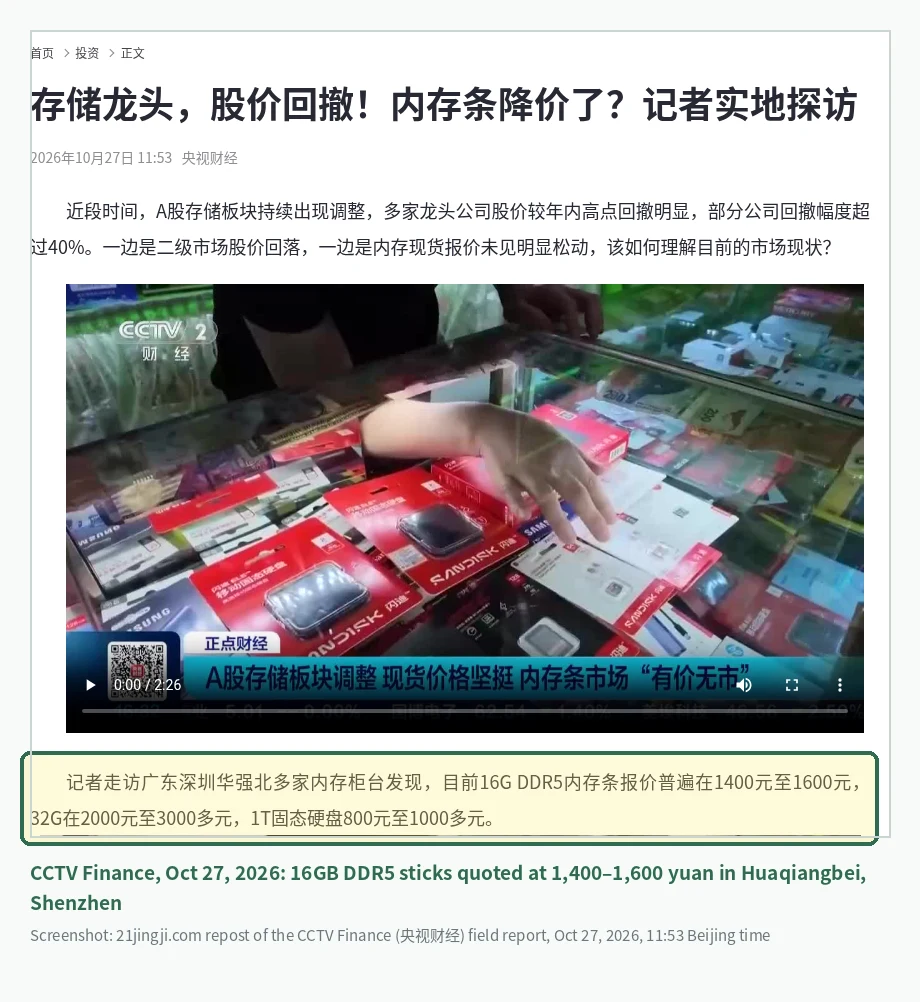
China’s state broadcaster sent reporters to Huaqiangbei, the electronics market in Shenzhen where a large share of China’s DIY PC parts change hands. CCTV Finance (央视财经) posted the numbers on the evening of October 26 and ran the full field report on October 27 (21jingji.com repost, Oct 27, 2026). Here’s what they found:
- 16GB DDR5 sticks were generally quoted at 1,400 to 1,600 yuan.
- 32GB DDR5 sticks were 2,000 to “3,000-plus” yuan.
- 1TB SSDs were 800 to “1,000-plus” yuan.
- Prices had slipped only 20 to 50 yuan from recent highs, and many stalls said sales were down 20% to 30% since the start of October.
One detail is easy to misread. The “inversion” (倒挂) in the CCTV report is not about DDR4 and DDR5. It means some dealers are selling below what they paid. Factory prices are still going up, but dealers who stocked up at high prices now face customers who are holding off, so some of them sell at a loss to free up cash.
A week earlier, on October 21, the Shenzhen Commercial Daily visited the same market. It found 16GB DDR4 sticks at 530 yuan for the cheapest Chinese brands and over 600 yuan for Samsung and other imports, against 1,300 yuan for a Kingston 16GB DDR5 stick. A year before, a 16GB DDR4 stick cost under 200 yuan (Eastmoney repost, Oct 21, 2026). You may still see that “1,300-plus yuan” figure quoted. It’s from October 21. CCTV’s 1,400 to 1,600 yuan range is the newer number.
So in China, just like in the US, DDR4 is still the cheaper stick at retail. It has simply gone from under 200 yuan to 530 yuan in a year.
Global RAM price trend: both kinds are still rising
In the US, RamRadar tracks asking prices on eBay and Newegg. Desktop DDR5 averaged $9.89 per GB in November 2025 and $18.40 in October 2026. DDR4 went from $5.04 to $8.04. In the 30 days to October 27, the DDR5 average rose 17.2% and DDR4 rose 14.3% (RamRadar RAM Price Index).
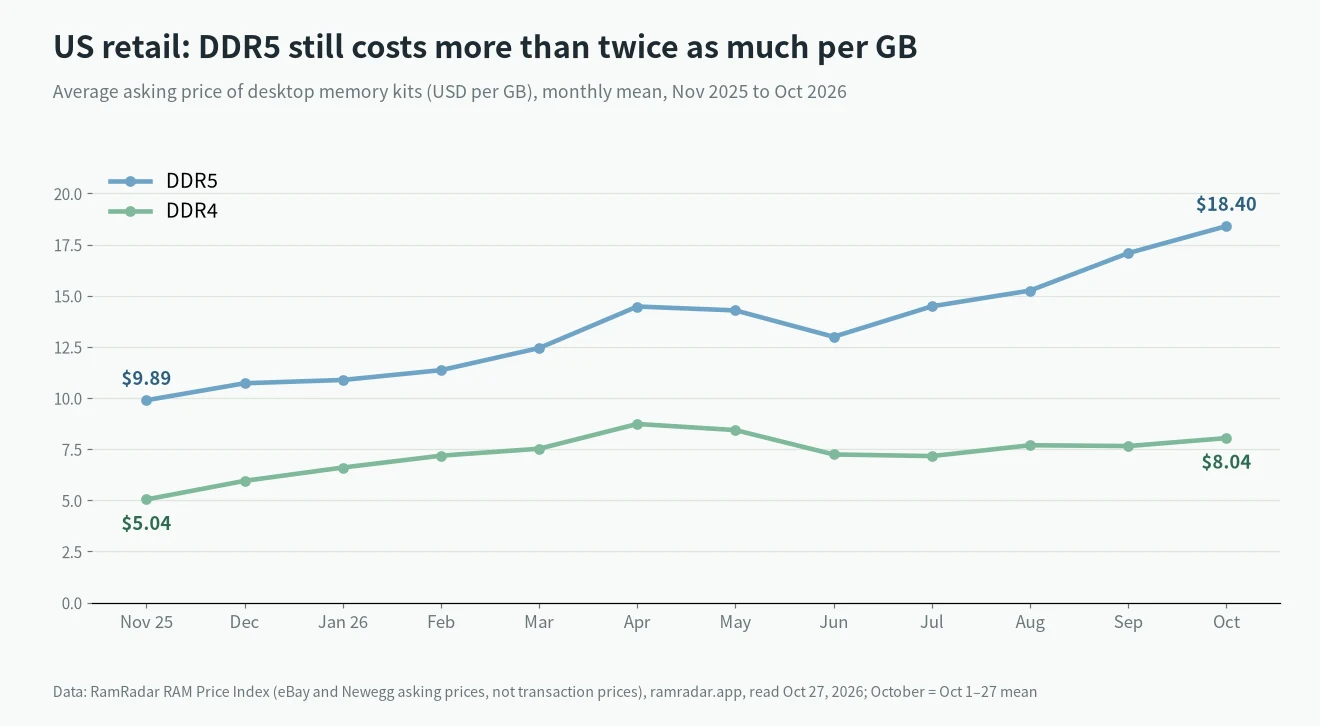
Contract prices point the same way. TrendForce expects conventional DRAM contract prices to rise another 10% to 15% in the fourth quarter of 2026 compared with the third, a slower pace than earlier this year. TrendForce’s October 21 spot market update says DDR5 supply is tight and sellers are reluctant to sell, while DDR4 trading is quiet because module makers are holding back on orders.
Further out, Citi expects the gap between DRAM demand and supply to peak at 13.9% in the fourth quarter of 2027, with the shortage lasting into 2028, according to the same IT Home report.
What this means for your PC, Mac or AI workstation
You have a DDR4 PC and need more RAM
Buy what you need now. DDR4 is leaving production, its chip prices rose faster than DDR5’s over the past three months, and nobody I’ve read expects that to reverse soon. If your PC runs fine on what it has, don’t buy extra just in case. Paying a peak price for memory you don’t use is the worst outcome here.
You’re building a new PC
Pick a DDR5 platform. Yes, DDR5 costs more per GB at retail today. But every new desktop CPU platform uses DDR5, and buying into DDR4 now means paying rising prices for a platform with no upgrade path. If the budget is tight, start with 16GB of DDR5 on a board with free slots and add more later.
You’re buying a Mac
Apple’s memory is part of the chip package, so you can’t add more later. Pick the size you’ll need for the next few years at checkout. TrendForce says notebook prices are already reflecting higher component costs this quarter. I went through Mac memory sizes in my guide on buying a Mac now or waiting, and if you’re watching this week’s launch, read my wait-or-buy advice on the touch screen MacBook Pro.
You’re building an AI workstation
System RAM is only half the bill. Graphics cards use their own memory, and those prices are climbing too. On the same October 21 visit, a Huaqiangbei graphics card wholesaler told the Shenzhen Commercial Daily that an RTX 5090 now sells for 55,000 yuan, up from 22,000 yuan on January 1. I worked out what fits in a 5090’s 32GB in my RTX 5090 for AI post. If a build needs 128GB of system RAM, price the memory first and plan the rest of the parts around it.
Buy now or wait?
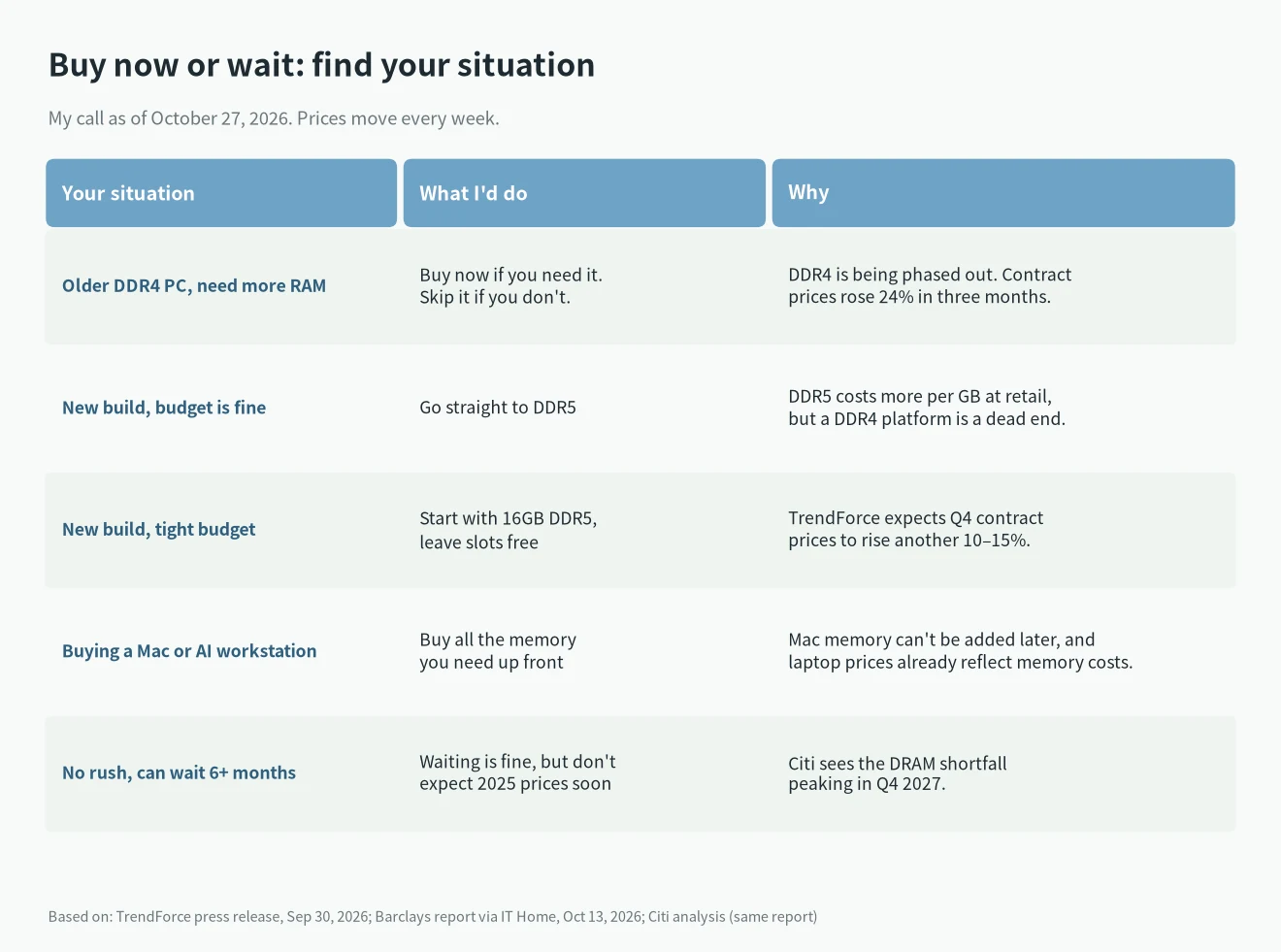
Waiting only makes sense if you can wait a long time. The forecasts I found all point up for the fourth quarter of 2026, and the most-cited long-range view puts the worst of the shortage in late 2027. If you need memory in the next three months, buy it. If you can wait six months or more, waiting is a reasonable bet, but I wouldn’t count on prices returning to where they were a year ago.
FAQ
Does DDR4 cost more than DDR5 in stores?
Not per gigabyte. On October 27, 2026, the median US desktop kit cost $7.81 per GB for DDR4 and $18.12 for DDR5 (RamRadar). In Shenzhen, a cheap 16GB DDR4 stick was 530 yuan on October 21 while a 16GB DDR5 stick was 1,300 yuan or more. The inversion is in chip prices and in how fast prices are rising.
When will RAM prices go down?
Not this quarter, going by the forecasts. TrendForce expects DRAM contract prices to rise 10% to 15% in the fourth quarter of 2026, and Citi sees the shortage peaking in late 2027. Chinese retail is showing small dips of 20 to 50 yuan because dealers need cash, not because supply has improved.
Why are RAM prices so high?
Memory makers are putting their best production lines into HBM and server DDR5 for AI data centers, and phasing out DDR4 at the same time. PC memory gets what’s left.
Should I upgrade my DDR4 PC or switch to DDR5?
If your DDR4 PC does what you need, add RAM only if you’re short. If you were already planning a new CPU and motherboard, go DDR5 and skip buying more DDR4.
I’ll update the numbers on this page when TrendForce posts its next round of contract prices.