

M6 MacBook Pro Memory Bandwidth: Why the $1,999 Base Model Is Slower, and the Easy Config to Pick (2026)
M6 MacBook Pro memory bandwidth depends on memory size: 153GB/s with 16GB, 170GB/s with 24GB or 32GB. The $200 step to 24GB buys both more memory and about 11% more bandwidth. Checked against Apple specs and store prices on October 28, 2026.
 bufferAbout the author6 min read

Short answer: M6 MacBook Pro memory bandwidth depends on how much memory you buy. The $1,999 base model with 16GB runs at 153GB/s. The 24GB and 32GB versions run at 170GB/s, according to Apple’s official tech specs. So the $200 step from 16GB to 24GB gets you 8GB more memory and about 11% more bandwidth at the same time. If you plan to run local AI models, buy 24GB or 32GB. If you need far more speed, the M5 Pro starts at $2,499 with 307GB/s. Prices below come from the US Apple Store and the Apple Newsroom announcement of October 27, 2026, checked on October 28, 2026.
M6 MacBook Pro price and memory bandwidth by configuration
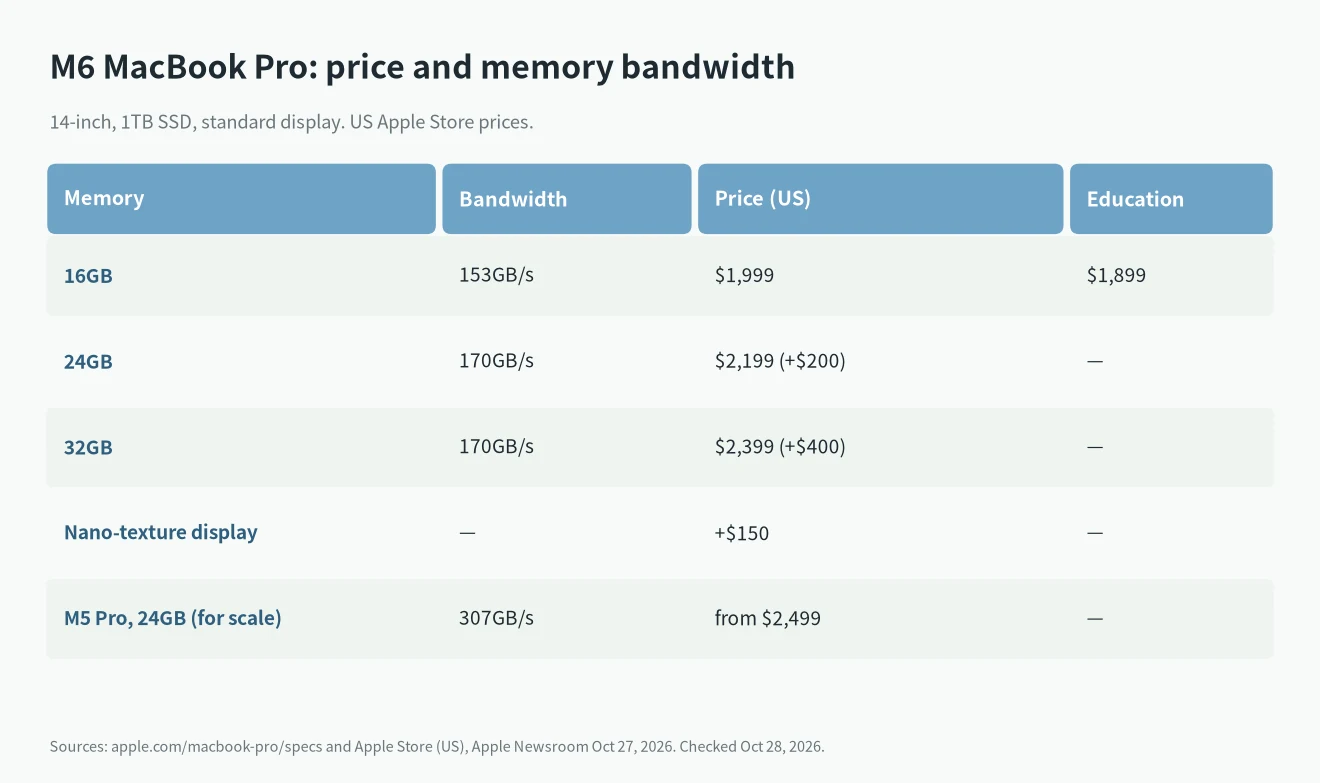
Every M6 model is the 14-inch MacBook Pro with a 1TB SSD to start. Memory is the only part that changes the bandwidth.
| Memory | Bandwidth | US price | Education |
|---|---|---|---|
| 16GB | 153GB/s | $1,999 | $1,899 |
| 24GB | 170GB/s | $2,199 | — |
| 32GB | 170GB/s | $2,399 | — |
Storage goes up to 2TB or 4TB, and the nano-texture display adds $150. Pre-orders opened on October 28 and the laptop arrives on November 6. The base model ships with a 70W USB-C power adapter.
Why the 16GB M6 MacBook Pro memory bandwidth is lower
The short version: the M6 MacBook Pro memory bandwidth on the base model is lower because of the 16GB memory option, not because the chip is different.
Apple lists the numbers plainly on the spec page: “16GB unified memory (153GB/s memory bandwidth)” and “24GB or 32GB unified memory (170GB/s memory bandwidth)”. Apple does not explain why. A lower figure on the smallest memory option usually comes from the memory parts used in that configuration, but Apple has not confirmed this, so treat it as a likely reason, not a fact.
What matters for you is the result. The M6 chip itself is the same in all three models: a 12-core CPU with 2 super cores, 4 performance cores and 6 efficiency cores, a 12-core GPU with Neural Accelerators, and a dual 16-core Neural Engine. The 16GB version simply reads memory a bit slower.
For browsing, office work, photo editing and most coding, you will not notice 153 versus 170GB/s. You notice it when the work is limited by memory reads, and the clearest case is a local large language model.
What M6 MacBook Pro memory bandwidth means for local LLMs
When a local model writes text, the chip reads almost all of the model’s weights for every token. That is why memory bandwidth sets the speed limit, and memory size decides what fits. We covered the same rule for the previous chip in our M5 local LLM guide.
A simple rule gives the ceiling: bandwidth divided by model size. A 4-bit Qwen3 8B is 5.2GB on Ollama, so 170GB/s gives a ceiling of about 33 tokens per second, and 153GB/s about 29. Real speed is lower than the ceiling, but the ratio between the two models holds.
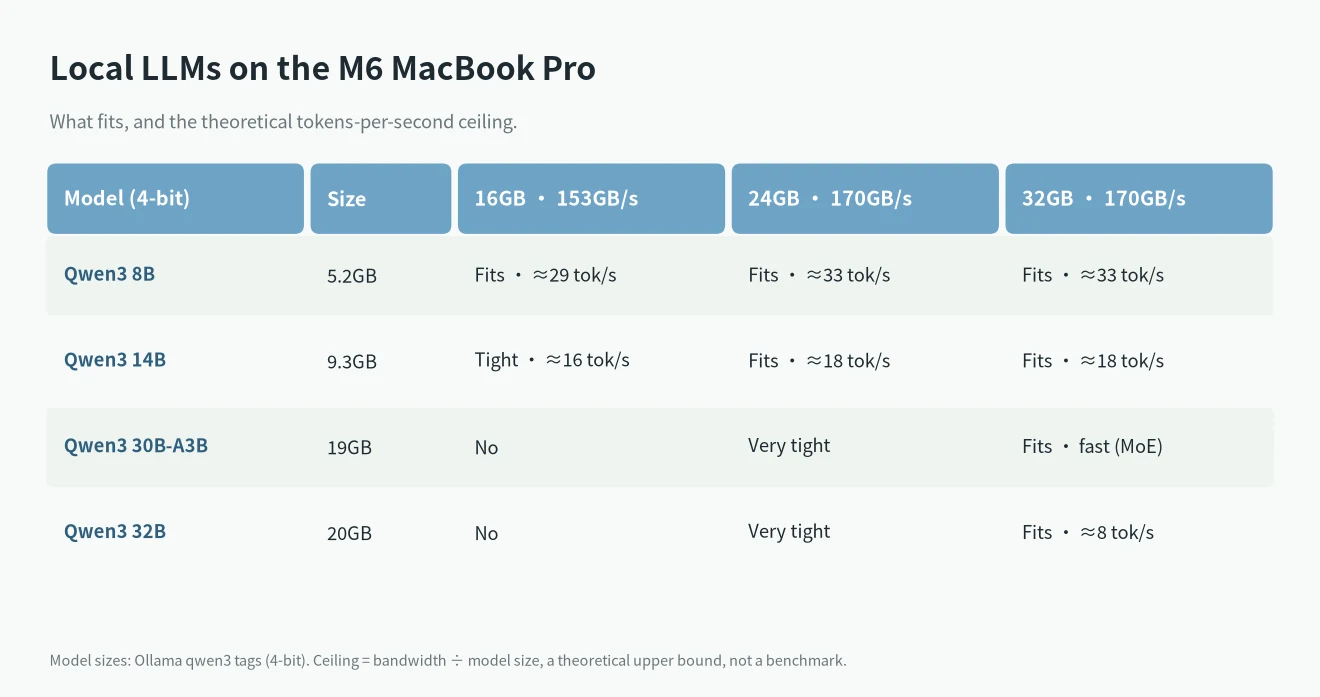
- 16GB: 8B models run well. A 14B model at 9.3GB fits, but macOS and your apps share the same 16GB, so it gets tight.
- 24GB: 8B and 14B models are comfortable. 30B-class models around 19 to 20GB are very tight and leave little room for anything else.
- 32GB: Qwen3 32B (20GB) fits, with a ceiling around 8 tokens per second. The mixture-of-experts Qwen3 30B-A3B fits too and runs much faster, because it only reads about 3B active parameters per token.
For more model picks by memory size, see the best local LLMs to run.
M6 vs M5 Pro and M5 Max memory bandwidth
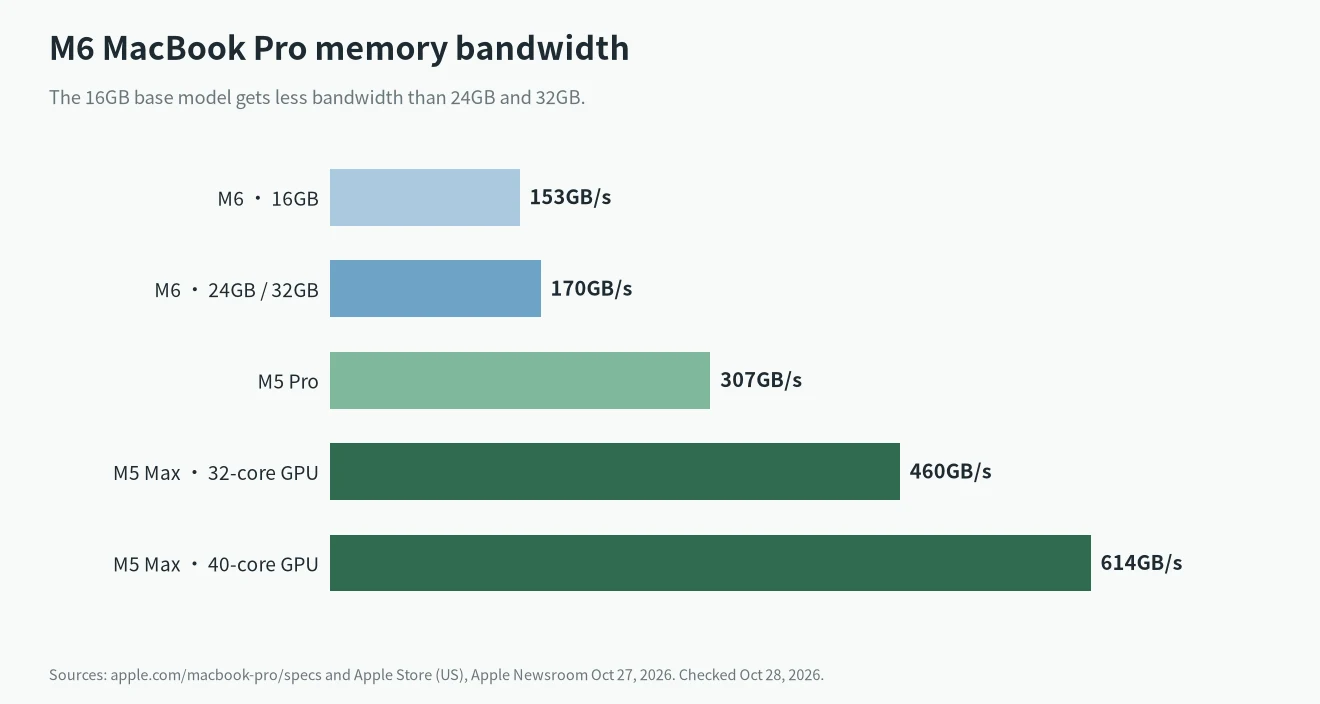
The M6 is the entry chip. Apple says it has up to 30% faster graphics and up to 25% faster AI performance than the M5 in the previous 14-inch model, and up to 1.3x faster time to first token for LLMs. Those gains come from the GPU and Neural Accelerators. The memory bandwidth ceiling is still far below the higher chips.
| Chip | Max memory | Memory bandwidth | 14-inch from (US) |
|---|---|---|---|
| M6 | 32GB | 153 or 170GB/s | $1,999 |
| M5 Pro | 64GB | 307GB/s | $2,499 |
| M5 Max | 128GB | 460 or 614GB/s | $4,099 |
The M5 Pro also brings Thunderbolt 5 instead of Thunderbolt 4. If you want 70B models or long contexts, look at an M5 Max or a desktop. Our DGX Spark vs Mac Studio comparison covers that tier, and the Mac mini local LLM guide covers a cheaper desk setup.
Which M6 MacBook Pro to buy
- Buy 16GB ($1,999) if you will not run local models and want the lowest price. It is still a fast laptop with up to 24 hours of video playback.
- Buy 24GB ($2,199) if you want to try local AI. This is the best value step, because it fixes both memory size and memory bandwidth.
- Buy 32GB ($2,399) if you want 30B-class models on a laptop.
- Skip to M5 Pro ($2,499) if token speed matters more than price. For $100 more than the 32GB M6, you get 307GB/s, close to double.
Memory cannot be upgraded later on any Apple silicon Mac, so pick it now. If you are unsure, remember that the M6 MacBook Pro memory bandwidth gap and the memory gap point the same way: both favor 24GB.
One more thing to check before you order: Apple ties bandwidth only to memory size, so a 24GB model with 2TB or 4TB of storage still has 170GB/s. Extra storage does not change it.
FAQ
What is the M6 MacBook Pro memory bandwidth?
153GB/s with 16GB of unified memory, and 170GB/s with 24GB or 32GB, per Apple’s specs page.
Is the M6 faster than the M5 for AI?
Apple says up to 25% faster AI performance and up to 1.3x faster time to first token than the M5 14-inch model. Token generation speed still depends mostly on memory bandwidth.
Does M6 MacBook Pro memory bandwidth matter for video editing or games?
A little. Large video timelines and games also read a lot of memory, but the GPU and the Media Engine usually matter more. For local LLMs, M6 MacBook Pro memory bandwidth is the main limit on speed.
Is 16GB enough in 2026?
For everyday work, yes. For local AI, 16GB limits you to small models, and the lower 153GB/s makes them a little slower too. That is why most people who care about AI should start at 24GB.
Can I add memory later?
No. Unified memory is part of the chip package, so choose the size when you order.
When does it ship?
Pre-orders opened on October 28, 2026, and it is available from November 6 in 35 countries and regions, according to Apple.