

Rubin vs MI455X Specs: NVIDIA’s Quiet Memory Bandwidth Cut, Side by Side (2026)
Rubin vs MI455X specs from NVIDIA's and AMD's own pages. NVIDIA's Rubin page quietly went from 22 to 19.2 TB/s per GPU in early September. Full tables, sources, timeline and the open questions.
 bufferAbout the author8 min read

Last updated: October 26, 2026 (Beijing time, UTC+8). I’ll keep updating this page when NVIDIA or AMD change their spec pages.
I had to read this one twice this morning. NVIDIA’s own Vera Rubin page now lists less memory bandwidth per GPU than it did over the summer. There was no announcement.
That changes the Rubin vs MI455X comparison most people are still quoting. Below are the numbers from each company’s own pages, what changed and when, and what nobody has explained yet.
I opened every page cited here on October 26, 2026. If something isn’t on an official NVIDIA or AMD page, I mark it as reported.
Rubin vs MI455X specs side by side
This first table is per GPU. It uses what each company lists today.
| Spec | NVIDIA Rubin GPU | AMD Instinct MI455X |
|---|---|---|
| HBM4 capacity | 288 GB | 432 GB (12 stacks) |
| Peak memory bandwidth | 19.2 TB/s (22 TB/s until early September) | 23.3 TB/s |
| Scale-up link | NVLink 6: 3 TB/s (was 3.6 TB/s) | UALoE: 3.6 TB/s |
| FP4 | NVFP4: 50 PFLOPS inference (sparse), 35 PFLOPS training (dense) | OCP MXFP4: 40.3 PFLOPS |
| FP8 | 17.5 PFLOPS (dense) | 20.1 PFLOPS |
| FP16/BF16 | 4 PFLOPS (dense) | 5 PFLOPS (10.1 with structured sparsity) |
| FP64 | 33 TFLOPS | 5 TFLOPS |
| Transistors | 336 billion (NVIDIA tech blog) | 320 billion |
| Process | Not listed on the pages I read | TSMC 2nm and 3nm |
| Status | Page says “Available Now” | Launch date 7/23/2026 |
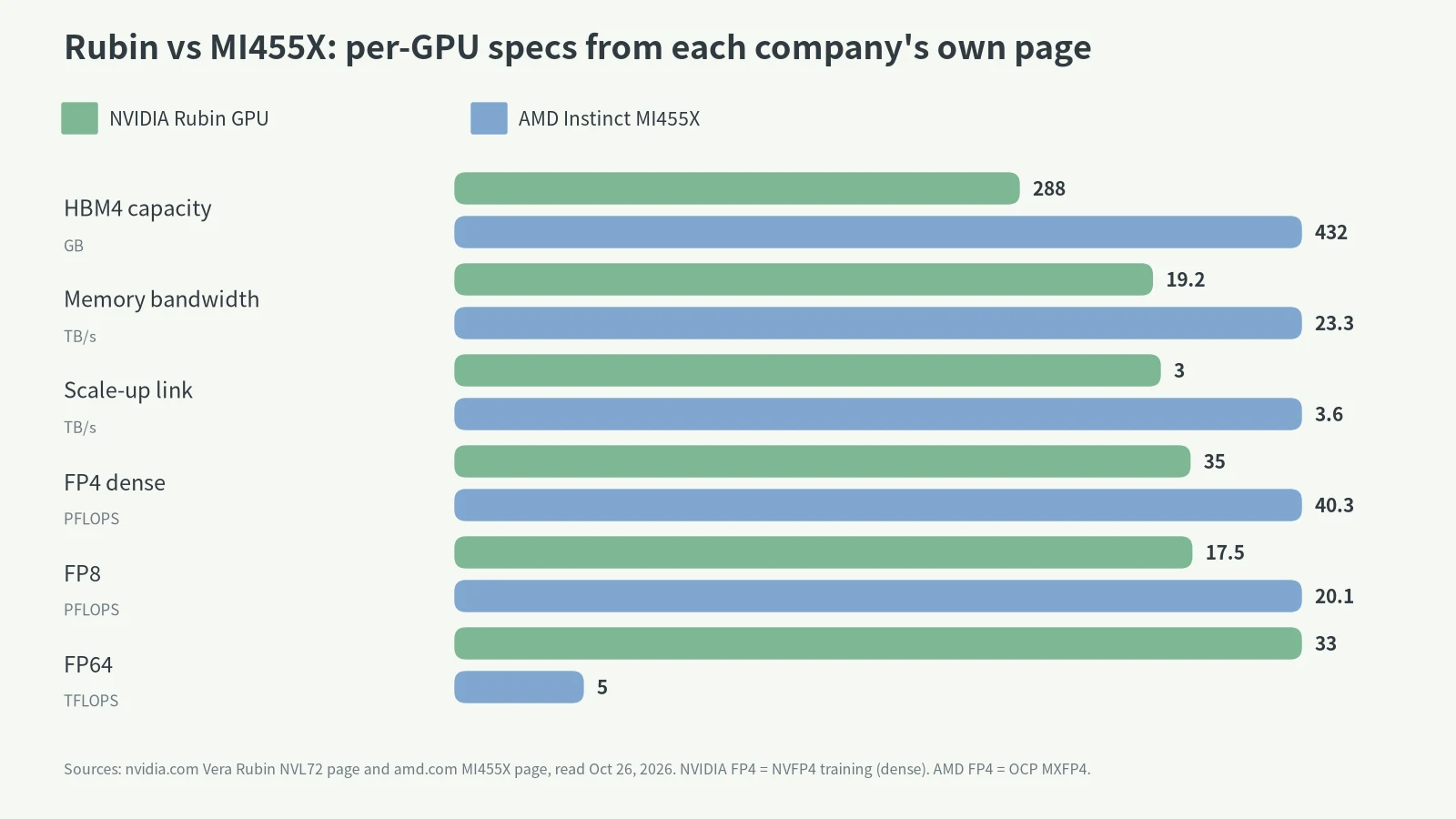
On paper, AMD’s lead in memory bandwidth went from about 6% (23.3 vs 22) to about 21% (23.3 vs 19.2). MI455X also has 50% more memory, 432 GB against 288 GB.
These are peak numbers from spec sheets. They aren’t benchmarks.
The FP4 numbers don’t line up neatly. NVIDIA marks its 50 PFLOPS inference figure as sparse and its 35 PFLOPS training figure as dense. AMD’s own comparison chart puts MI455X at 40 against Vera Rubin at 35.
Rack level: Vera Rubin NVL72 vs AMD Helios
| Spec | Vera Rubin NVL72 | AMD Helios |
|---|---|---|
| GPUs and CPUs | 72 Rubin GPUs, 36 Vera CPUs | 72 MI455X GPUs, 18 EPYC CPUs |
| HBM4 | 20.7 TB | 31 TB |
| Memory bandwidth | 1,400 TB/s (was 1,580 TB/s) | 1.7 PB/s (CDNA 5 white paper) |
| Scale-up bandwidth | 216 TB/s NVLink (was 260 TB/s) | 260 TB/s |
| Scale-out bandwidth | 32.4 TB/s, bi-directional (was 28.8 TB/s) | 43 TB/s |
| FP4 | 3,600 PFLOPS inference (sparse), 2,520 PFLOPS training (dense) | Up to 2.9 EF (MXFP4) |
| Power | MaxP 227 kW (NVIDIA datasheet) | Not listed in the AMD documents I read |
What changed on NVIDIA’s Vera Rubin page
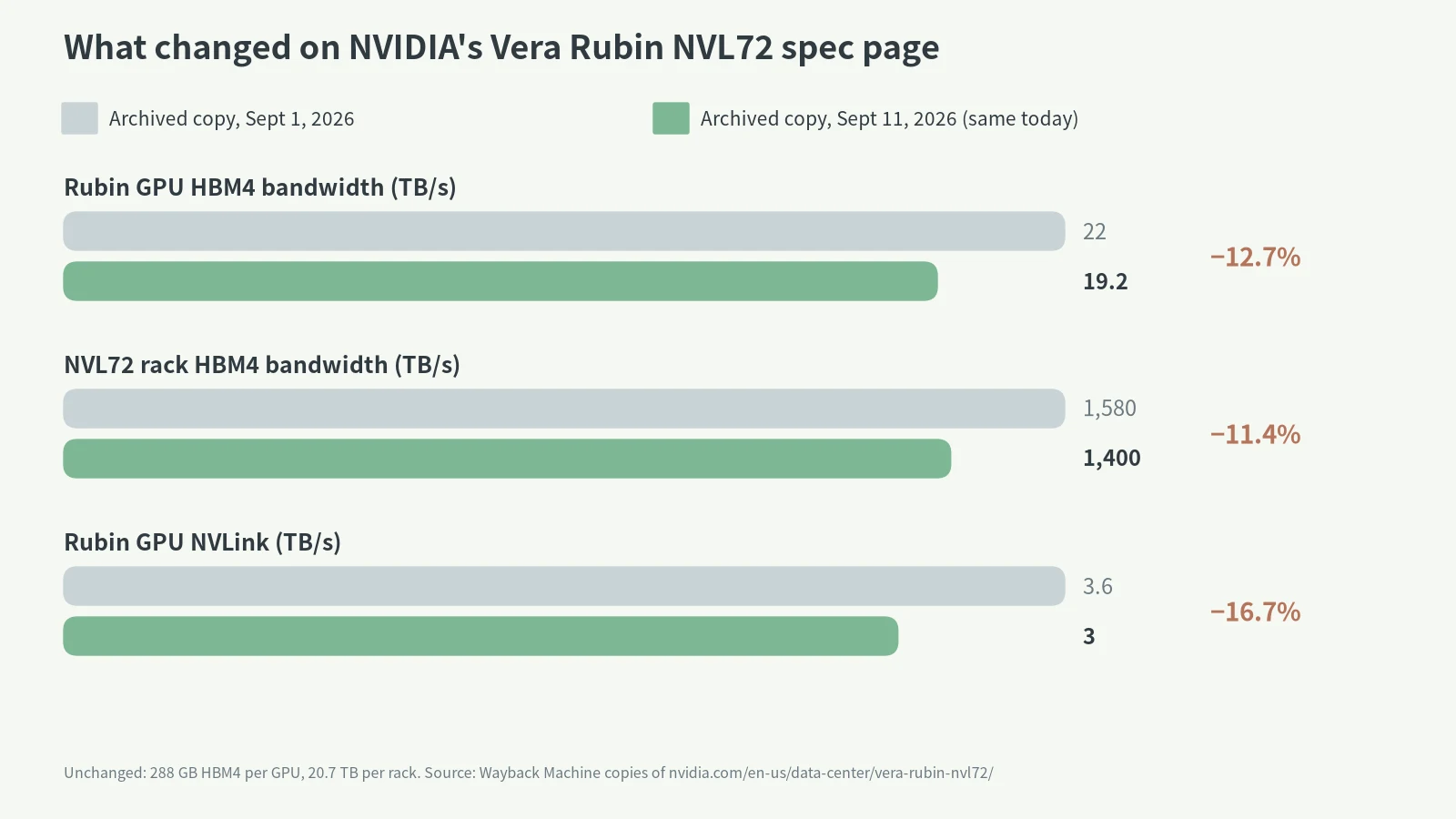
I went through the Wayback Machine copies of NVIDIA’s Vera Rubin NVL72 page. Every copy from January 5 through September 1, 2026 shows the same numbers. The copy from September 11 shows new ones, and the live page today matches it.
For a Rubin vs MI455X comparison, the per-GPU line is the one most people quote, and it dropped by 12.7%.
There’s no archived copy between September 1 and September 11. So the most I can say is that the page changed somewhere in that window.
| Spec | Sept 1 copy | Sept 11 copy and today | Change |
|---|---|---|---|
| Rubin GPU HBM4 bandwidth | 22 TB/s | 19.2 TB/s | −12.7% |
| Superchip HBM4 bandwidth | 44 TB/s | 38.5 TB/s | −12.5% |
| NVL72 rack HBM4 bandwidth | 1,580 TB/s | 1,400 TB/s | −11.4% |
| Rubin GPU NVLink | 3.6 TB/s | 3 TB/s | −16.7% |
| Superchip NVLink | 7.2 TB/s | 6 TB/s | −16.7% |
| NVL72 rack NVLink | 260 TB/s | 216 TB/s | −16.9% |
| Rack scale-out networking | 28.8 TB/s | 32.4 TB/s | +12.5% |
| HBM4 capacity (GPU / rack) | 288 GB / 20.7 TB | 288 GB / 20.7 TB | No change |
A few other things moved in the same edit. The old footnote said “Preliminary information. All values are up to and subject to change.” That line is gone.
The new page labels the 50 PFLOPS NVFP4 inference number as sparse. It also adds a table for a 100 MW AI factory.
The Vera Rubin datasheet PDF, dated October 15, 2026, uses the new numbers too.
I couldn’t find a press release, blog post or note from NVIDIA that explains the change.
About the 11.7 to 9.3 Gbps claim
Most people heard about this from a post by X user jukan05 at 07:49 Beijing time on October 26. It said “NVIDIA has officially lowered the HBM4 pin speed. 11.7-> 9.3Gbps”. When I checked it a few hours later, it had about 154,000 views.
His screenshot is from NVIDIA’s Korean spec page. It does show 288 GB of HBM4 at 19.2 TB/s.
The pin speeds are his own numbers. NVIDIA’s pages list bandwidth, not pin speed, and I couldn’t find 11.7 or 9.3 Gbps on any NVIDIA page.
So the accurate version is this. NVIDIA’s spec page changed quietly in early September. NVIDIA didn’t announce a downgrade.
Some pages still say 22 TB/s
Not every NVIDIA page has been updated. The HGX page still lists the Rubin GPU at 288 GB of HBM4 and 22 TB/s, with 3.6 TB/s of NVLink.
NVIDIA’s technical blog post on the Rubin GPU architecture, dated July 21, 2026, also says up to 22 TB/s. So does the January 5 post on the Vera Rubin platform.
AMD’s MI455X page is behind as well. Its comparison section still shows Vera Rubin at 22.0 TB/s.
The AMD side: 23.3 TB/s, with one exception
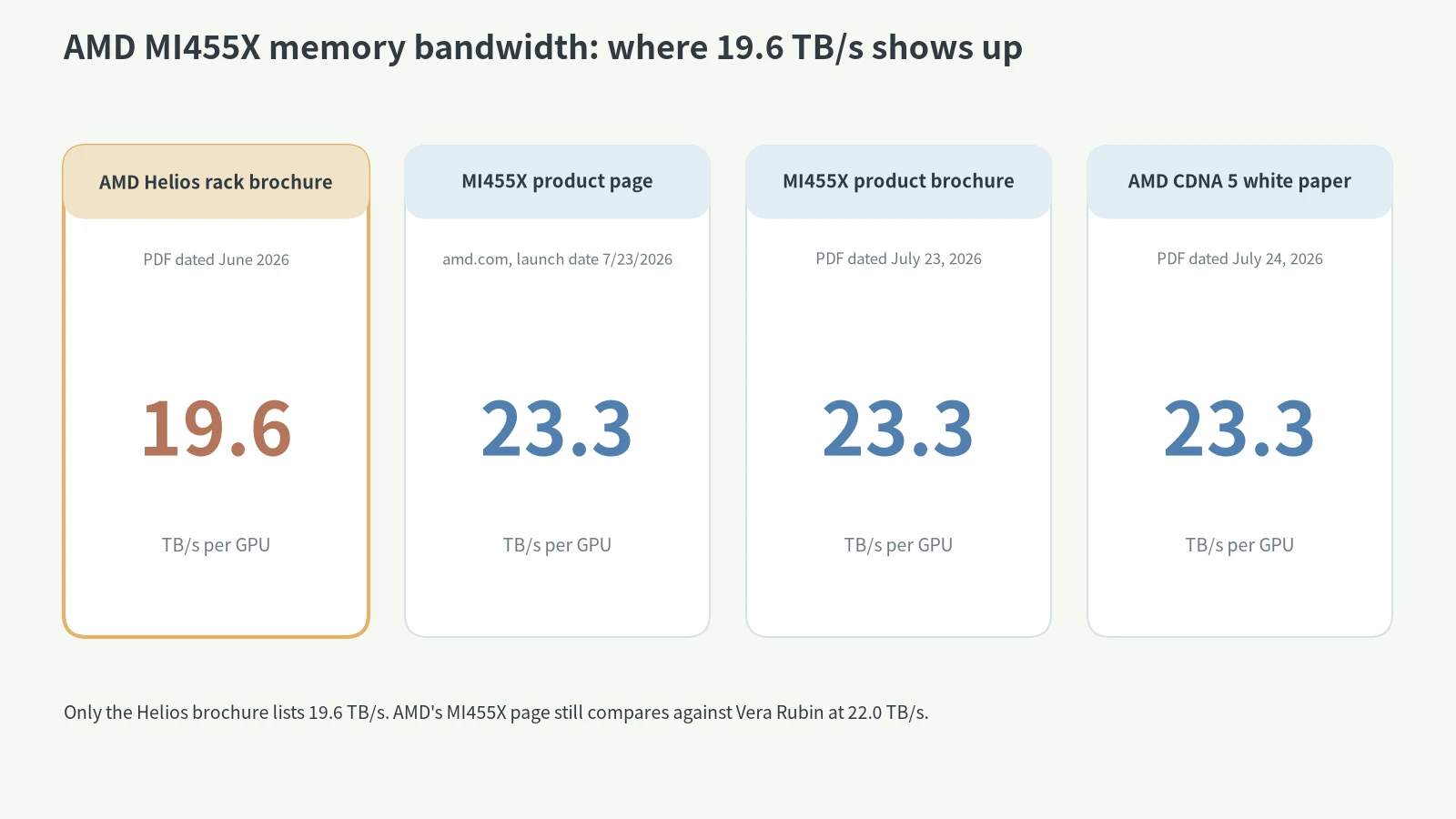
The MI455X product page lists 432 GB of HBM4 across 12 stacks and 23.3 TB/s of peak memory bandwidth.
The MI455X brochure, dated July 23, 2026, says 23.3 TB/s. The CDNA 5 white paper, dated July 24, 2026, says 23.3 TB/s too.
One version of AMD’s Helios material lists 19.6 TB/s. That’s the Helios rack brochure, a PDF dated June 2026. It says “up to 19.6 TB/s per GPU”, and its footnotes call the figures engineering projections that are subject to change.
If you see 19.6 TB/s in a Rubin vs MI455X chart, check where it came from. The MI455X documents AMD published in July all say 23.3.
Rubin vs MI455X bandwidth timeline
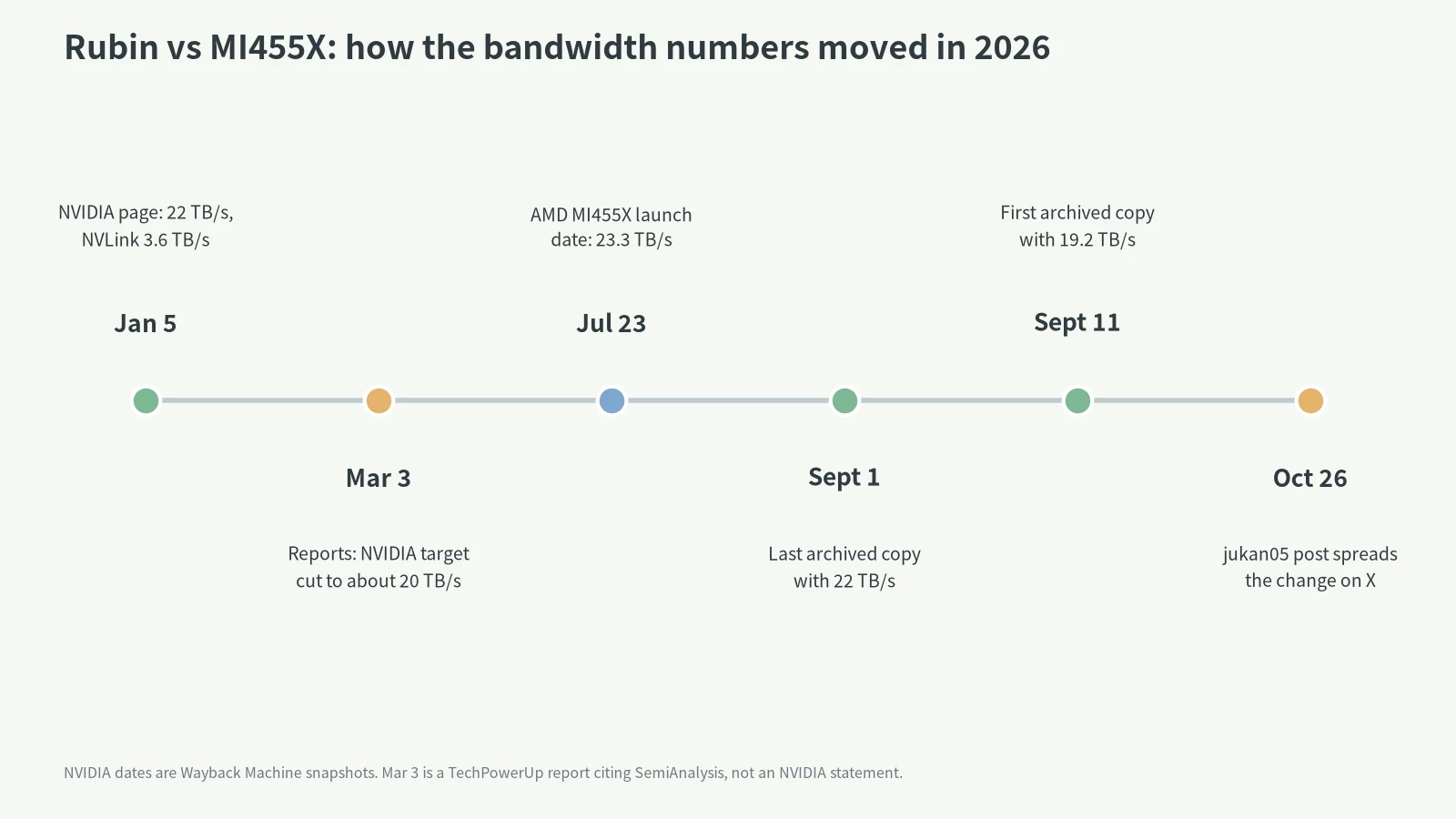
- Jan 5, 2026: The earliest archived copy of NVIDIA’s Vera Rubin NVL72 page shows 22 TB/s per GPU and 3.6 TB/s of NVLink. NVIDIA’s platform blog post from the same day says the same.
- Mar 3, 2026: TechPowerUp reported, citing a SemiAnalysis note, that NVIDIA had lowered its HBM4 target and that early shipments would land closer to 20 TB/s. This is a report, not an NVIDIA statement.
- June 2026: AMD’s Helios brochure lists 19.6 TB/s per GPU.
- Jul 23, 2026: AMD’s listed launch date for MI455X. The MI455X brochure says 23.3 TB/s.
- Sept 1, 2026: The last archived copy of NVIDIA’s page that shows 22 TB/s.
- Sept 11, 2026: The first archived copy that shows 19.2 TB/s.
- Oct 15, 2026: NVIDIA’s Vera Rubin datasheet PDF carries the new numbers.
- Oct 26, 2026: jukan05’s post spreads the change on X.
Why did the number change? Still open
Nobody outside NVIDIA knows yet.
One possibility is HBM4 supply. In March, TechPowerUp reported that SK hynix and Samsung were struggling to hit NVIDIA’s original target. That same report said NVIDIA would accept about 20 TB/s for early shipments.
Another possibility is yield. Running memory a little slower can let more parts pass testing. I haven’t seen anything official that points either way.
It could be a mix of both, or something else. I’ll update this section if NVIDIA comments.
One detail I can’t explain yet: NVLink dropped by about 17% in the same edit, and scale-out networking went up by 12.5%. Neither of those is about HBM4.
What this means for Rubin vs MI455X
If you only look at memory, MI455X now leads on both capacity and bandwidth on paper.
NVIDIA still lists much more FP64, 33 TFLOPS against AMD’s 5 TFLOPS. Its headline FP4 inference number is also higher, but that one is a sparse figure.
Real performance depends on software, networking and the workload. A spec page can’t tell you that.
If you rent GPUs instead of buying racks, the price you pay matters more than any spec page. I looked at that in my post on rising GPU rental prices and falling neocloud stocks. For a single card at home, my RTX 5090 for AI guide goes through what fits in 32 GB. And for the cheaper-chip side of the market, there’s my DeepSeek and Huawei post.
Sources
- NVIDIA Vera Rubin NVL72 page (live)
- Wayback Machine copy of the NVIDIA page, Sept 1, 2026
- Wayback Machine copy of the NVIDIA page, Sept 11, 2026
- NVIDIA Vera Rubin datasheet (PDF, Oct 15, 2026)
- NVIDIA HGX page
- NVIDIA Technical Blog: Inside NVIDIA Rubin GPU Architecture (Jul 21, 2026)
- NVIDIA Technical Blog: Inside the NVIDIA Vera Rubin Platform (Jan 5, 2026)
- AMD Instinct MI455X product page
- AMD Instinct MI455X brochure (PDF)
- AMD CDNA 5 white paper (PDF)
- AMD Helios brochure (PDF)
- jukan05 on X, Oct 26, 2026
- TechPowerUp, Mar 3, 2026 (report)
What I’m watching next
- Whether NVIDIA updates its HGX page and blog posts to 19.2 TB/s.
- Whether AMD updates the Vera Rubin number on its own comparison chart.
- Any comment from NVIDIA on why the numbers changed.
- Independent Rubin vs MI455X tests on shipping systems, which matter more than either spec page.
This post compares published specs only. It’s not buying or investment advice.