
What Is a Token in AI? The Easy 2026 Guide to Tokens, Counting and Cost
What is a token in AI, checked against OpenAI, Google, Anthropic and DeepSeek docs on October 27, 2026: what a token is, official ratios, the four token types, a worked cost example and how to count your own usage.
 bufferAbout the author6 min read

What is a token in AI? It’s the small piece of text a language model reads and writes, and it’s also the unit AI APIs bill you in. A token isn’t a word and isn’t a character. OpenAI’s rough rule for English is that 100 tokens come to about 75 words. The same sentence can turn into a different number of tokens on a different model, so treat every ratio below as an estimate. I checked each number against the official docs from OpenAI, Google, Anthropic and DeepSeek on October 27, 2026.
The short answer
So what is a token in AI? Four points cover it:
- What it is: a chunk of text the model works with. It can be one character, part of a word, a whole word, or a punctuation mark.
- Why it matters: API prices, context windows and many rate limits are all counted in tokens.
- Rough size: in English, 1 token is about 4 characters, or about three quarters of a word.
- Where the exact number lives: the usage field returned with every API response. Each provider also has a counting tool.
What is a token in AI, step by step
A model doesn’t read text the way you do. A tokenizer first splits the text into pieces. Each piece is a token, and each token maps to a number the model can compute with. When the model answers, it writes one token at a time.
The OpenAI Help Center says a token can be a character, part of a word, a whole word or punctuation, and that spaces change how text is split. “red”, “Red” and ” red” with a leading space can become different tokens.
DeepSeek’s docs put it in plain terms: usually one Chinese word, one English word, one number or one symbol counts as one token.
How the ratios differ by provider and language
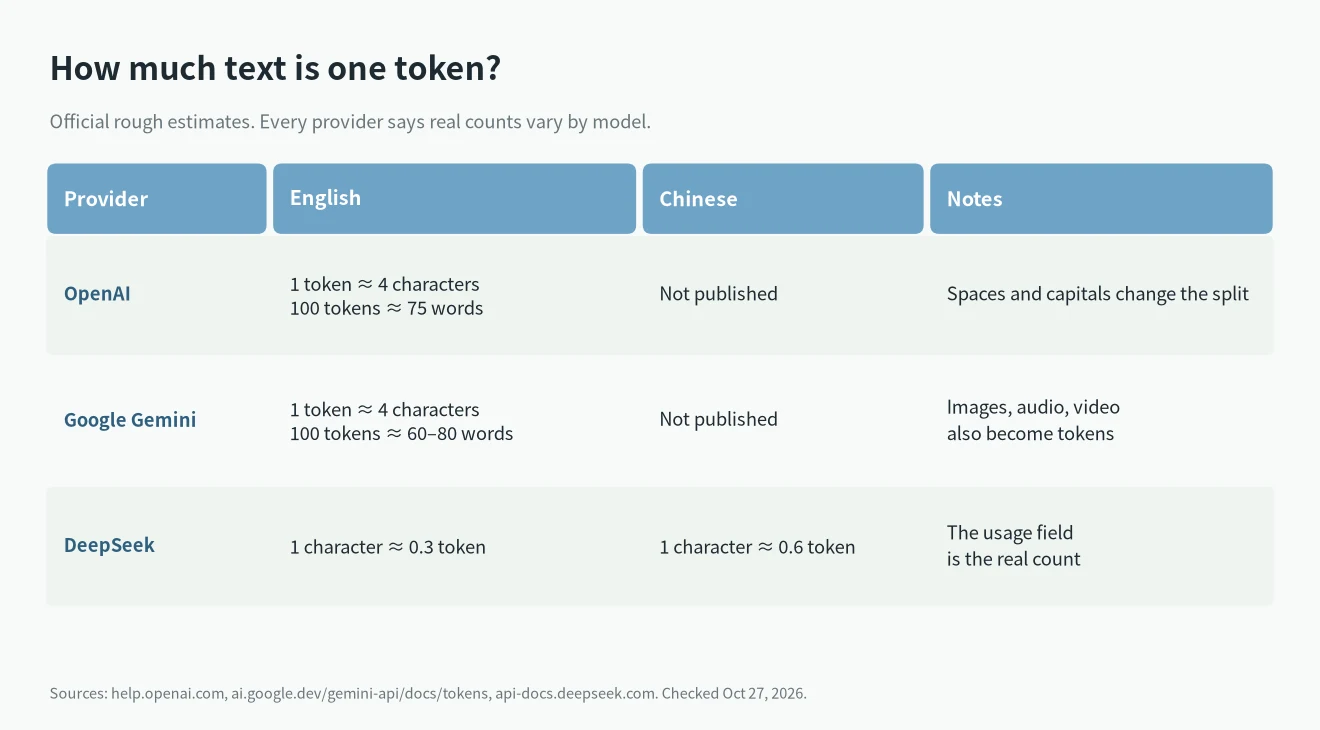
Every provider gives its own rough ratio, and every one of them calls it an estimate:
- OpenAI: 1 token is about 4 characters of English, about three quarters of a word. 100 tokens are about 75 words.
- Google Gemini: 1 token is about 4 characters. 100 tokens are about 60 to 80 English words, according to the Gemini token docs.
- DeepSeek: 1 English character is about 0.3 tokens. 1 Chinese character is about 0.6 tokens.
So a 1,000-word English email is roughly 1,333 tokens by OpenAI’s rule and 1,250 to 1,667 tokens by Google’s. OpenAI and Google don’t publish a ratio for other languages, so I won’t guess one for them.
How tokens turn into a bill
Once you know what is a token in AI, the bill is simple arithmetic. DeepSeek’s pricing page says it directly: the expense is the number of tokens times the price. Prices are usually listed per million tokens.
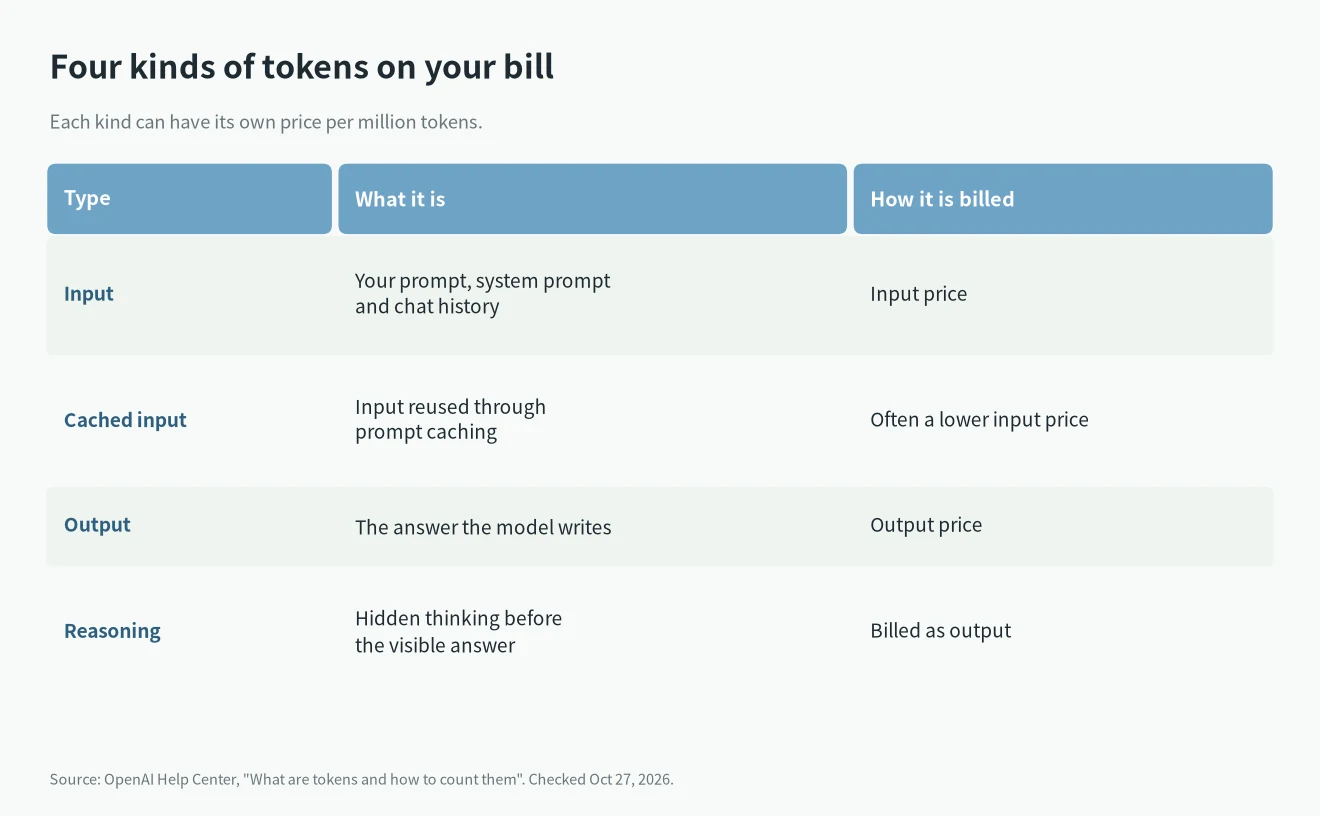
Not all tokens cost the same. OpenAI’s help article splits them into four kinds:
- Input tokens: everything you send, including the system prompt and the chat history.
- Cached input tokens: input reused through prompt caching. They can be priced lower.
- Output tokens: what the model writes back.
- Reasoning tokens: tokens a reasoning model uses before its visible answer. You don’t see them, but they’re billed as output tokens.
That’s why a short answer can still use a lot of tokens. Gemini’s docs add that system instructions and tool definitions count as input tokens, and that images and audio are converted to tokens too. A small image of up to 384 pixels on each side counts as 258 tokens, and audio is 32 tokens per second.
A worked example
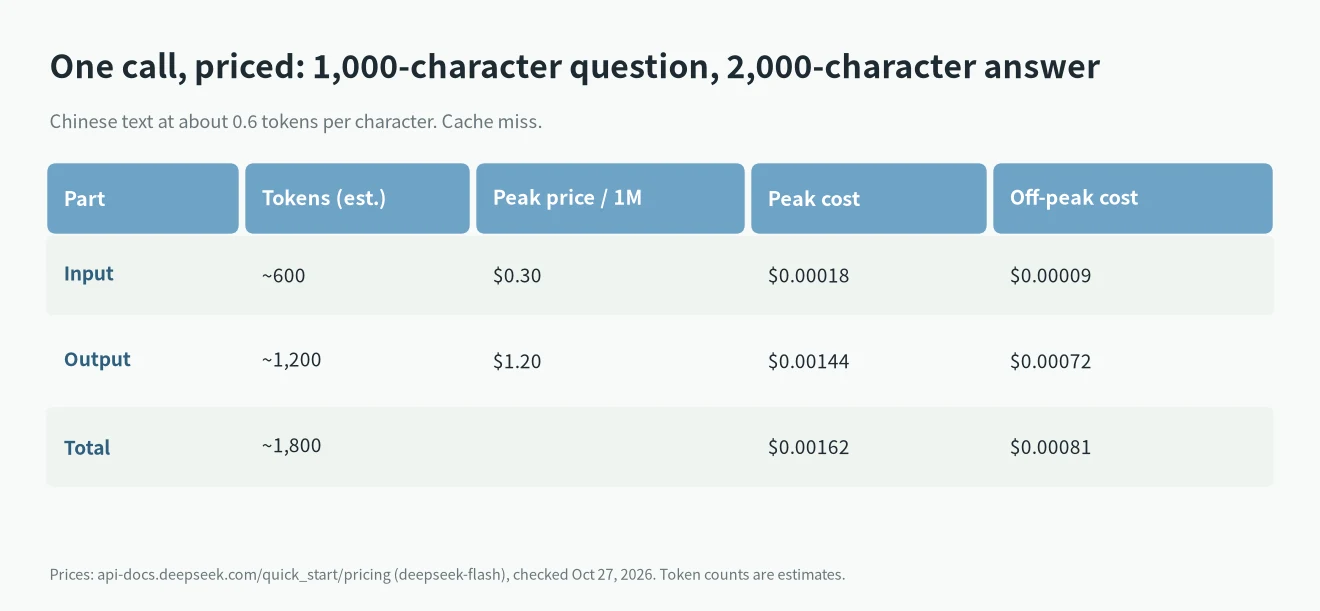
To see what is a token in AI in money terms, take deepseek-flash on the DeepSeek pricing page. At peak hours, input that misses the cache costs $0.30 per million tokens, and output costs $1.20 per million tokens.
Say you send a 1,000-character Chinese question and get a 2,000-character Chinese answer. At about 0.6 tokens per Chinese character:
- Input is about 600 tokens, or about $0.00018.
- Output is about 1,200 tokens, or about $0.00144.
- The total is about $0.00162.
Off-peak prices are half the peak prices, so the same call costs about $0.00081. Peak hours are 01:00–04:00 and 06:00–10:00 UTC, Monday to Friday, excluding Chinese public holidays. These are estimates. The real count comes back in the usage field, and thinking mode adds reasoning tokens on top.
I compared per-token prices across six providers in my LLM API pricing comparison.
How to check how many tokens you used
The best way to learn what is a token in AI in practice is to count a few of your own prompts:
- Read the response: OpenAI Chat Completions returns prompt_tokens, completion_tokens and total_tokens. The Responses API returns input_tokens, output_tokens and total_tokens.
- Count before you send: OpenAI has the Tokenizer page and the tiktoken library. Gemini has count_tokens. Claude has a token counting endpoint. DeepSeek offers a tokenizer you can download and run offline.
- Check the console: every provider has a usage dashboard.
One trap: Anthropic says Claude 4.7 and later models use a newer tokenizer, and the same text produces about 30 percent more tokens than on earlier models. Recount your prompts on the model you plan to use.
What else tokens control
Knowing what is a token in AI also explains a few limits you’ll run into:
- Context window: how much a model can handle in one request is counted in tokens. Gemini 3 and 2.5 models allow 1,048,576 input tokens and 65,536 output tokens.
- Subscriptions: ChatGPT and Claude plans don’t bill per token, and each uses its own usage rules. If you’re weighing a plan against the API, see ChatGPT subscription vs API.
- Free tiers: free API tiers usually cap tokens or requests, as in the Gemini API free tier.
- Coding tools: when you point Claude Code at another model, you still pay per token, as in DeepSeek API for Claude Code.
What I couldn’t confirm
A few gaps remain in what the providers say about what is a token in AI:
- Non-English ratios from OpenAI, Google and Anthropic: their docs give English estimates only. DeepSeek is the only one of the four that publishes a Chinese ratio.
- Full tokenizer details: only OpenAI’s tiktoken and DeepSeek’s tokenizer can be downloaded and run. For Gemini and Claude you count through their APIs.
If you remember one thing about what is a token in AI, make it this: it’s the billing unit, and the usage field on each response is the number that counts.