
Gemini 4 Hydrogen Price: Twice 3.8 Flash Until January 1
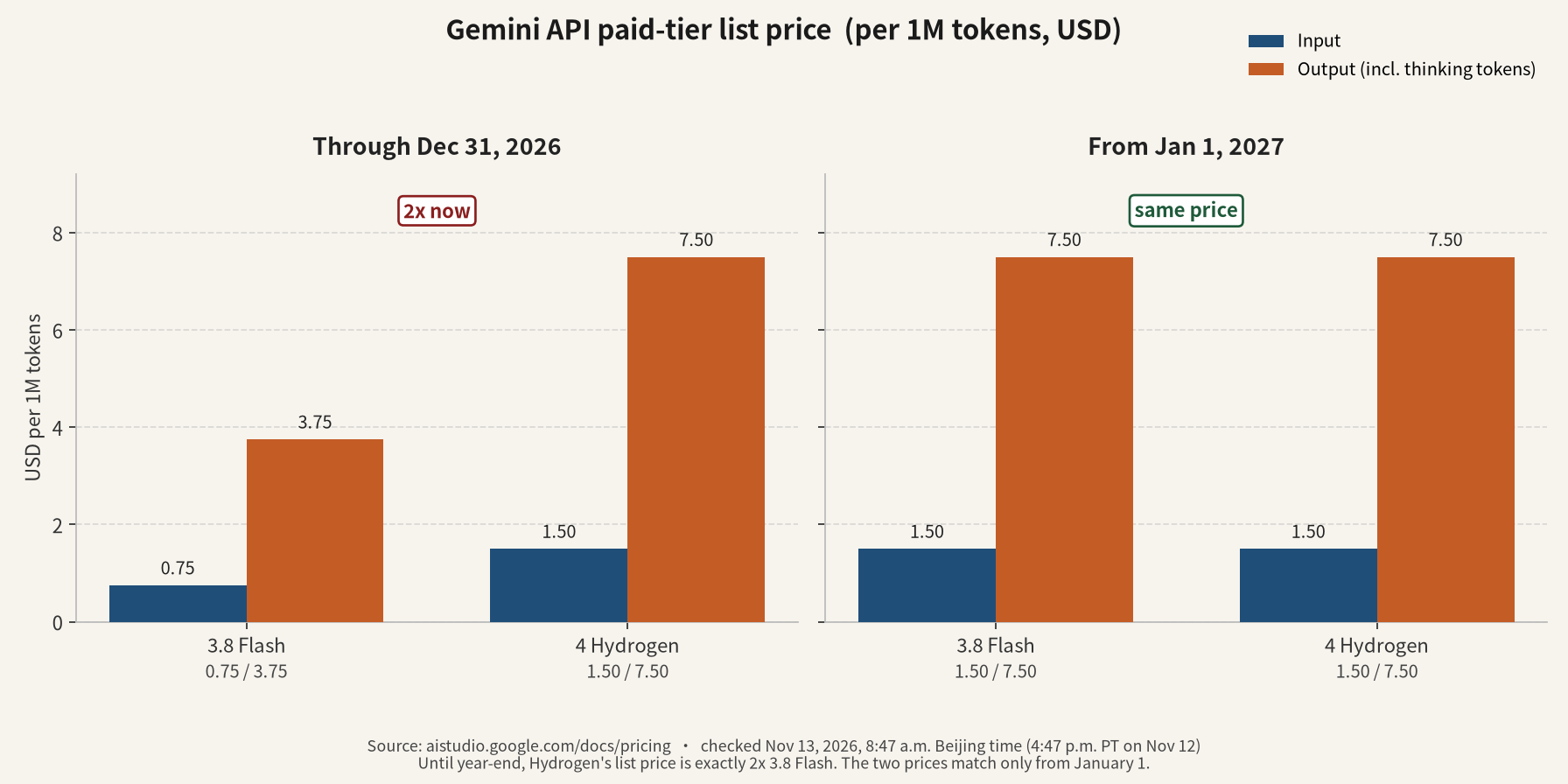
Official Gemini API prices checked Nov 13, 2026: Hydrogen is $1.50 in / $7.50 out per 1M tokens. 3.8 Flash stays at $0.75 / $3.75 through Dec 31. The "same price" claim only holds from January 1.
 bufferAbout the author9 min read
Google published Gemini 4 Hydrogen on November 12, 2026 at 10:00 a.m. PT (2:00 a.m. Beijing time on November 13). The official blog puts the API list price at $1.50 per million input tokens and $7.50 per million output tokens, flat across a 1 million-token context window.
Some coverage treated that as the same price as Gemini 3.8 Flash. I went back to Google’s official pricing page on November 13, 2026 at 8:47 a.m. Beijing time (4:47 p.m. PT on November 12). The numbers on that page are more precise: Hydrogen already costs twice as much as 3.8 Flash. The two list prices only match from January 1, 2027, when the 3.8 Flash promotional rate ends.
What the official price page says
I checked Gemini Developer API pricing. Every figure below is a paid-tier list price in US dollars per 1 million tokens.
| Model | Model ID | Input through Dec 31, 2026 | Output through Dec 31, 2026 | Input from Jan 1, 2027 | Output from Jan 1, 2027 |
|---|---|---|---|---|---|
| Gemini 4 Hydrogen | gemini-4-hydrogen | $1.50 | $7.50 | $1.50 | $7.50 |
| Gemini 3.8 Flash | gemini-3.8-flash | $0.75 | $3.75 | $1.50 | $7.50 |
Hydrogen’s input and output lines have no promotional end date on that page. They are already at $1.50 / $7.50.
3.8 Flash is explicit. The official wording is “$0.75 through December 31, 2026. $1.50 starting January 1, 2027” for input, and “$3.75 through December 31, 2026. $7.50 starting January 1, 2027” for output. Both output prices include thinking tokens.
That is a clean 2× gap until the end of the year, then a tie on the standard input/output list price.
A few other official lines also affect the bill:
- Output price includes thinking tokens. If Hydrogen spends more tokens thinking than 3.8 Flash does on the same prompt, the bill can be higher than a simple 2× on prompt volume.
- Context caching: Hydrogen is $0.075 per 1 million tokens, implicit caching only. The page says explicit caching is not supported. 3.8 Flash is $0.075 through December 31, 2026 and $0.15 starting January 1, 2027, plus a storage price of $0.50 per 1 million tokens per hour through December 31, then $1.00 from January 1. So after January 1 the standard input/output list prices match, but the cache lines do not.
- Both models, paid tier: Grounding with Google Search includes 5,000 free search requests per month, shared across Gemini 3 and newer models, then $14 per 1,000 requests, with a daily cap of 1,500 requests per project. Google Maps grounding uses the same shared monthly free allowance, then $14 per 1,000 search queries.
- Free tier: both Hydrogen and 3.8 Flash list input and output as “Free of charge.” The same table says free-tier content is used to improve Google’s products, and paid-tier content is not. Gemini 4 Carbon and Gemini 4 Argon are not available on the Free tier.
- The pricing page does not publish a fixed free-tier RPM, TPM or RPD number next to these models. Google’s rate-limits page says limits vary and should be checked for the active project in Google AI Studio. I am not inventing those numbers here.
- A note at the bottom of the pricing page says Google AI Studio usage is free of charge in all available regions.
For context, Gemini 4 Carbon and Gemini 4 Argon are on a different schedule: $2.00 input / $10.00 output through November 30, 2026, then $4.00 / $20.00 starting December 1, 2026. Those figures are not the Hydrogen comparison.
The “no price rise” wording, and what Ars Technica wrote
Google’s announcement is mainly about the model. In the passages I checked, the official blog states Hydrogen’s price as $1.50 / $7.50 and does not say that this is the same as 3.8 Flash today.
Ars Technica’s article on November 12, 2026 at 2:23 p.m. EST (11:23 a.m. PT; 3:23 a.m. Beijing time on November 13) put it this way:
Developers can plug into Hydrogen via the API at $1.50 per million input tokens and $7.50 per million output tokens, which is unchanged from 3.8 Flash.
That last clause is the comparison point. On the official price page, $1.50 / $7.50 is 3.8 Flash’s price starting January 1, 2027, not its current promotional price. Until December 31, 3.8 Flash is $0.75 / $3.75. “Unchanged” only holds if you compare Hydrogen with 3.8 Flash’s post-promotion rate, not with what you are billed for 3.8 Flash today.
Stay on 3.8 Flash until year-end, or switch?
This is a cost question, not a quality verdict. The example uses the official list prices above, with no cache hits and no grounding charges, and it holds input and output volume constant. Thinking tokens still count as output, so a real bill will move if one model thinks more than the other.
Take a month of paid API traffic at 20 million input tokens and 4 million output tokens.
Through December 31, 2026:
- 3.8 Flash: 20 × $0.75 + 4 × $3.75 = $15 + $15 = $30
- Hydrogen: 20 × $1.50 + 4 × $7.50 = $30 + $30 = $60
Hydrogen costs $30 more on that volume — exactly twice as much.
The same volume from January 1, 2027:
- 3.8 Flash: 20 × $1.50 + 4 × $7.50 = $60
- Hydrogen: $60
From that date, the standard input/output list prices are the same. The decision then is about quality, speed, cache behavior and whatever your own tests show — not about a list-price gap.
From the day I checked (November 13) through December 31 is 49 calendar days of promotional 3.8 Flash pricing, if the official end date does not change.
A practical way to decide:
- If 3.8 Flash already does the job, leaving paid calls on
gemini-3.8-flashthrough December 31 cuts the standard input/output list cost in half versusgemini-4-hydrogen. - If you need Hydrogen for a specific workload, you are paying a 2× list-price premium to use it before January 1. Run a short A/B on your own prompts before moving production traffic.
- After January 1, do not assume the bills stay identical just because the input/output list prices match. Cache prices diverge, and thinking-token volume can still differ.
3.8 Flash is not marked as shut down on the pricing page I checked. The same page says that from December 1, 2026, requests to the deprecated gemini-2.5-pro are automatically routed to Gemini 3.8 Flash and billed at 3.8 Flash rates. That is another sign Google is still treating 3.8 Flash as a current model, not a leftover that disappears when Hydrogen ships.
Free tier and the Gemini app
Two different products get mixed together here: the Gemini Developer API and the Gemini consumer app. I am only repeating what official Google pages say.
API free tier. On the official pricing table, Hydrogen and 3.8 Flash both list input and output as free of charge on the Free tier. Grounding with Google Search is “Not available” on the Free tier for both. Free-tier content is used to improve Google’s products; paid-tier content is not. I did not find a published, model-specific free-tier RPM, TPM or RPD figure on the pricing page. Treat any specific daily request number you see elsewhere as unconfirmed unless it appears on Google’s own rate-limits page or the AI Studio quota screen for your project.
Gemini app. Google’s official blog (November 12, 2026) says Hydrogen is rolling out in the Gemini app, and a footnote states: “In the Gemini app, free users will get access to Gemini 4 Hydrogen via auto model selection when it’s the appropriate model for the prompt.”
The official help page About Gemini models is more specific. I re-read it on November 13, 2026. For a personal Google Account, and with the page’s own caveat that the information is subject to change:
- No Google AI plan: Auto or Flash-Lite for chats. Tasks are listed as N/A. The footnote says that if auto model selection is on, Gemini chooses the model for each prompt; most prompts use Flash-Lite; prompts that require more reasoning may use Hydrogen; if auto model selection is off, all responses use Flash-Lite.
- Google AI Plus: Flash-Lite, Hydrogen and Pro in chats. The same help page says that if you have a Google AI plan, you can switch models manually.
- Google AI Pro: those plus Argon in chats, and Hydrogen or Argon for Tasks.
- Google AI Ultra: Flash-Lite, Hydrogen, Argon and Carbon in chats; Hydrogen, Argon or Carbon for Tasks.
That official table does not match a claim that AI Plus and free users have no Hydrogen path at all. Ars Technica wrote that “The new model is live for AI Pro and Ultra subscribers, but AI Plus and free users are still stuck with the old 3.5 Flash-Lite model.” For app availability, I am going with the Google help page and the official blog, not that sentence.
The official blog also says Hydrogen is in Google Search for all users. I have not independently tested Search, or a free Gemini app account, for this article.
A third-party score, named
This is not an official Google benchmark. On Artificial Analysis’s Gemini 4 Hydrogen page, which I checked on November 13, 2026, the Artificial Analysis Intelligence Index (version 5.0.1, a composite of nine evaluations) shows 54 at the xhigh thinking setting and 51 at high. Google’s own blog cites the same two index figures when comparing Hydrogen with Argon (51 versus 50 at high, 54 at xhigh). I am not treating that index as a substitute for your own tests, and I am not repeating third-party cost-per-task comparisons I could not read as a hard number from the same page during this check.
What I would do
If I were paying the Gemini API bill this month and 3.8 Flash was already good enough, I would keep production traffic on 3.8 Flash until January 1 and only point selected jobs at Hydrogen. If I needed the new model, I would measure quality and output-token use on my own traces first, because thinking tokens are billed as output. I would not rely on “same price as Flash” as a description of today’s invoice.
Prices change. Before you move a large workload, reopen the official pricing page.
For a broader official-price table across providers, see our LLM API pricing comparison. For what the Gemini API free tier does and does not include, see Gemini API free tier limits.
Sources: Google official blog (dated November 12, 2026, 10:00 a.m. PT / 2:00 a.m. Beijing time on November 13); Gemini Developer API pricing (checked November 13, 2026, 8:47 a.m. Beijing time / 4:47 p.m. PT on November 12); Gemini API rate limits; About Gemini models (checked November 13, 2026); Ars Technica (November 12, 2026, 2:23 p.m. EST / 11:23 a.m. PT / 3:23 a.m. Beijing time on November 13), cited only as a comparison point; Artificial Analysis Intelligence Index (third-party, checked November 13, 2026).