

Cursor vs Claude Code (2026): Simple Pricing Breakdown and the Best Pick for You
Cursor vs Claude Code, with official prices for every tier, how each one bills you for Claude, and why running both is often the cheapest setup.
 bufferAbout the author7 min read

I keep getting asked the same thing: Cursor vs Claude Code, which one do I pay for? A month ago my answer was a shrug and “depends how you code.” That’s still true, but the money side changed a lot. Cursor is now sold inside The X Subscription, and Claude models inside Cursor are no longer part of the included usage. So I went back to both official pricing pages and redid the math (as of October 21, 2026, Beijing time, last checked). Every price below links to where I read it.
Quick framing so we don’t talk past each other. Cursor is an AI code editor. Claude Code is Anthropic’s coding agent that lives in your terminal (and now a few other places). They overlap more than people think, and you can absolutely run one inside the other. More on that later.
The short answer
Cursor vs Claude Code comes down to where you want the AI to sit and who you want to pay per token. If you want Claude doing the heavy lifting, Claude Code on a Claude plan is the cheaper way to get it. If you want a full editor with autocomplete and the freedom to switch between Grok, Claude, GPT and Gemini, Cursor wins, but you pay API list price every time you pick a non-Cursor model.
And if you like Cursor’s editor but want Claude on a flat fee, run both. That combo is what I’d actually set up for most people.
Cursor vs Claude Code pricing, straight from the official pages
Here’s the part that surprised me. Per cursor.com/pricing and the Models & Pricing docs, new Cursor customers now pick a plan from The X Subscription, one bundle for Grok, Cursor and X. Existing Pro, Pro+ and Ultra subscribers stay on what Cursor calls legacy plans, which keep working as before.
| Plan | Cursor (X Subscription) | Claude (Anthropic) |
|---|---|---|
| Free | $0, limited Agent and Chat | $0, no Claude Code |
| Entry | Plus $8/mo ($80/yr): Cursor’s own models only | Pro $20/mo ($200/yr): Claude Code included |
| Middle | Premium $30/mo ($300/yr): 4x Plus usage, third-party models at API price | Max 5x $100/mo: 5x Pro per session, $100/mo API credit |
| Top | Super $100 (15x Plus), Ultra $200 (50x Plus) | Max 20x $200/mo: 20x Pro per session, $200/mo API credit |
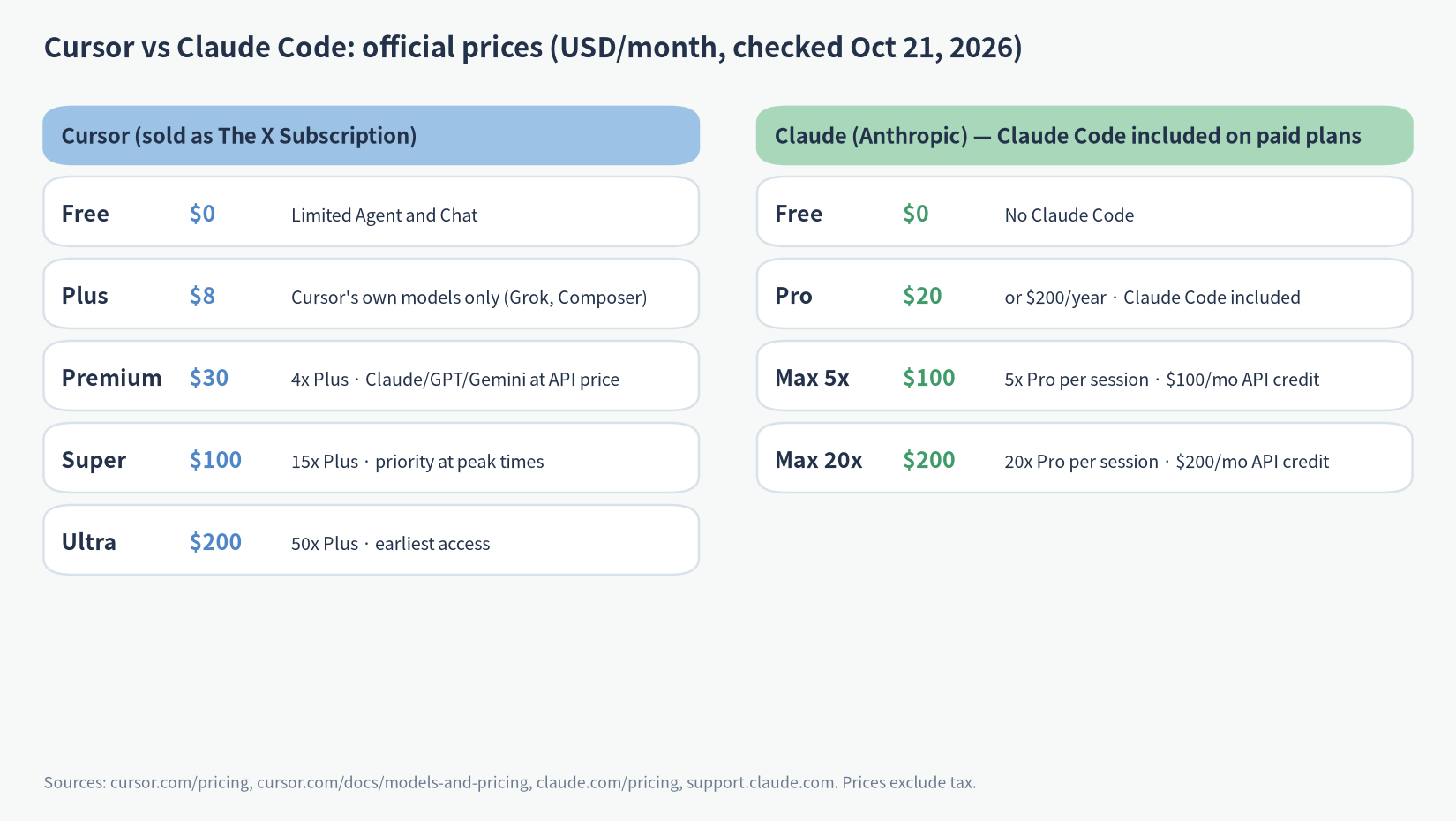
The line that matters most is buried in the docs: Cursor’s included weekly pool covers Cursor’s own models only, which right now means Grok 4.7, Grok 4.6, Grok 4.5 and Composer 2.5. Claude, GPT and Gemini are “third-party models.” On Premium and up you can use them, but they’re billed at the model’s API list price from prepaid credit, from the very first request. On Plus you can’t use them at all, and you can’t bring your own API key either.
On the Claude side, claude.com/pricing says Claude Code is included in every paid plan and shares one usage pool with chat, desktop and mobile. Max is monthly only, $100 for 5x and $200 for 20x per Anthropic’s Max help page, and both Max tiers now come with $100 or $200 a month in API credits. I wrote up whether Max is worth it in my Claude Pro vs Max breakdown, so I won’t repeat it here.
So here’s the gripe. In Cursor, Claude Opus 5.5 costs $4 per million input tokens and $20 per million output, Sonnet 5.5 is $2 and $10. Those are the same numbers Anthropic lists for its API. A long agent session can chew through a lot of tokens, and none of it comes out of the $30 you already paid. On a Claude plan, that same session just eats into your 5-hour window.
How each one works: an IDE vs a terminal agent
Cursor is an editor first. You get the agent in a side panel, tab autocomplete, inline diffs you accept or reject, and model switching. It also has a CLI now: you install it and type agent, with the same Agent, Plan and Ask modes as the editor, plus a way to hand a task off to a Cloud Agent and pick it up later on the web. Cloud Agents, Automations and Bugbot reviews only show up from Premium.
Claude Code went the other way. It started as a terminal tool, and per the official overview it now also runs as a VS Code extension, a JetBrains plugin, a desktop app and on the web. It reads your repo, edits files, runs commands, makes commits. It only speaks Claude, though. If you want GPT or Gemini in the same flow, that’s not what it’s for.
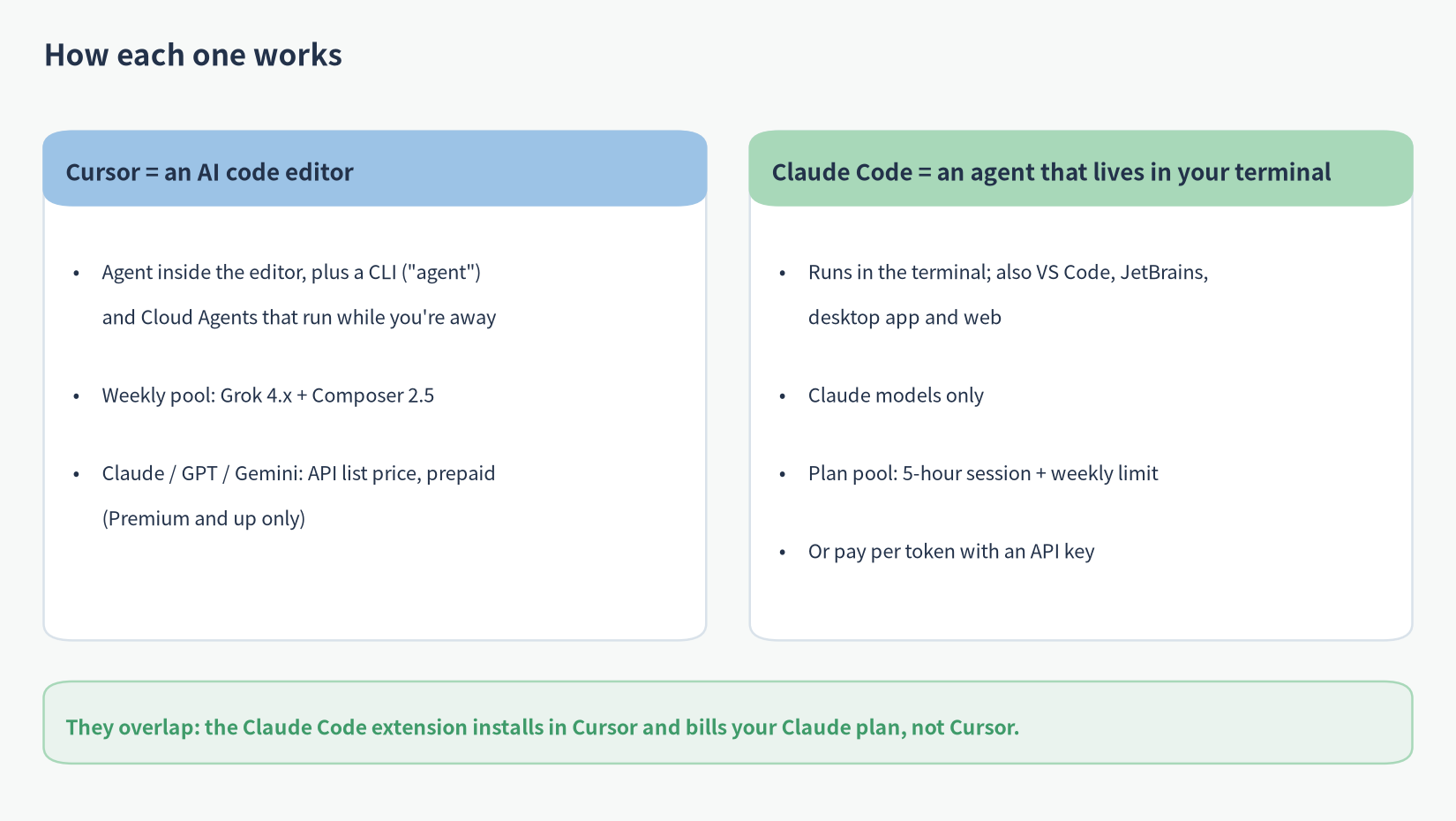
Limits are another place where Cursor vs Claude Code differ, and this trips people up. Cursor’s pool refreshes weekly, and the docs say requests are never downgraded when you run out; you wait, top up, or upgrade. Claude uses a rolling 5-hour session plus a weekly cap, and Anthropic says there’s no fixed message count. Neither company publishes a hard number of prompts. If someone quotes you one, they made it up.
Cursor vs Claude Code: who should pick which
Pick Cursor if the editor is the point. You like tab completion, you review diffs line by line, and you jump between models depending on the task. Plus at $8 is honestly a cheap way to try the editor with Cursor’s own models. Go Premium only if you know you want Claude or GPT in there, and budget for the per-token bill on top.
Pick Claude Code if you mostly want to hand over a whole task, “add tests for this module and fix what breaks,” and come back to a diff. Pro at $20 covers a decent amount, and if you live in it all day, Max is cheaper than paying Claude’s API rates inside any editor. If you’re also weighing OpenAI’s agent, I compared Claude Code vs Codex separately.
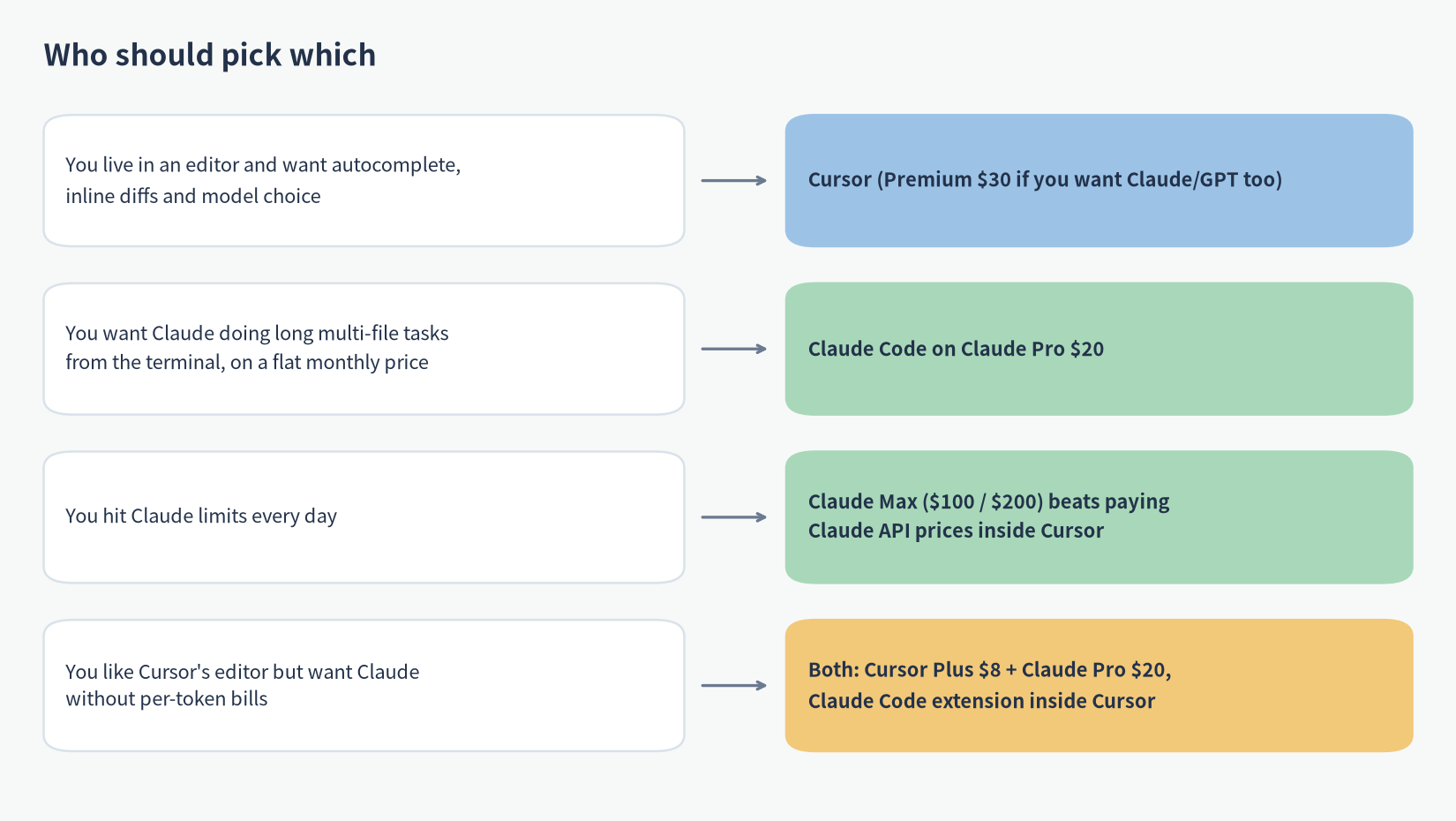
I’d skip Cursor Premium just to get Claude. That’s $30 for the seat plus API prices for every Claude token. Claude Pro gives you Claude Code for $20 with the usage baked in. The math only flips if you barely use Claude and mostly want Grok or Composer.
Can you use Claude Code and Cursor together?
Yes, and it’s officially supported. The Claude Code docs have an “Install for Cursor” link right next to the VS Code one, because Cursor runs VS Code extensions. Install it, sign in with your Claude account, and Claude Code runs in a Cursor tab while Cursor’s own agent and autocomplete keep working on Cursor’s pool.
So the honest Cursor vs Claude Code answer for a lot of people is “both.” That’s the setup I like: Cursor Plus at $8 for the editor and Grok models, Claude Pro at $20 for Claude Code. $28 a month, no per-token surprise for Claude. One gotcha. If you have an ANTHROPIC_API_KEY environment variable lying around and approve it when Claude Code asks, it uses the key, meaning API billing, instead of your subscription. Check that before you blame your plan.
FAQ
Cursor vs Claude Code pricing: which is cheaper?
For Claude specifically, Claude Code. Pro is $20 with usage included; in Cursor, Claude models cost API list price on top of a $30+ plan. For non-Claude models, Cursor Plus at $8 is the cheapest paid way in.
Cursor vs Claude Code: which is better?
Different jobs, which is why Cursor vs Claude Code isn’t really apples to apples. Claude Code is better at taking a task and running with it in the terminal. Cursor is the better editor, with autocomplete and model choice. Most of the “which is better” fights are really people comparing an agent with an IDE.
Can I use Claude models inside Cursor?
On Premium, Super or Ultra, yes, at API list price from prepaid credit. On Plus and Free, no. Teams and Enterprise add a Cursor Token Rate of $0.25 per million tokens on top for third-party models.
Does Cursor have a terminal agent like Claude Code?
Yes. The Cursor CLI installs with one command and runs as agent, with Agent, Plan and Ask modes and a print mode for scripts and CI.
Do Claude Max API credits work in Cursor?
Neither company documents that combo. The credits are for the Claude Platform, and Cursor Plus doesn’t accept your own keys at all. I wouldn’t buy anything counting on it.
What happened to Cursor Pro at $20?
It’s a legacy plan now. If you already have it, it keeps working with its two monthly usage pools. New sign-ups get The X Subscription tiers.
More on this: all my Claude guides, the AI subscription and API price comparison, and the Claude & Codex usage limit tracker.