

Claude Code vs Codex: Which One Should You Pay For? An Honest 2026 Guide
Claude Code vs Codex, compared on price, usage limits, models, setup and account risk, with a decision table by user type.
 bufferAbout the author10 min read

Claude Code vs Codex is the question I get most from people who have twenty dollars a month for AI coding and not forty. Fair. Both tools live in your terminal, both edit your repo, both come bundled with a chat subscription you might already pay for. So I went through the official pricing pages, help docs and GitHub releases on October 20, 2026 and wrote down what each one actually gives you for the money. One thing up front: I didn’t run benchmarks. Where a number isn’t published, I say so instead of guessing.
The short answer
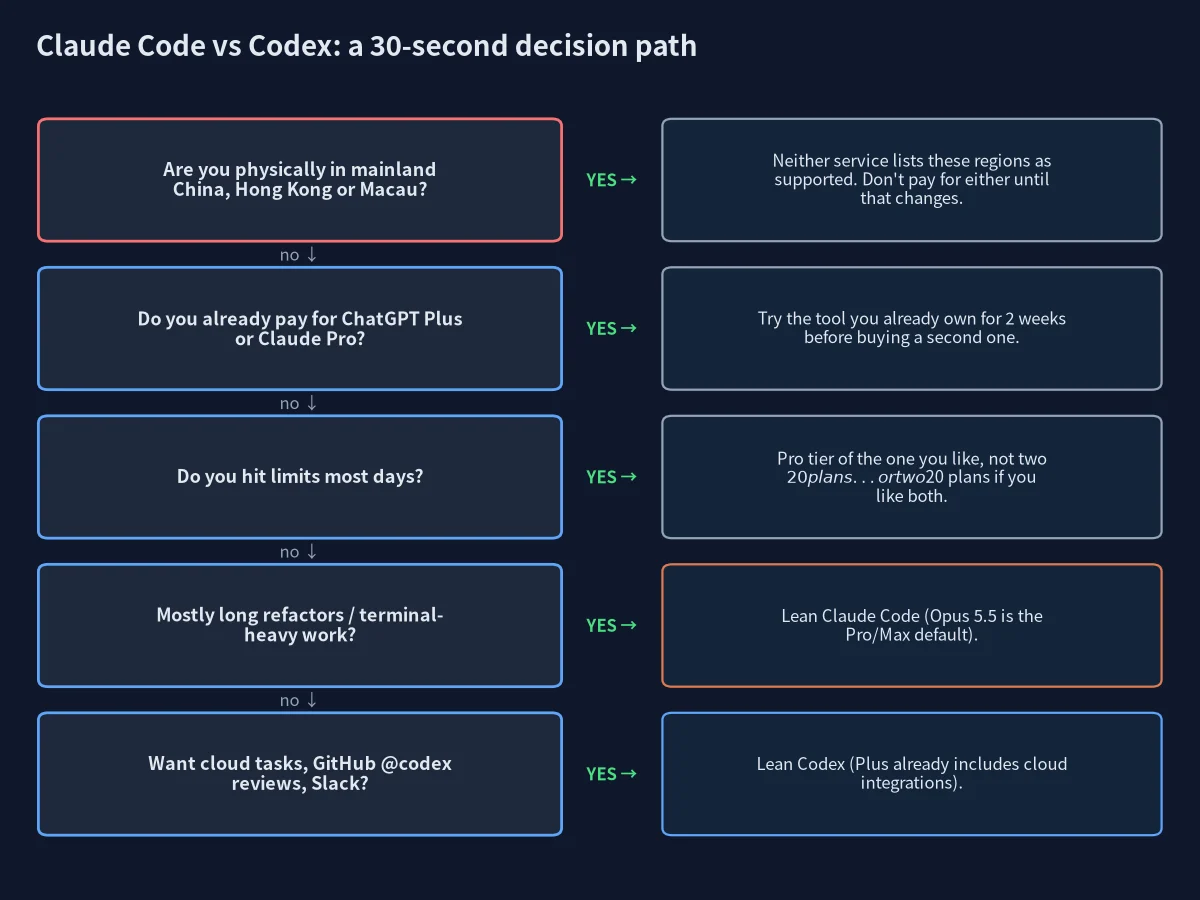
Here’s my Claude Code vs Codex verdict in one breath. If you already pay for ChatGPT Plus, start with Codex. It’s already in your plan, and OpenAI publishes a rough per-5-hour estimate, which is more than Anthropic does. If you already pay for Claude Pro, start with Claude Code, for the same reason. If you pay for neither, the decision comes down to limits and the kind of work you do, not to who wins some leaderboard this week. And if you’re physically in mainland China, Hong Kong or Macau, skip to the account-risk section before paying anyone.
Price: what you actually pay each month
Claude Code is not sold separately. It comes with Claude Pro ($20 a month billed monthly), Max 5x (from $100) and Max 20x ($200). Max is monthly only, and Anthropic’s prices exclude tax (claude.com/pricing). The free Claude plan doesn’t include Claude Code at all.
Codex rides on ChatGPT. Free and Go ($8) get a limited taste: GPT-6 Luna in the desktop app only. Plus is $20, Pro comes in $100, $200 and $500 tiers (monthly only), and Business is $25 per user per month on monthly billing, with a two-user minimum (Codex pricing).
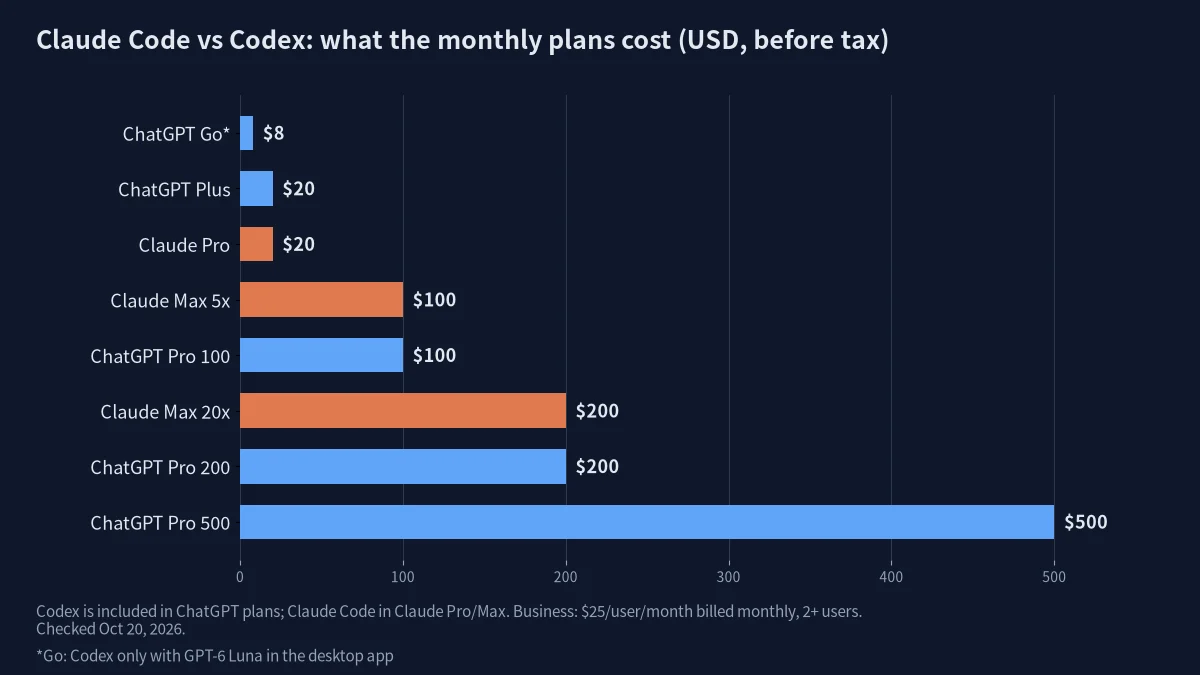
Two gotchas I’d want someone to tell me. First, the Max plan’s monthly API credits ($100 or $200) can’t be used in Claude Code or the Claude apps. They’re for building on the Claude Platform, full stop (Anthropic support). Second, ChatGPT Pro 200 got quietly cheaper for OpenAI, not for you: new Pro 200 subscriptions come with a lower usage allowance at the same $200. If you had Pro 200 between September 22 and September 29, 2026, you keep the old allowance through October 29, then it drops (OpenAI Help Center). OpenAI hasn’t said by how much. A third-party write-up claims it went from 20x Plus to 10x (nerdschalk); I couldn’t confirm that on any OpenAI page, so treat it as a report, not a fact.
Paying in another currency? App Store prices are usually higher than web prices and include local tax. I keep a side-by-side AI subscription and API price comparison for the US, Spain and Mexico.
Claude Code vs Codex usage limits: the part that actually decides it
Here’s the honest summary: Anthropic tells you the shape of the limits but not the size. Pro and Max both have a five-hour session limit plus a weekly limit, and everything you do in the Claude apps and in Claude Code draws from the same pool. Max gives you 5x or 20x Pro’s usage per 5-hour session. Max also has a separate weekly limit for Fable, the top model, and Fable can use up to 50% of your weekly limits there; on Pro, Fable only runs on paid usage credits (pricing, support). There’s no message count anywhere. You check where you stand with /status or Settings → Usage.
OpenAI is a bit more forthcoming, but don’t get excited. For Plus and Standard Business it publishes estimates of local messages per 5 hours: GPT-6 Astra 5–45, GPT-6.1 Sol 15–160, GPT-6 Sol 15–150, GPT-6 Luna 350–3,000. Pro plans currently have no five-hour limit, though weekly limits may apply (source). Five to forty-five messages is a range so wide it’s almost decorative, but at least it tells you Astra eats your quota fast and Luna barely touches it.
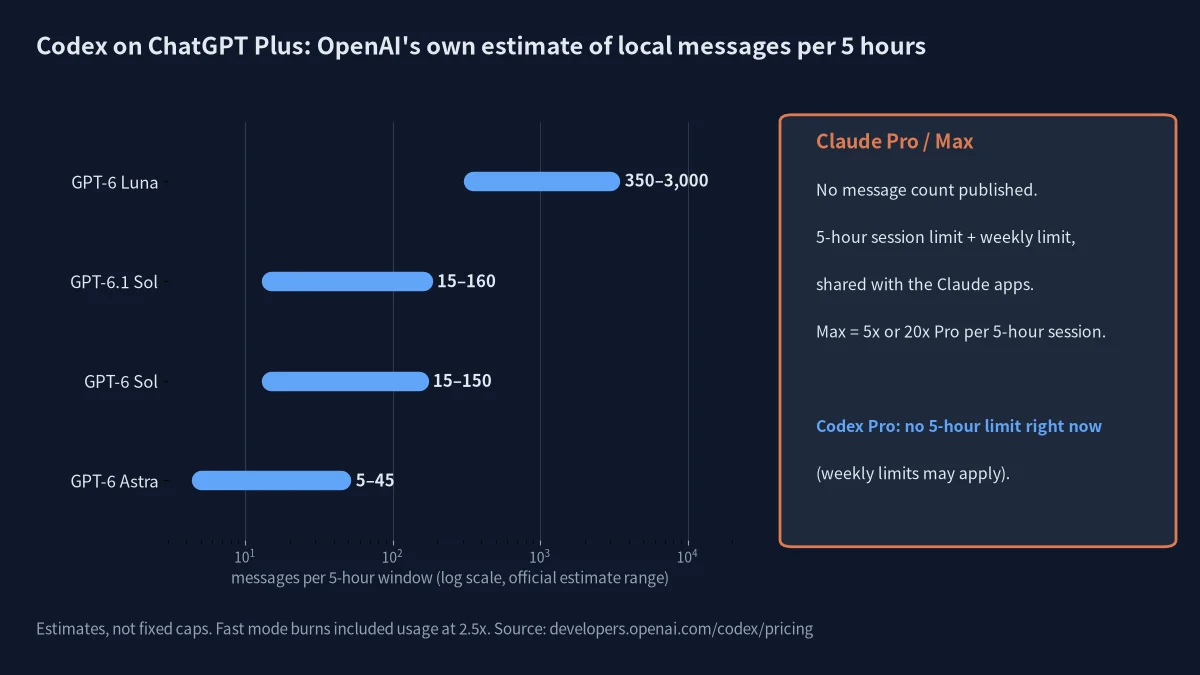
In any Claude Code vs Codex comparison, the multipliers are where people burn money without noticing. On Codex, Fast mode spends your included usage at 2.5x, and Ultrafast (Pro $500 only) at 8x. On purchased credits it’s 2x and 6x. Image generation eats limits 3–5x faster, and cloud tasks cost more than local ones. Also, please don’t compare Claude’s “5x/20x” with anyone else’s multipliers. Each company measures against its own base plan, so the numbers aren’t on the same scale.
Two recent changes worth knowing. Claude Code v2.1.304 (released October 19, 2026, UTC) now warns Pro and Max users when resuming an inactive conversation would use a noticeable share of the 5-hour limit, and offers to start fresh instead. Small thing, but I’ve lost a chunk of a window to exactly that. On the OpenAI side, Codex lead Tibo (@thsottiaux) announced on October 4 that for 28 days the team would ship one clear improvement or a full usage reset every day; Day 14 was editing earlier messages in a desktop-app thread. That’s a staffer’s posts on X, not a written policy, so don’t plan your month around free resets.
I log every reset, limit change and ban wave in my Claude and Codex usage limit tracker, if you want to see the pattern over time.
Which models each one uses
On Pro and Max, Claude Code defaults to Opus 5.5. You can switch to Sonnet 5.5 or Haiku 5.5 with /model, and Fable 5.1 is opt-in, never the default (model docs). Codex recommends GPT-6.1 Sol for most coding, GPT-6 Astra for the hardest work and GPT-6 Luna for simple, repeatable jobs. GPT-5.5 left Codex for ChatGPT sign-in on October 14, 2026 (Codex models); API-key users still have it.
The Claude Code vs Codex math changes if you go the API route instead of a subscription. One tip, one trap. Opus 5.5 is cheaper than older Opus models: $4/$20 per million input/output tokens against $5/$25 for Opus 5 and 4.x. The trap is Haiku 5.5: once a prompt passes 100,000 tokens, the whole request is billed at $0.50/$2.50 instead of $0.10/$0.50, cached tokens included (API pricing). Codex with an API key bills at OpenAI API rates and loses the cloud features.
Setup: CLI, IDE extension, desktop and web
On setup, Claude Code vs Codex is close to a tie. Claude Code installs with one command on macOS, Linux and WSL (Homebrew and WinGet work too), then you run claude in a project and log in with your Claude account. It also runs in VS Code, Cursor and JetBrains IDEs, in the desktop app and on the web.
curl -fsSL https://claude.ai/install.sh | bash
cd your-project && claude
The one footgun: if ANTHROPIC_API_KEY is set in your environment, Claude Code uses it and bills you at API rates instead of using your subscription. Check that before you wonder where your money went.
Codex is just as short. Install, run codex, pick “Sign in with ChatGPT”. There’s an IDE extension (VS Code, Cursor, Windsurf), a desktop app (codex app) and the cloud agent at chatgpt.com/codex.
curl -fsSL https://chatgpt.com/codex/install.sh | sh
cd your-project && codex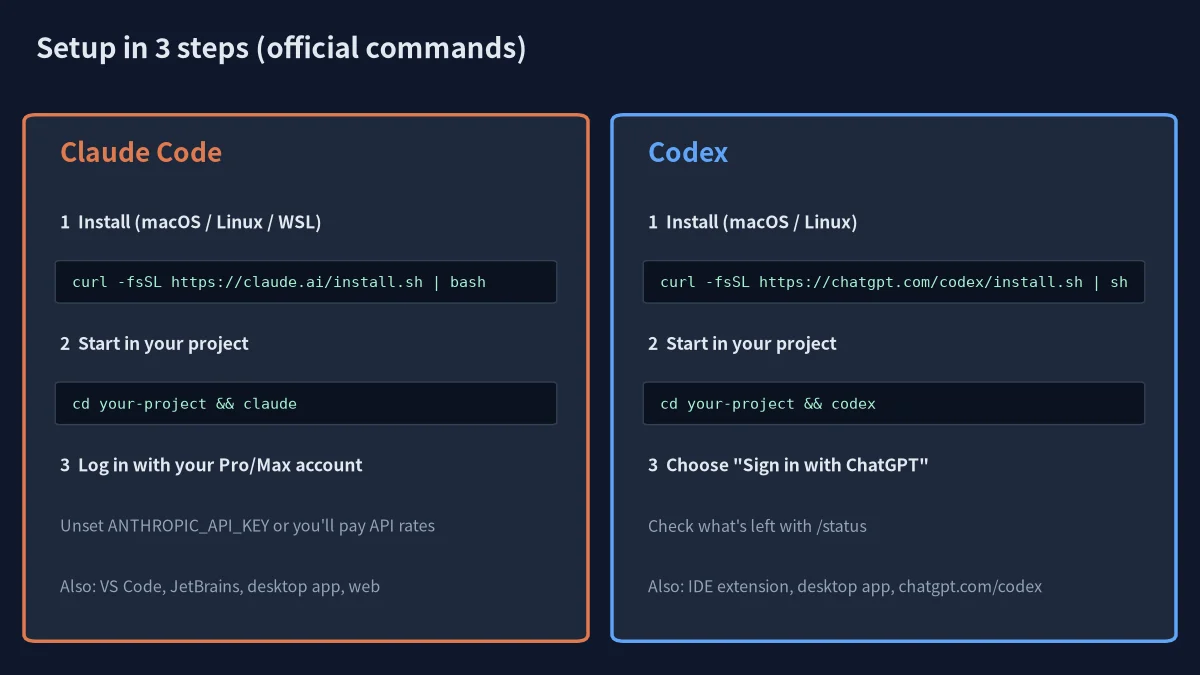
Both CLIs are open on GitHub, and both ship updates constantly. When I checked, Claude Code was on v2.1.304 and Codex CLI on 0.163.0.
GitHubopenai/codexLightweight coding agent that runs in your terminal
Claude Code vs Codex strengths for real tasks
Again, no benchmarks from me. This is what the feature lists and changelogs say each tool is built around.
Claude Code feels built for long sessions in a terminal: Opus as the default, hooks, skills, plugins and mods you can write yourself, subagents, an auto mode with a guided setup, and a Code Review product for teams with Quick, Standard and Deep levels. If your day is big refactors and poking at a repo from the shell, this is its home turf.
Codex leans into delegation. Even on Plus you get Codex cloud, @codex on GitHub issues and PRs, automatic PR reviews, and Slack and Linear integrations. It has worktrees, scheduled tasks, local /review, and the speed modes if you’re willing to pay in quota. If you like firing off tasks and checking back later, that’s where it shines.
And yes, people are already gluing other models onto both. free-claude-code is an unofficial project that lets Claude Code, Codex and several other tools run on free, local or third-party models. It swaps the engine, not the subscription, so quality depends on the model you plug in. It isn’t affiliated with Anthropic, and the installer is a curl-to-shell script, so read it first.
Account risk: mainland China, Hong Kong and Macau
This part of the Claude Code vs Codex question is plain fact, not advice. Anthropic’s Supported Regions Policy lists the places where Claude, Claude Code and its API are available. Mainland China, Hong Kong and Macau are not on it, and the policy also excludes companies headquartered in, or majority-owned from, unsupported regions, even if their staff sit somewhere else (Anthropic). OpenAI’s supported-countries list doesn’t include them either, and it says that using its services outside the list may get your account blocked or suspended (OpenAI). OpenAI’s Pro help page also prohibits sharing credentials and reselling access.
I’m not going to tell you how to get around any of that. If you’re in one of those regions, the money-smart move is simply not to prepay for either.
Claude Code vs Codex: decision table by user type
| Who you are | My pick | Why |
|---|---|---|
| Already paying ChatGPT Plus | Codex | It’s already included; use it for two weeks before buying anything else |
| Already paying Claude Pro | Claude Code | Same logic; Opus 5.5 is the default on Pro |
| $20 budget, starting from zero | Either; lean Codex if you want published estimates | OpenAI publishes per-5-hour ranges, Anthropic doesn’t |
| Heavy daily coder hitting limits | Max 5x or ChatGPT Pro 100 | Codex Pro has no 5-hour limit right now; Claude Max gives 5x Pro per session |
| Want GitHub PR reviews, Slack, cloud tasks | Codex | Included from Plus up |
| Long terminal refactors, custom hooks and mods | Claude Code | That’s what it’s built around |
| Small team (2+ people) | ChatGPT Business or Claude Team | Admin controls and no training on business data by default |
| CI and automation | API key on either | Pay per token; Codex loses cloud features with an API key |
| Physically in mainland China, Hong Kong or Macau | Neither | Not supported regions; accounts can be blocked |
If you made it this far, my Claude Code vs Codex habit is boring: one $20 plan, watch the usage page for two weeks, and only upgrade when I’m hitting the wall more days than not. Paying for both at $20 is often smarter than one $100 plan you use at half capacity. Prices and limits here are as of October 20, 2026. These companies change them often, sometimes overnight, so check the official pages before you pay.
Codex vs Claude Code FAQ
Codex vs Claude Code benchmarks: who wins?
I didn’t run any, and I’m not going to pretend otherwise. Leaderboards flip every few weeks anyway. What doesn’t flip is which subscription you already pay for and how much quota each plan gives you, and that’s what I’d decide on.
What does Reddit say about Codex vs Claude Code?
I didn’t base anything on this page on Reddit threads. They’re fine for a vibe check, but limits and prices change faster than old threads get corrected. For numbers, trust the official sections above over any upvote count.
Codex vs Claude Code vs Cursor, Gemini CLI or OpenCode?
Haven’t compared those here, so no verdict from me on them yet. This page sticks to the two I checked against official pricing and docs.
More on this: more Claude guides and more OpenAI guides.