
Gemini 4 Neon Price: Costs More Than Carbon Until December 1, Then 25% Less
Official Gemini API prices checked Nov 19, 2026, 8:45 a.m. Beijing time: Neon is $3 input / $15 output per 1M tokens. Carbon and Argon stay at $2 / $10 through Nov 30, then $4 / $20 from Dec 1. 3.8 Flash doubles on Jan 1, 2027. From Dec 1, gemini-2.5-pro routes to 3.8 Flash. Includes a 10M-in / 2M-out calculation.
 bufferAbout the author7 min read

Google DeepMind posted the launch note on November 18, 2026 at 21:34 UTC (5:34 a.m. Beijing time on November 19), saying Gemini 4 Neon was rolling out. The same day’s official blog lists the API price as $3 per million input tokens ($0.15 per million cached input tokens, a 95% discount) and $15 per million output tokens, with a 1 million-token context window.
The blog places Neon between Carbon and Hydrogen, and says that at its default high thinking level, Neon has a 32% lower cost per task than Carbon. If you pay the API bill, start with the list prices. I checked the Gemini Developer API pricing page on November 19, 2026 at 8:45 a.m. Beijing time (00:45 UTC). On the official paid-tier rates, Neon costs more per token than Carbon and Argon through November 30, while those two models are still on their introductory price. Only when that introductory rate ends on December 1 is Neon 25% cheaper per token than their standard price.
The official price timeline
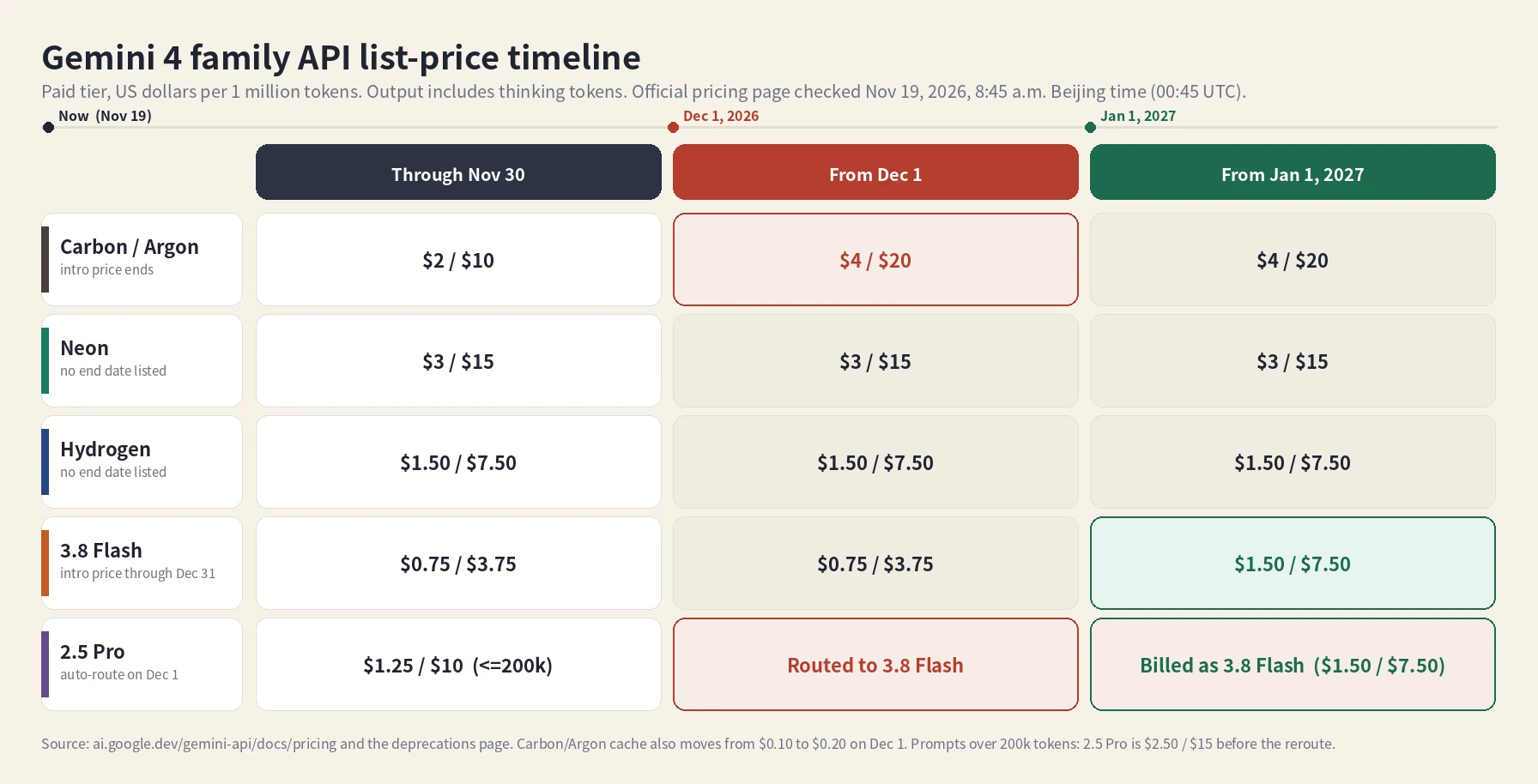
Every figure below is a paid-tier list price in US dollars per 1 million tokens. Output prices include thinking tokens. Checked November 19, 2026, at 8:45 a.m. Beijing time (00:45 UTC).
| Model | Model ID | Through Nov 30, 2026 | From Dec 1, 2026 | From Jan 1, 2027 |
|---|---|---|---|---|
| Gemini 4 Carbon / Argon | gemini-4-carbon / gemini-4-argon | $2.00 in / $10.00 out | $4.00 in / $20.00 out | Same as previous column |
| Gemini 4 Neon | gemini-4-neon | $3.00 in / $15.00 out | Same | Same |
| Gemini 4 Hydrogen | gemini-4-hydrogen | $1.50 in / $7.50 out | Same | Same |
| Gemini 3.8 Flash | gemini-3.8-flash | $0.75 in / $3.75 out | Same (through Dec 31) | $1.50 in / $7.50 out |
| Gemini 2.5 Pro | gemini-2.5-pro | Prompts of 200k tokens or less: $1.25 in / $10.00 out (over 200k: $2.50 / $15.00) | Auto-routed to 3.8 Flash and billed at 3.8 Flash rates | Still billed at 3.8 Flash rates ($1.50 / $7.50 from this date) |
The official wording for Carbon and Argon is: “$2.00 through November 30, 2026. $4.00 starting December 1, 2026.” Output is $10.00 through November 30 and $20.00 starting December 1. That is an introductory price reaching its stated end date, not a separate “price increase” notice on the page. Context caching moves from $0.10 to $0.20 on the same date, and only implicit caching is supported.
Neon is listed at $3.00 input, $15.00 output and $0.15 cache, with no end date on the page. Hydrogen is already $1.50 / $7.50, also with no promotional end date. Hydrogen and 3.8 Flash list input and output as free of charge on the Free tier; Carbon, Argon and Neon are not available there.
For 3.8 Flash, the official wording is “$0.75 through December 31, 2026. $1.50 starting January 1, 2027” for input, and “$3.75 through December 31, 2026. $7.50 starting January 1, 2027” for output. We already compared Hydrogen with 3.8 Flash: until New Year’s Day, Hydrogen’s list price is exactly twice the then-current 3.8 Flash rate.
A sample bill: 10 million input tokens and 2 million output tokens
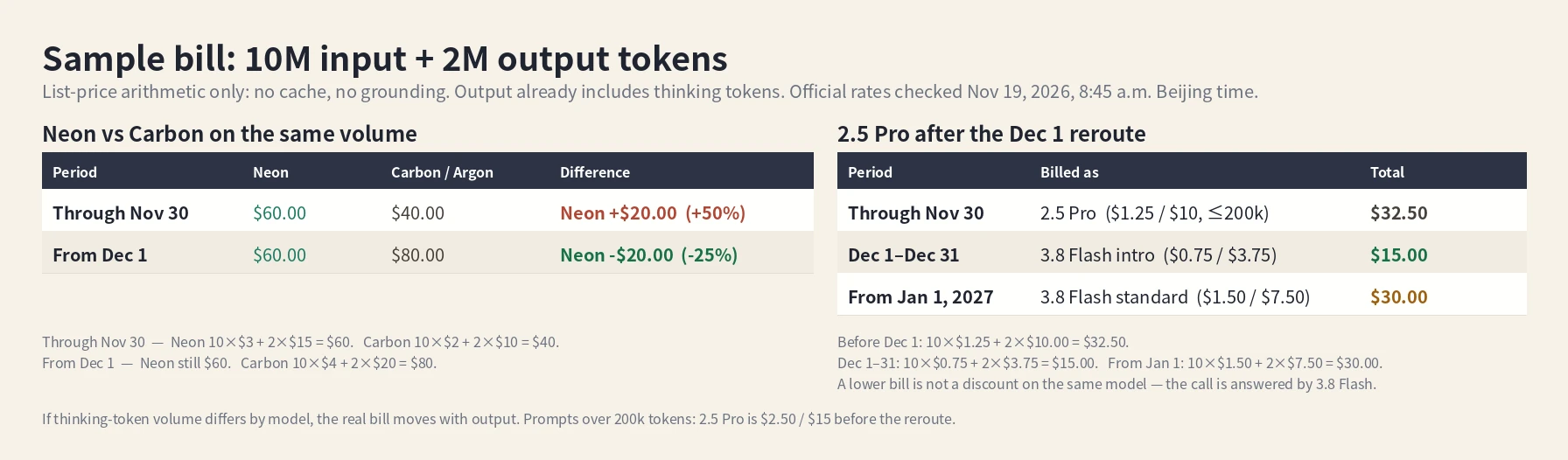
Take a block of paid traffic at 10 million input tokens and 2 million output tokens, with no cache hits and no Search grounding. If thinking tokens are present, the official page bills them as output, so the output figure here is the total already including thinking tokens. Real thinking volume will differ by model, and the bill will move with it. This is list-price arithmetic only.
Through November 30, 2026:
- Neon: 10 x $3.00 + 2 x $15.00 = $30 + $30 = $60.00
- Carbon / Argon: 10 x $2.00 + 2 x $10.00 = $20 + $20 = $40.00
Neon costs $20.00 more — exactly 50% more.
From December 1, 2026:
- Neon: still $60.00
- Carbon / Argon: 10 x $4.00 + 2 x $20.00 = $40 + $40 = $80.00
Neon costs $20.00 less — exactly 25% less. On the same volume, the cheaper model flips on December 1. That is not the same claim as “Neon is always cheaper.”
On December 1, gemini-2.5-pro is routed to 3.8 Flash
The pricing page and the deprecations page are explicit: gemini-2.5-pro is deprecated and is no longer available to select in Google AI Studio. Effective December 1, 2026, all API requests to that model ID automatically route to gemini-3.8-flash and are billed at Gemini 3.8 Flash rates. Google tells developers to change the model string before that date and to read the 3.8 Flash migration guide — function calling, thought_signature, and the switch from thinking_budget to thinking_level are among the breaking changes.
Using the same 10 million input and 2 million output tokens, and 2.5 Pro’s current short-context list price ($1.25 / $10.00 for prompts of 200k tokens or less):
- Before December 1 (still 2.5 Pro): 10 x $1.25 + 2 x $10.00 = $12.50 + $20.00 = $32.50
- December 1 through December 31 (3.8 Flash introductory price): 10 x $0.75 + 2 x $3.75 = $15.00
- From January 1, 2027 (3.8 Flash standard price): 10 x $1.50 + 2 x $7.50 = $30.00
If output volume stays the same, the bill drops first, then rises again on January 1, while still sitting slightly below the old 2.5 Pro short-context list price. For prompts over 200k tokens, 2.5 Pro’s current rate is $2.50 input and $15.00 output, so the gap is wider. This is only price arithmetic. After the reroute, the model answering the call is a Flash model, not the original Pro. A lower bill is not a discount on the same model.
On the same date, gemini-2.5-flash routes to gemini-3.5-flash-lite and is billed at 3.5 Flash-Lite rates (current paid-tier list price: $0.30 input / $2.50 output). That is a parallel official change, not the main line of this article.
Artificial Analysis cost per task
Google’s blog figure is a 32% lower cost per task than Carbon at the default high thinking level. Artificial Analysis publishes a different set of settings.
I opened AA’s November 18 article and the original post from the same day at 21:45 UTC (5:45 a.m. Beijing time on November 19). The short, unexpanded post line only says “~17% lower Cost per Task.” The full post and the article both give the hard numbers: Neon (xhigh) costs $6.44 per task, about 17% less than Carbon (high) at $7.76 on standard, non-discounted pricing. AA also states that Neon’s $3 / $15 rate is 50% above Carbon’s current discounted $2 / $10 price, which ends on November 30, and 25% below the standard $4 / $20. So $6.44 and $7.76 are calculated on Carbon’s standard price, not on the introductory price still in effect today.
AA adds that Neon uses about 15% more output tokens per task, so the saving versus the standard price comes entirely from the lower token rates. On your own workload, a change in thinking tokens will move that ratio. We have a separate guide to how the Artificial Analysis Intelligence Index is scored.
Who can use Neon in the app, which is not the API bill
The official blog says Neon is rolling out on the paid tier of the Gemini API in Google AI Studio, to paid Google AI Pro and Ultra subscribers in Google Antigravity, and to Pro and Ultra subscribers in the Gemini app. Carbon, Argon and Neon are not available on the API Free tier. For plan differences, see our Google AI Pro vs Ultra comparison. To add ChatGPT, Claude and Cursor into an annual subscription total, use the AI subscription cost calculator. Those are subscription prices, not the API token rates above. For what the free API tier still includes, see Gemini API free tier limits.
A wider official-price table is in our LLM API pricing comparison. After this article is approved and published, that page will need a Neon row and the December 1 node for Carbon and Argon.
Prices change. Before you move a large workload, reopen the official pricing page.
Sources: Google DeepMind launch post (November 18, 2026, 21:34 UTC / 5:34 a.m. Beijing time on November 19); Google official blog: Introducing Gemini 4 Neon (page date November 18, 2026); Gemini Developer API pricing (checked November 19, 2026, 8:45 a.m. Beijing time); Gemini deprecations (checked the same day); Artificial Analysis article and full original post (third-party, November 18, 2026, 21:45 UTC / 5:45 a.m. Beijing time on November 19); Logan Kilpatrick’s post (November 18, 2026, 23:34 UTC / 7:34 a.m. Beijing time on November 19; the text is “Neon is a great model : )” with evaluation charts, and this article does not take prices from those images).