
ChatGPT Go vs Plus vs Pro: Which Plan to Buy in 2026 (Honest Notes)
ChatGPT Go vs Plus vs Pro, checked against OpenAI's own pages on Oct 20, 2026: $8, $20 or $100–$500 a month, what Codex you actually get, and three rules for picking without overpaying.
 bufferAbout the author10 min read

Okay, ChatGPT Go vs Plus vs Pro. I get asked this more than anything else right now, usually by someone who’s already paying for the wrong one. So I sat down on October 20, 2026, opened OpenAI’s own pricing page, the Codex pricing doc and the help center, and wrote down only what they actually say. Short version: Go is $8, Plus is $20, Pro is $100, $200 or $500 a month. The gap between them is not where most people think it is.
If a number isn’t on an official OpenAI page today, it isn’t in this post. That’s annoying in a couple of places. I’ll point those out as we go.
The short answer (if you’re in a hurry)
- Mostly chatting, writing emails, translating, homework help? Go, or honestly just Free. Both get unlimited everyday text chats, within OpenAI’s abuse guardrails.
- You want the reasoning models, real deep research, or Codex outside a desktop trial? Plus. This is the plan most people should be on.
- You run into Plus limits several times a week and the work pays you? Pro 100 first. Not 200. Definitely not 500 on day one.
- Team of two or more who need admin and “no training on business data by default”? Look at Business, not three personal Pro accounts.
ChatGPT Go vs Plus vs Pro: the official prices
These are the US prices OpenAI shows today. Go and Plus are on the Codex pricing page ($8 and $20 a month). The three Pro tiers are spelled out in the Pro tiers help article. Business is $25 per user per month billed monthly, or $20 per user per month billed annually, from 2 users up.
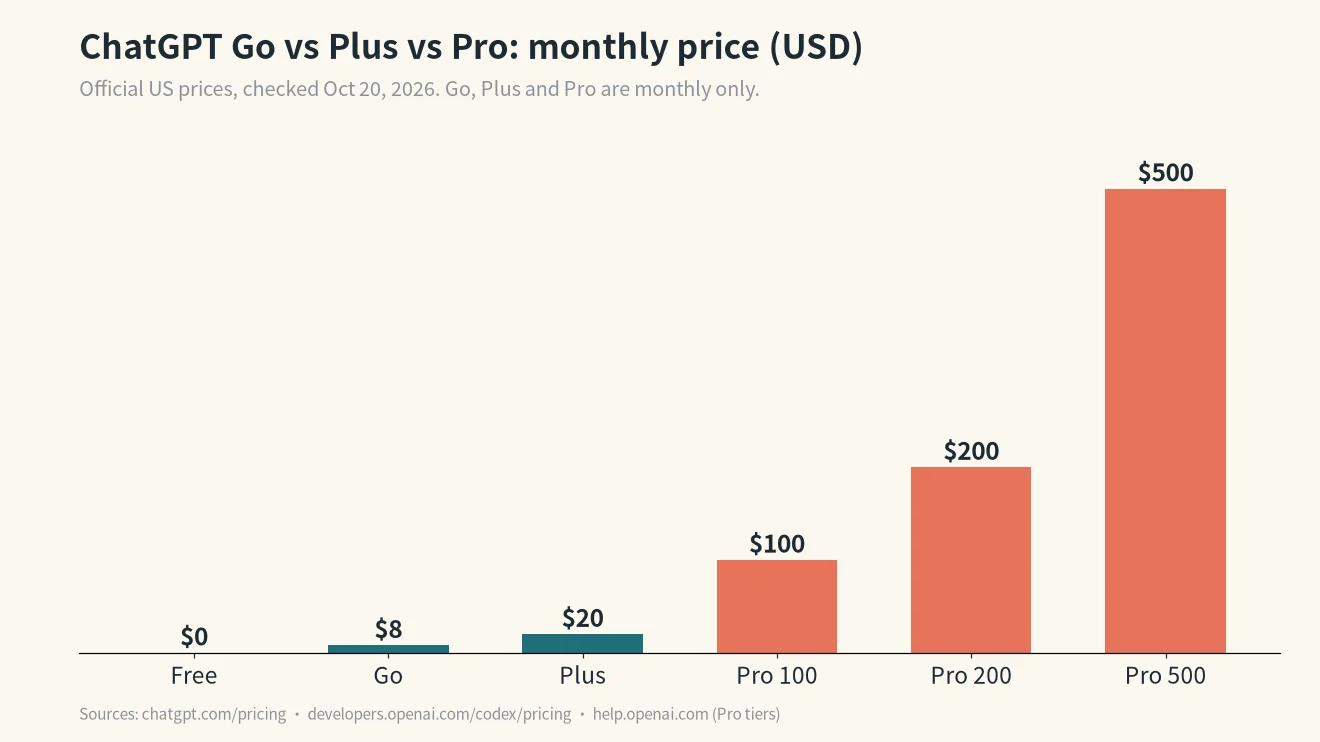
| Plan | US price | Billing | Worth knowing |
|---|---|---|---|
| Free | $0 | — | Unlimited text chats; uploads, images, voice, deep research and Codex are limited |
| Go | $8/mo | Monthly only | “This plan may include ads” |
| Plus | $20/mo | Monthly only | Reasoning models, Codex on web/CLI/IDE, scheduled tasks, custom GPTs |
| Pro 100 / 200 / 500 | $100 / $200 / $500 | Monthly only | Pro 500 is the only one with Ultrafast |
| Business | $25/user/mo, or $20 annual | 2+ users | Admin controls, SAML SSO, no training on business data by default |
One gripe: there’s no annual discount for any personal plan. The Go help article says it flat out: no annual billing and no paying several months ahead for Go, Plus or Pro. So whatever the monthly number is, a year is just that times twelve.
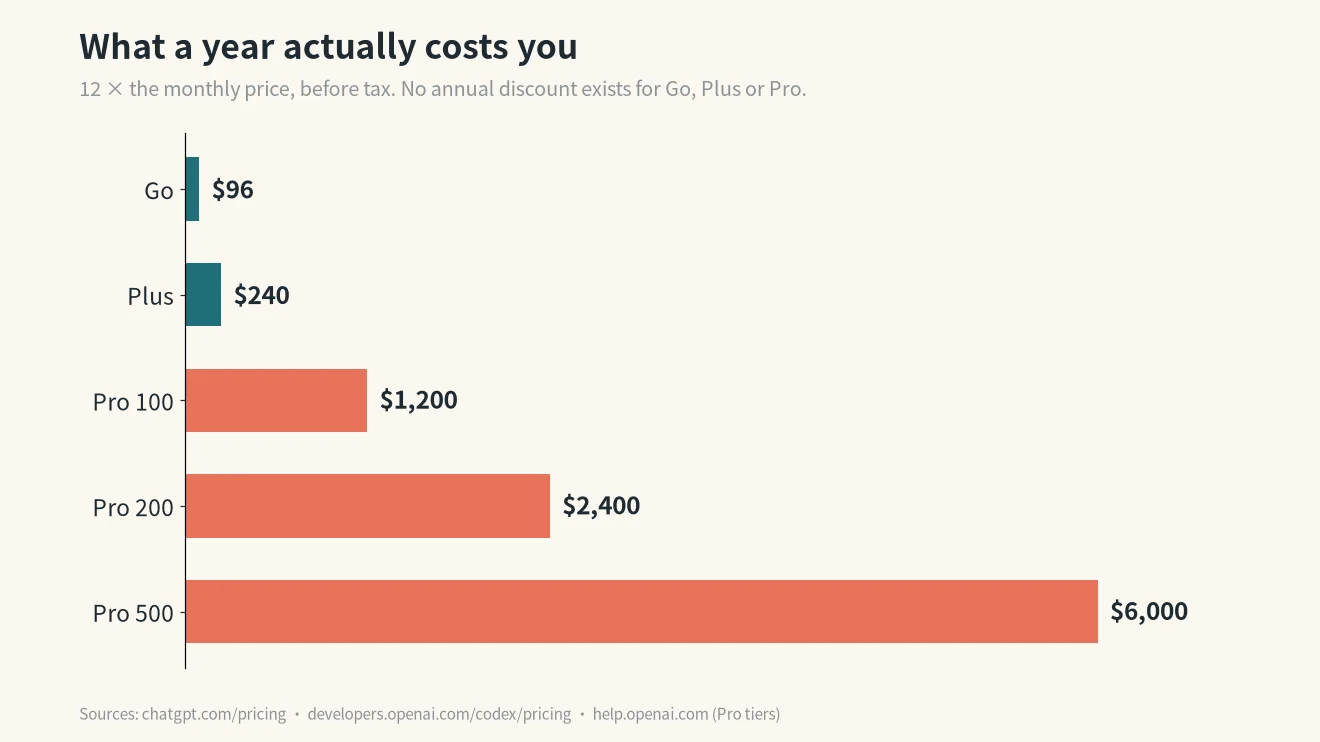
Look at that jump. On the ChatGPT Go vs Plus side it’s $144 more a year. Plus to Pro 100 is $960 more. That second gap is the one worth sleeping on.
Outside the US you’ll usually be billed in local currency. OpenAI’s multi-currency billing page lists EUR for the EEA and MXN for Mexico, but the actual local amounts only show up on the pricing page and at checkout for your region. I couldn’t pull them from an official page today, so I’m not quoting them. Check before you click pay.
What ChatGPT Go actually gets you
Go is the cheap seat. It’s not a tiny Plus, though. Different animal.
According to the pricing page you get more messages with tools, more uploads, more image creation, more voice, and longer memory than Free. Context goes from 27K to 54K on the Instant model, which is roughly 12 pages of input up to about 40. Scheduled tasks are in. Projects too.
What you don’t get: the GPT-6 Sol and Astra reasoning models, interactive tables and charts, image generation with Thinking, developer mode. Deep research stays “limited”, same as Free. And Codex on Go means GPT-6 Luna at Standard speed in the desktop app, “subject to rollout”. That’s a taste, not a tool.
Then the ads. The pricing page says Go “may include ads”. Back in January, when OpenAI launched Go worldwide, it said Plus, Pro, Business and Enterprise would stay ad-free. If ads in your assistant bug you, and they bug me, that alone is a reason to skip Go.
So who’s Go for? Someone who uses ChatGPT like a smarter search box plus a writing helper, hits the Free upload or image cap every week, and never touches code. That’s a lot of people. My mum would be fine on Go.
ChatGPT Go vs Plus: where the $12 goes
This is the real decision for most readers, so let me be blunt about the ChatGPT Go vs Plus gap. You’re not paying $12 more for “more messages”. You’re paying for a different class of model and for Codex that actually works.
- Reasoning models. Plus gets GPT-6 Sol, GPT-6.1 Sol and GPT-6 Astra. Go doesn’t. For anything with steps in it (planning, analysis, debugging) that’s the whole ballgame.
- Context. On reasoning models Plus gets a 256K total window, about 320 pages of input.
- Deep research. Full access instead of limited.
- Codex. Web, CLI, IDE extension, iOS, plus cloud stuff like automatic code review and Slack.
- Extras. Interactive charts, image generation with Thinking, developer mode, Sites, early features.
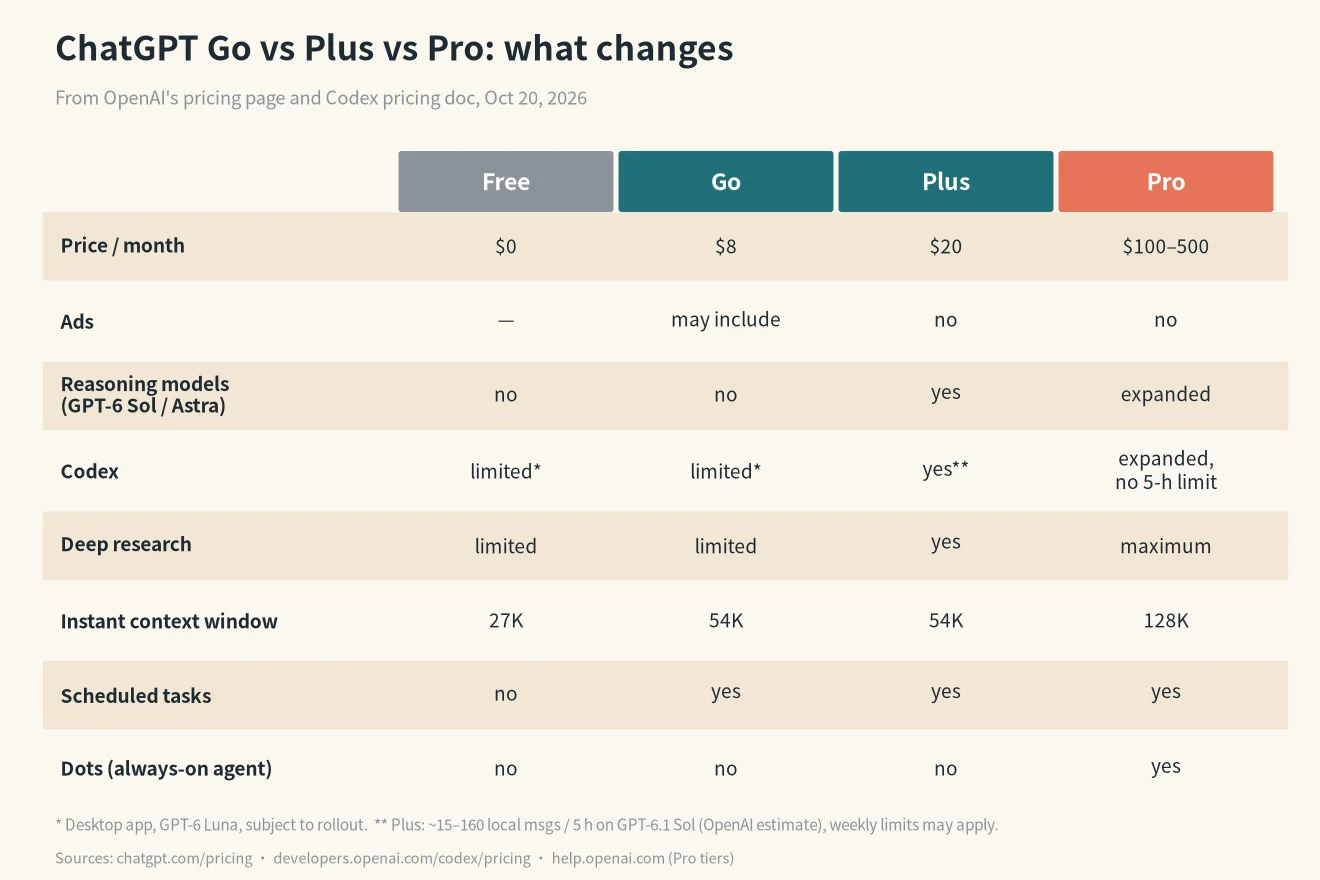
If you’ve ever pasted a spreadsheet in and asked “what’s going on here”, you want Plus. If you only ask it to rewrite emails nicer, you don’t.
Codex usage on each plan (the numbers OpenAI publishes)
This is where it gets fuzzy, and it’s not my fault. OpenAI’s Codex pricing doc gives estimates for Plus only, as local messages per five hours:
| Model | Plus: local messages per 5 hours (OpenAI estimate) |
|---|---|
| GPT-6 Astra | 5–45 |
| GPT-6.1 Sol | 15–160 |
| GPT-6 Sol | 15–150 |
| GPT-6 Luna | 350–3,000 |
Five to forty-five. That’s a nine-times range on the same plan. OpenAI also notes “Weekly limits may also apply” and that cloud tasks can use more than local ones. So treat these as weather forecasts.
If you code at all, this is where ChatGPT Go vs Plus stops being close: Go’s Codex is a desktop-only taste of one small model. For Pro, the doc says “Pro plans currently have no five-hour limit”. Weekly limits aren’t spelled out. Free and Go get GPT-6 Luna in the desktop app and that’s it.
Two things that quietly eat your allowance. Fast mode burns included usage at 2.5x the Standard rate. Ultrafast (Pro 500 only) burns it at 8x. I’ve watched people flip Fast on “just to try” and then wonder where their week went.
If you’re torn between Codex and Claude Code entirely, I wrote that up separately: Claude Code vs Codex. And I keep a running log of limit resets and outages in the Claude & Codex usage limit tracker.
Pro 100 vs Pro 200 vs Pro 500
Here’s what OpenAI’s Pro tiers article actually commits to: Pro 200 includes more usage than Pro 100, and Pro 500 has the highest included usage. That’s it. No multipliers. I’ve seen “5x / 10x / 25x” floating around, but it’s not on any official page I could find, so don’t plan around it.
What Pro adds over Plus, per the pricing page: Pro reasoning powered by GPT-6 Astra, longer Codex and ChatGPT Work sessions, Dots (the always-on agent), unlimited and faster image creation, maximum deep research and memory, a 128K Instant window (about 250 pages in), and 400K on reasoning models. Pro 500 alone gets Ultrafast.
Heads-up for current Pro 200 people. New Pro 200 subscriptions come with a lower usage allowance than the old one, same $200 price. If you had an active Pro 200 sub at any point from September 22 through 10 a.m. Pacific on September 29, 2026, you keep the old allowance through October 29, 2026, then you move down. Nine days from now. Watch your usage that week before deciding anything.
And no, buying credits on Pro 100 or 200 doesn’t unlock Ultrafast. OpenAI says so explicitly.
Which plan should you buy? My three rules
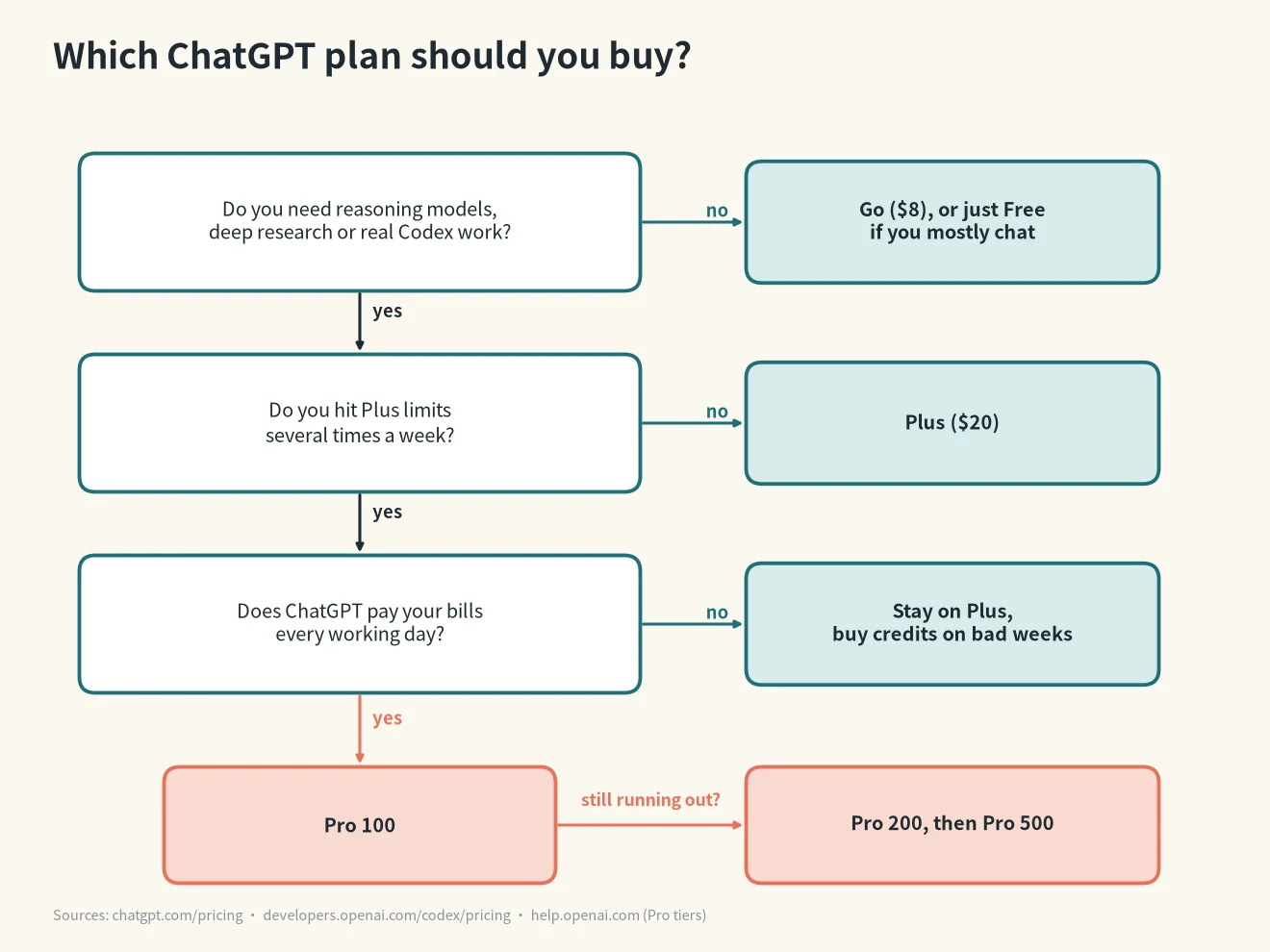
Rule one: start one tier lower than you think. Nothing is prepaid for more than a month, so you’re never locked in, and plan changes live under Settings → My Plan. In a ChatGPT Go vs Plus toss-up, try Go for a month; if you miss the reasoning models within a week, you’ll know.
Rule two: Plus plus credits beats Pro for bursty weeks. Plus and Pro users who hit the limit can buy extra credits instead of upgrading. If you blow through Plus one week a month, that’s usually cheaper than an extra $80 every month. Usually. Do the maths on your own bad week.
Rule three: Pro only when it pays rent. If ChatGPT or Codex is part of how you earn money every working day, and Plus keeps stopping you mid-task, Pro 100 is a fair deal. Run it a full month. Only then look at 200.
Same logic I used for Anthropic’s plans, by the way. If you’re weighing Claude too, see Claude Pro vs Max, and for the full cross-vendor price table there’s the AI subscription & API price comparison.
Is Business worth it instead?
Only if you’re actually a team. It starts at two seats, $25 each per month or $20 on annual billing. You get a dedicated workspace, admin controls, SAML SSO and MFA, and no training on your business data by default. Codex limits per five hours on Standard Business match Plus in OpenAI’s table. So it’s not “more AI”, it’s more control. A solo freelancer gets nothing from it.
Region and cancelling, briefly
ChatGPT is only supported in the countries on OpenAI’s supported countries list, and OpenAI says using it from elsewhere “may result in your account being blocked or suspended”. Mainland China and Hong Kong aren’t on the list. Read it before you pay, especially if you travel.
Cancelling stops the next renewal. You keep the plan until the end of the billing period, and it doesn’t refund earlier charges automatically. Bought through Apple or Google Play? Cancel there, not on the website. Deleting the app doesn’t cancel anything, which, yes, people do.
ChatGPT Go vs Plus vs Pro: my final take
If I could only give one line: Plus is the default, Go is for chatters who hate paying $20, and Pro is for people whose income depends on it. The $8-to-$20 step buys you better thinking. The $20-to-$100 step mostly buys you fewer interruptions. Know which one you’re actually short on.
Prices and limits here were checked on October 20, 2026 (Beijing time). OpenAI changes this stuff often, Pro 200 literally changed three weeks ago, so if you’re reading this in a month, click the source links first.
ChatGPT Plus vs Go and Pro limits: quick FAQ
ChatGPT Plus vs Go: is Plus worth the extra $12?
If you do anything with steps in it, yes. Plus gets the GPT-6 Sol and Astra reasoning models, full deep research and real Codex; Go gets none of that and “may include ads”. For rewriting emails and quick questions, Go is fine and $144 a year cheaper.
Is ChatGPT Plus worth it for students, writing or image generation?
For plain writing help and homework questions, I’d try Go or even Free first, since both get unlimited everyday text chats. Plus starts to matter when you need reasoning on harder problems, full deep research for papers, or image generation with Thinking. Students are exactly the people who should start one tier lower.
What are ChatGPT Pro’s limits per day?
OpenAI doesn’t publish a daily number. The Codex doc says Pro plans currently have no five-hour limit, but weekly limits aren’t spelled out, and the Pro tiers only promise “more usage” as you go up. Any exact Pro limit you read on Reddit is someone’s own count, not an official figure.
Hit the ChatGPT Pro limit? When does it reset?
OpenAI doesn’t give a reset time I could quote, so I won’t make one up. What you can do: buy extra credits on Plus or Pro instead of upgrading, and turn off Fast mode, which eats included usage at 2.5x. I log resets I can confirm in the usage limit tracker linked above.
Is ChatGPT Pro worth it for coding?
Only if Codex is part of how you get paid and Plus keeps stopping you mid-task. Then Pro 100 is fair. Run a full month before even looking at Pro 200.
More on this: more OpenAI guides.