

Moonshot Indonesia B300 Lease Reportedly Scrapped: Nov 19 Rule Is a License Requirement, Not a Blanket Ban
The Information reported on Nov 19, citing two people with direct knowledge, that Moonshot AI scrapped a $150 million lease for Nvidia B300 chips at an Indonesian data center. I checked the Federal Register at 8:56 a.m. Beijing time on Nov 20, 2026: the remote-access rule took effect Nov 19. It is a license requirement with a 12,000,000 aggregate TPP threshold, not a blanket ban.
 bufferAbout the author10 min read

The Information published a story on November 19, 2026, by Claudia Chong and Qianer Liu. According to two people with direct knowledge of the matter, Beijing-based Moonshot AI, the developer of the Kimi models, scrapped a $150 million deal to access Nvidia Blackwell chips through a data center in Indonesia. The company had signed a contract with a Southeast Asian neocloud, which the reporting does not name, to rent access to a sizable cluster of Blackwell Ultra B300 chips, starting as early as next year. The B300 is barred by the U.S. government from sale to China.
This is not a Moonshot announcement. I could not open the paywalled English text on theinformation.com. The sentences above come from the English lede reprinted by Benzinga, which I did open. The byline on that page is The Information, and the stamp is 5:00 a.m. ET on November 19 (6:00 p.m. Beijing time). The lede ties the cancellation to a U.S. Commerce Department rule announced the same week, and says Chinese companies had been able to reach restricted Nvidia chips from data centers outside the country. It does not mention a prepayment share, Kimi K4, or whether the company commented.
The same day, an interim final rule from the Bureau of Industry and Security (BIS), *Addressing Remote Access to Advanced Semiconductors*, was published in the Federal Register and took effect. I opened the Federal Register page at 8:56 a.m. Beijing time on November 20, 2026 (00:56 UTC). The official wording is: “This rule is effective November 19, 2026.” Comments are due by January 19, 2027. The citation is 91 FR 74970, Document 2026-23529. BIS had issued a press release on November 16 saying the rule “is on display”; the effective date is the one in the Federal Register, not the date of that release. The press release says the rule is designed to ensure that existing restrictions on sensitive American technology “cannot be circumvented through remote computing arrangements involving data centers in third countries.” The rule text does not name Moonshot.
Announced on November 16, in force on November 19, and named in a report the same day
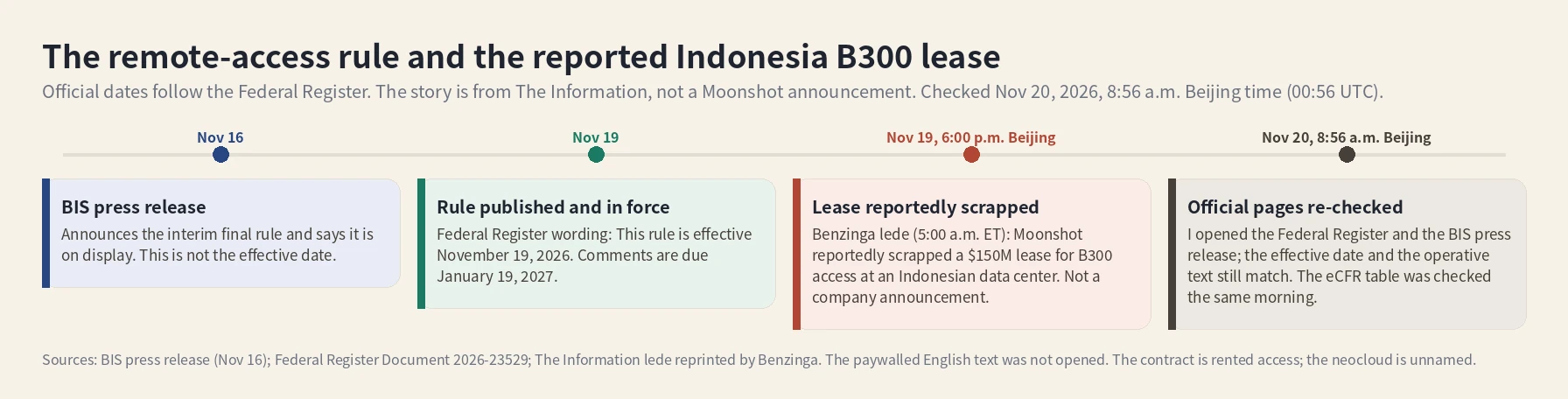
Two dates are easy to mix up. The November 16 press release is not the effective date. And this story is not a company confirmation. On the first point, the sentence in the Federal Register controls. On the second, the account still rests on a single outlet and unnamed people. In the sources I opened, I have not seen a formal confirmation from Moonshot, Nvidia, or the unnamed cloud provider. The reporting also does not name the neocloud, give a chip count, or specify a start month beyond “as early as next year.” The object of the contract is rented access, not a purchase of the chips.
What the rule actually requires: two separate licenses
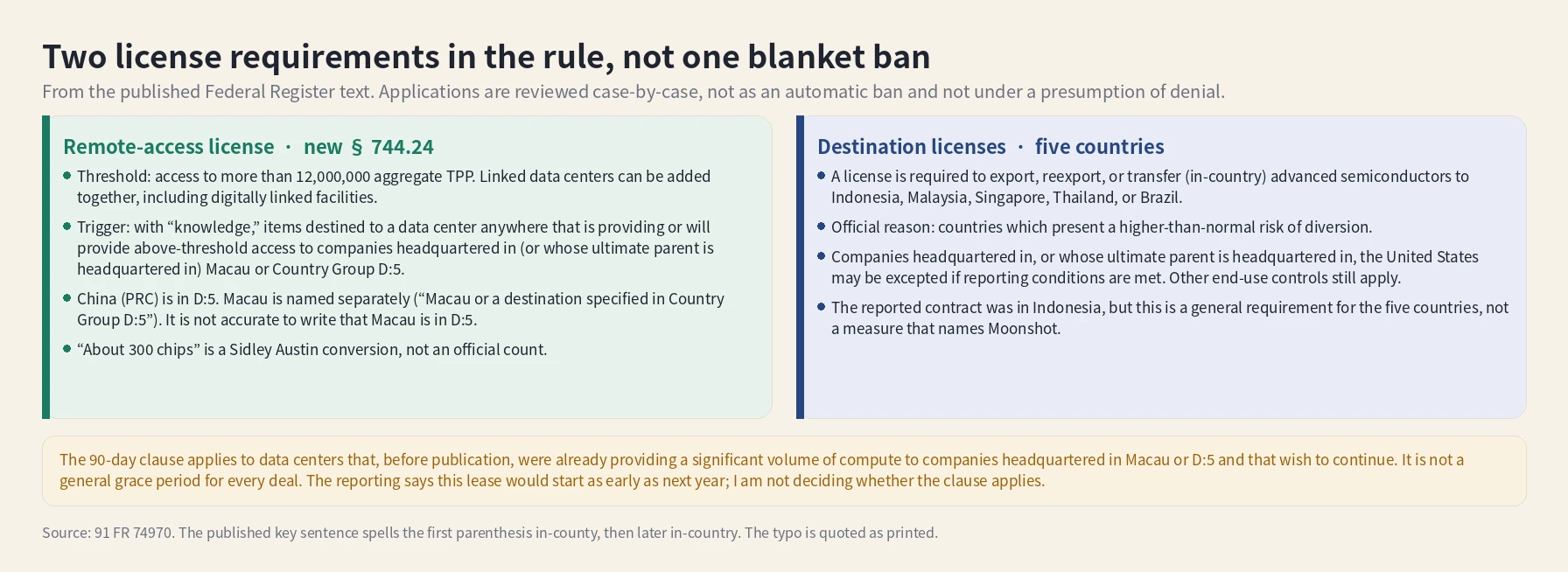
These are two license requirements, not one sentence that “the United States has banned Chinese companies from renting overseas GPUs.” That is what I read in the published text.
The first is new 15 CFR § 744.24. If you have “knowledge” at the time of an export, reexport, or transfer (in-country) of listed advanced computing items to a data center in any destination worldwide, and that data center is providing or will provide access to more than 12,000,000 “aggregate TPP” to companies headquartered in, or whose ultimate parent company is headquartered in, Macau or a destination specified in Country Group D:5, a license is required first. The threshold can add up “linked data centers,” including digitally linked facilities, not only halls that share a building. The key sentence in the published text is:
you may not export, reexport, or transfer (in-county) items specified in ECCNs … without a license if you have “knowledge” at the time of the export, reexport, or transfer (in-country) that the item is destined to a data center to or within any destination worldwide that is providing or will provide access to more than 12,000,000 “aggregate TPP” either at one data center or through
linked data centersto or for companies headquartered in, or whose ultimate parent company is headquartered in, Macau or a destination specified in Country Group D:5 in supplement no. 1 to part 740 of the EAR.
The first parenthesis is spelled “in-county”; later in the same sentence it is “in-country.” I am quoting the published text as printed, without silently correcting the typo.
The review policy is in the same section: “Applications for licenses required by this section will be reviewed on a case-by-case basis.” That is case-by-case review, not an automatic ban, and not a presumption of denial.
Country Group D:5 is titled “U.S. Arms Embargoed Countries.” Later the same morning I opened the eCFR table in Supplement No. 1 to Part 740. China (PRC) has an X in the D:5 column. Macau is blank in that column, though it is marked in D:1, D:3 and D:4. The rule’s own phrase is “Macau or a destination specified in Country Group D:5”; Macau is named separately, and it is not accurate to write that “Macau is in D:5.” The eCFR describes itself as “authoritative but unofficial.”
The second hook is a destination license. On top of existing advanced-semiconductor licenses, a license is required to export, reexport, or transfer (in-country) advanced semiconductors to Indonesia, Malaysia, Singapore, Thailand, or Brazil (and any additional country later designated by the Secretary of Commerce, in consultation with the Secretary of State or the Assistant to the President for National Security Affairs). The official reason is “countries which present a higher-than-normal risk of diversion.” The requirement does not apply to semiconductors destined to companies headquartered in, or whose ultimate parent company is headquartered in, the United States, if the stated reporting conditions are met; other end-use controls still apply. The reported Moonshot contract was sited in Indonesia, one of those five countries. The destination rule itself is a general requirement for those countries, not a measure that names this company.
One more clause is easy to misread as a three-month grace period for every deal. Data centers that, before publication, were already providing a “significant volume of compute power” to companies headquartered in Macau or Country Group D:5, and that wish to keep doing so, “must obtain a license with 90 days of the effective date of this IFR or face future export restrictions.” The official wording is “with,” not “within.” It covers service already being provided that the operator wants to continue. The reporting says this lease would start “as early as next year,” and it does not say whether service had already begun. I am not going to decide whether the clause applies.
The official threshold is 12,000,000 aggregate TPP. Yonhap, The Decoder, and the Chinese-language screenshots I opened all relay a conversion from the law firm Sidley Austin: the trigger is “equivalent to roughly 300” of the most advanced AI chips, while Chinese labs typically seek contracts for several thousand. That is a law-firm estimate, not an official chip count in the rule. I have not produced my own B300 conversion.
Can Chinese users still rent GPUs overseas?
The rule restricts items subject to the EAR. Where there is “knowledge,” those items may not be supplied, without a license, to a data center that is providing or will provide above-threshold compute to companies headquartered in Macau or a D:5 destination; on top of that sit the destination licenses for the five countries. It is not a ban written for individual developers that “a Chinese passport cannot rent any overseas cloud GPU.” Renting a few consumer cards and leasing a sizable B300 cluster are not the same magnitude under a 12,000,000 aggregate TPP threshold.
I have not placed test orders with overseas clouds, so I cannot offer a vendor-by-vendor list of what is still available. What can be checked today is the rule text, plus one reported cancellation of a lab-scale lease that had not yet started. Treating “overseas GPU rental is over” as a legal conclusion goes beyond what those two sources support.
What I verified in the lede, and what I can only relay
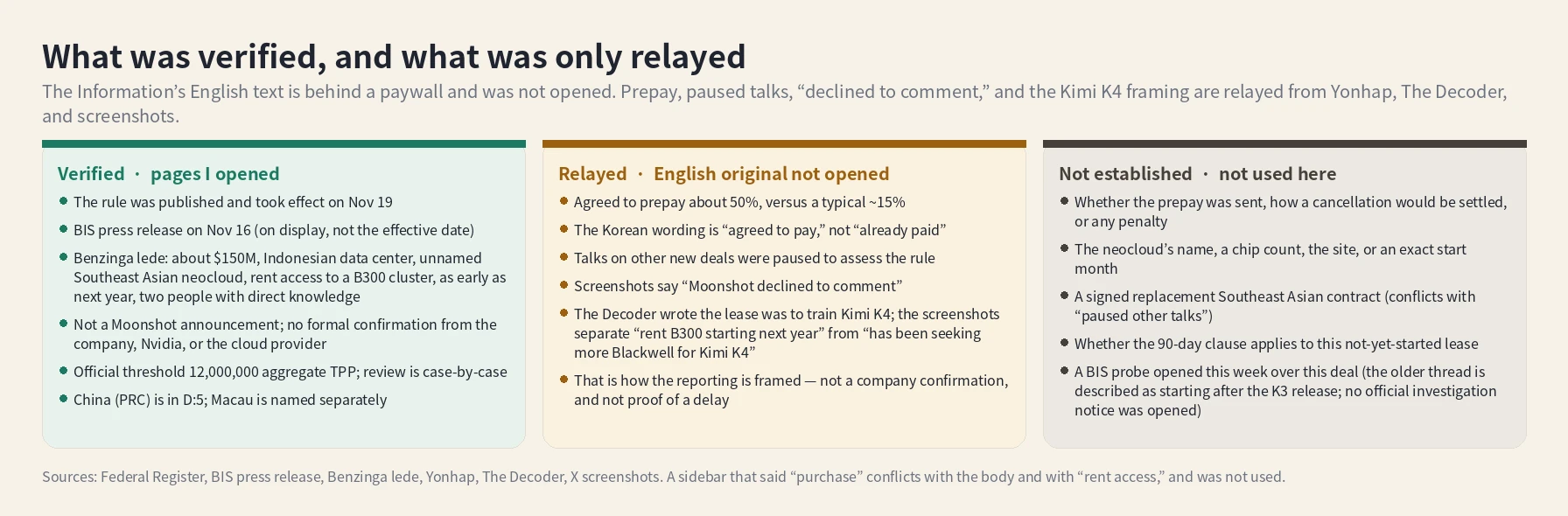
The prepayment, the paused talks, a “declined to comment” line, and the link to Kimi K4 do not appear in the Benzinga English lede I opened. Those details come from Yonhap, The Decoder, and two screenshots that look like a Chinese-language The Information page. I compared those relays with each other. I did not compare them with the paywalled English original, and I am flagging them as such.
The relayed wording is that, to meet a heavy demand for compute, Moonshot had agreed to prepay about 50 percent of the $150 million deal, compared with a typical contract term of about 15 percent. Yonhap’s Korean is “agreed to pay,” not “already paid.” None of the sources I opened says the money had already been sent, and that is not a basis for writing that $75 million has already been lost.
Another person familiar with the matter said Moonshot had also paused talks on other new deals in order to assess the impact of the new rule. The screenshots add that “Moonshot declined to comment.” I have not seen a matching statement on the company’s own channels.
Kimi K4 needs two sentences, not one. The Decoder wrote that the company had planned to rent a large B300 cluster there starting next year “to train its next language model, Kimi K4.” The screenshots I opened keep the ideas apart: one sentence says the B300 lease would start as early as next year; another recalls a July The Information report that the startup had been seeking more Blackwell chips for its next model, Kimi K4. That is how the reporting is framed. It is not a company confirmation, and it is not proof that Kimi K4 has been delayed, paused, or cancelled.
Domestic chips as background only, not a substitute for this lease
Yicai, in a report time-stamped 8:12 p.m. on November 19, quoted Alibaba CEO Wu Yongming on the company’s fiscal 2027 second-quarter call as saying that Qwen is already training its next model on T-Head chips, and that Bailian is already offering model inference on domestic chips. I have not independently verified the scale or the results. That remark is not evidence that domestic chips have replaced Nvidia, it is not Moonshot’s plan, and it does not fill in for this reported B300 lease.
The rule is still open for comment through January 19, 2027. For the obligations themselves, reopen the Federal Register page. Do not rely on a relay alone.
Related: Kimi K3.1 Pro API pricing; GPU rental prices and neocloud stocks; Using China-based models with Claude Code.
Sources: The Information article page (November 19, 2026, Claudia Chong and Qianer Liu; the paywalled English text was not opened); Benzinga reprint of the English lede (November 19, 2026, 5:00 a.m. ET / 6:00 p.m. Beijing time; I opened this page); Federal Register: Addressing Remote Access to Advanced Semiconductors (checked 8:56 a.m. Beijing time on November 20, 2026); BIS press release (dated November 16, 2026; checked the same morning); eCFR Supplement No. 1 to Part 740 (Country Group table, checked the same morning; the eCFR is not the official print edition); Yonhap’s relay (8:20 a.m. Korea time on November 20, 2026 / 7:20 a.m. Beijing time; I opened the full article); The Decoder (November 19, 2026; I opened the full article); X post with screenshots (November 19, 2026, 10:49 UTC / 6:49 p.m. Beijing time); Yicai on Wu Yongming, T-Head and Qwen (November 19, 2026, 8:12 p.m.; background only).