
Qwen4-Max Price: $1.5 / $4.5 on Singapore and How to Use It
Qwen4-Max is generally available. Singapore list price: $1.5 input and $4.5 output per 1M tokens; China-site Beijing is 10 / 30 CNY. Quotas and a 10-round cost example.
 bufferAbout the author9 min read

The official Qwen account (@Alibaba_Qwen) announced the general availability of Qwen4-Max at 18:01 PT on November 15 (10:01 Beijing time on November 16). The post says the API is live on QwenCloud, and that you can also try Qwen4-Max on Qwen Studio, QwenWork and Qoder. The official blog is titled “Qwen4-Max: Your New Teammate Has Arrived” (qwen.ai/blog?id=qwen4-max). This article covers pay-as-you-go pricing, quotas and how to call the generally available model. It is a separate page from our November 11 article on the Qwen4-Max preview and Token Plan tiers.
Start with the list prices. The official post quotes the international-site figures: $1.5 per million input tokens, $4.5 per million output tokens, and $0.075 per million tokens for implicit caching, “all lower than Qwen3.8-Max, with implicit caching down by 70%.” I checked those numbers against the international Model Studio pricing page, the China-site pricing page and the qwen4-max model page, all updated on November 17. Singapore on the international site is indeed $1.5 / $4.5, with cache writes at $1.875 for a 5-minute TTL and $3 for a 1-hour TTL, and cache hits at $0.075. On the China site, the China (Beijing) list price is 10 CNY per million input tokens and 30 CNY per million output tokens, with cache writes at 12.5 CNY (5 minutes) and 20 CNY (1 hour), and hits at 0.5 CNY. Both pages say they show standard prices only, and that current promotions are in the console.
Checked on 2026-11-18 at about 04:30 Beijing time (12:30 PT on November 17). List prices can change. The preview window ends at 24:00 Beijing time on November 25 (08:00 PT that day), and I plan to recheck after that date.
Two price lists, and they should not be mixed
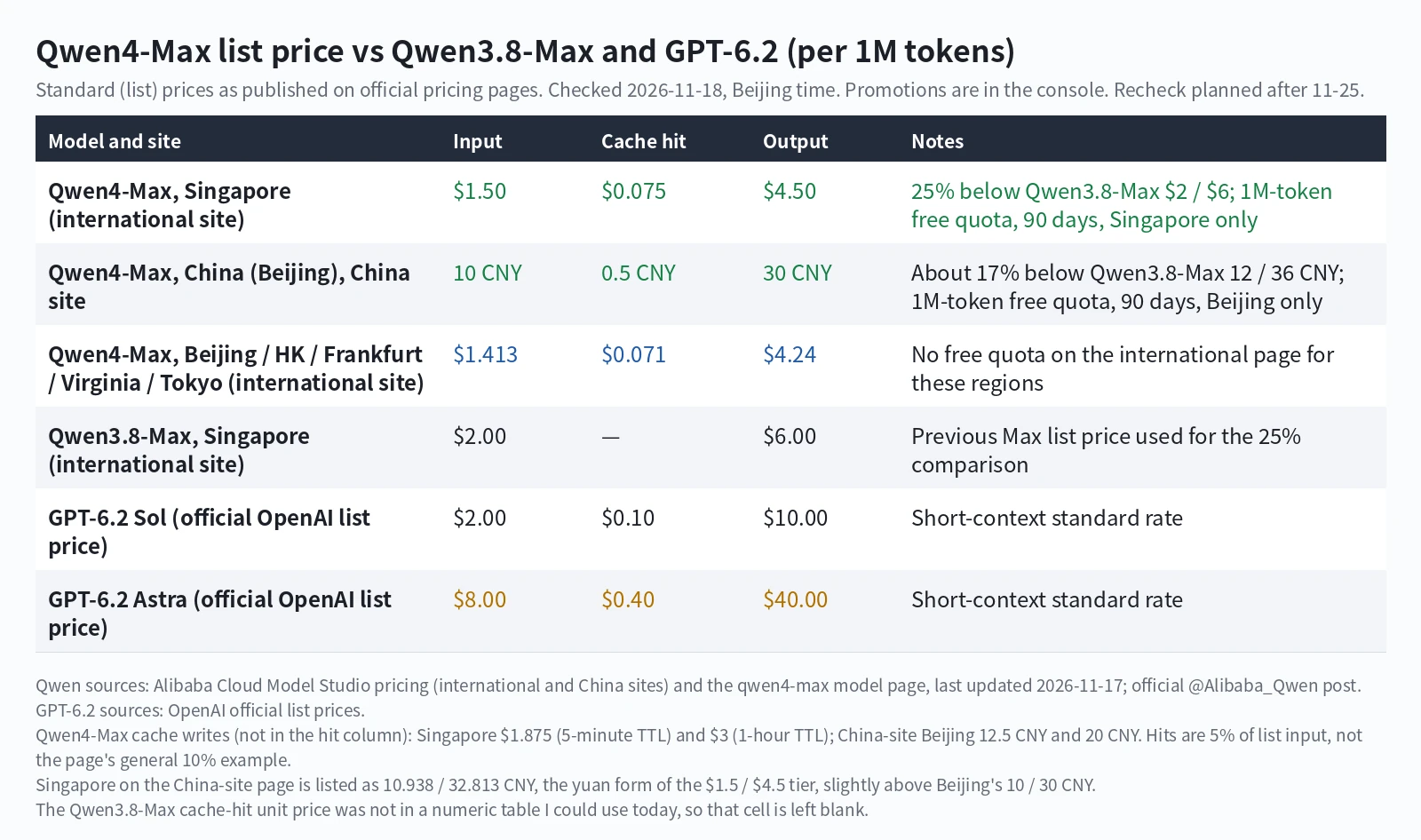
Against Qwen3.8-Max at $2 / $6 on Singapore, Qwen4-Max input and output are 25% lower. Against the previous 12 / 36 CNY on the China-site Beijing list, 10 / 30 CNY is about 17% lower. A blanket “25% price cut” does not hold for the China-site yuan prices.
The international page lists China (Beijing), Hong Kong (China), Frankfurt, Virginia and Tokyo at $1.413 / $4.24, with cache hits at $0.071, and it shows no free quota for those regions. The China-site page lists US (Virginia), Hong Kong (China), Frankfurt and Tokyo at 10 / 30 CNY; Singapore on that same China-site page is written as 10.938 / 32.813 CNY, which matches the $1.5 / $4.5 tier converted into yuan and is slightly higher than Beijing’s 10 / 30 CNY. Check which console and which region you are actually billing in.
Output prices include the chain of thought plus the final answer. Qwen4-Max has a single tier for 0 to 1 million tokens, with no higher rate for longer prompts. Explicit and implicit cache hits share the same unit price in the table; explicit cache also charges a creation fee, with a TTL of 5 minutes or 1 hour. The pricing page includes a general example that cache hits are billed at 10% of standard input, but the Qwen4-Max hit table is $0.075 and 0.5 CNY, which is 5% of standard input. The calculation below uses the table, not that example.
Batch inference is supported only in China (Beijing), according to the official model page; Singapore and the other regions do not support it. Batch File in Beijing is 5 CNY / 15 CNY per million tokens (the international dollar table lists $0.707 / $2.12). Batch Chat is labelled a limited-time 50% off, but the table shows the original prices of 10 / 30 CNY (or $1.413 / $4.24 on the dollar table). The promotional price has to be read in the console, and I will recheck it after November 25. Batch discounts and cache discounts cannot be combined.
The wider list is on our LLM API pricing comparison. That page does not yet have a Qwen4-Max row and will need one after this article is approved.
A 10-round cost example at the official rates
To line up with this morning’s GPT-6.2 Astra price article, I used the same assumed workload: 10 rounds, each carrying a 200,000-token project prefix, plus 8,000 new input tokens and 6,000 output tokens. In the first round the prefix is not yet cached, so all 208,000 input tokens are billed at the uncached input rate; in the next 9 rounds, the 200,000-token prefix is billed at the cache-hit rate and the 8,000 new tokens stay uncached. This is my own assumed usage, not an official Qwen workload, and it does not include explicit cache creation fees.
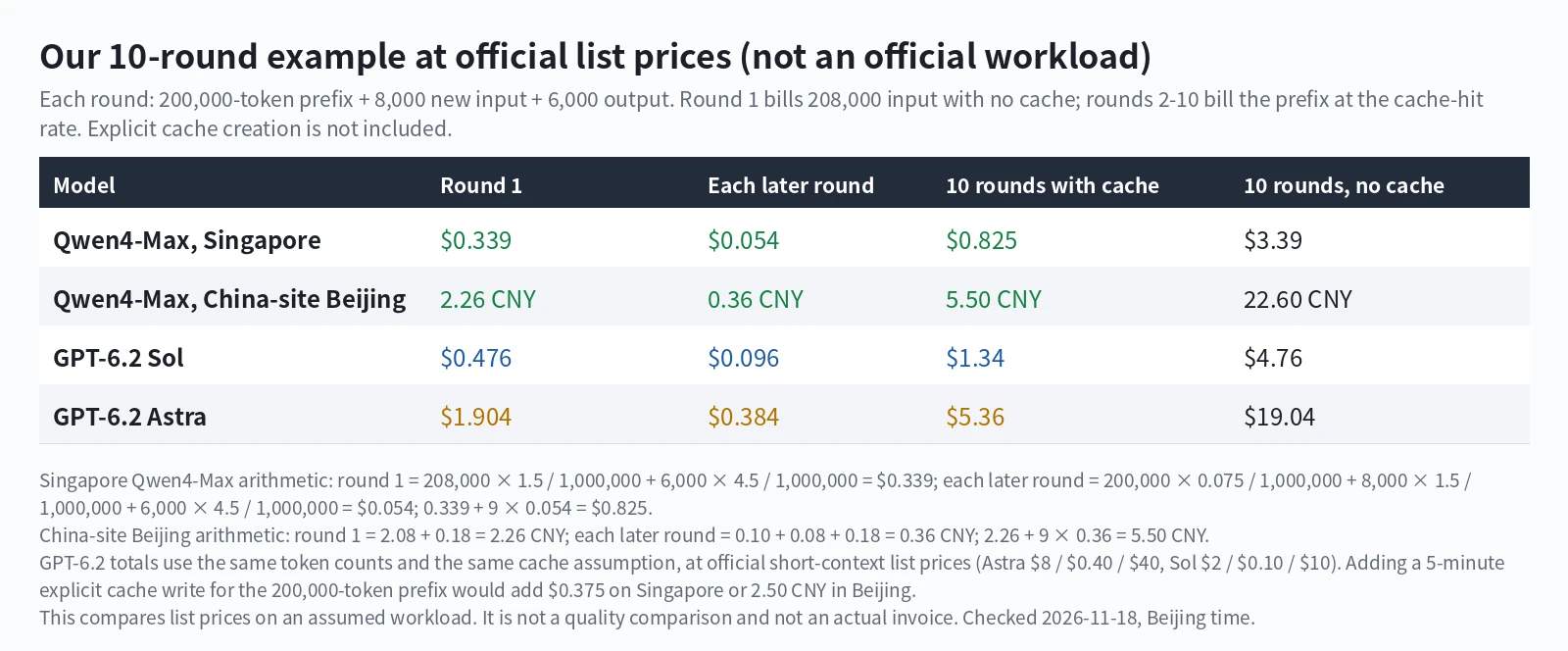
At the Singapore international rates of $1.5 / $0.075 / $4.5: the first round is 208,000 × 1.5 / 1,000,000 + 6,000 × 4.5 / 1,000,000 = $0.339; each of the next 9 rounds is 200,000 × 0.075 / 1,000,000 + 8,000 × 1.5 / 1,000,000 + 6,000 × 4.5 / 1,000,000 = $0.054. The 10-round total is $0.825. The same 10 rounds with no cache at all would be $3.39.
At the China-site Beijing rates of 10 / 0.5 / 30 CNY: the first round is 2.26 CNY, each later round is 0.36 CNY, and the 10-round total is 5.50 CNY; with no cache it would be 22.60 CNY. If the first round also created an explicit 5-minute cache for the 200,000-token prefix, that would add $0.375 on Singapore or 2.50 CNY in Beijing.
With the same token counts and the same uncached-then-cached assumption, the official OpenAI list prices give $1.34 for GPT-6.2 Sol and $5.36 for GPT-6.2 Astra (Sol is $2 input, $0.10 cached input and $10 output per million tokens; Astra is $8 / $0.40 / $40). That compares list prices on my assumed usage. It is not a quality comparison, and it is not an actual invoice.
Qwen also published a separate, self-reported cost figure. In a follow-up post at the same minute, @Alibaba_Qwen wrote that in its Work360 evaluation, average cost per task dropped from $4.43 to $1.67; token usage fell by about 24% (Xhigh) and 35% (High) on Work360, and by about 48% and 49% on Terminal-Bench 4.0. (post) Work360 is Qwen’s own evaluation. Those figures are official claims, not measurements I ran. The main post also says Qwen4-Max “outperforms Qwen3.8-Max with up to ~50% fewer tokens, while average cost per task drops over 60% in our internal evaluation,” which is the same promotional framing as the follow-up. I quote the “implicit caching down by 70%” line as written. The pricing page only marks Qwen3.8-Max as having a context-cache discount; I did not find the previous hit unit price in a table I could use to check that 70% figure, so I am not presenting it as a number I verified.
Free quota, rate limits and how to call it
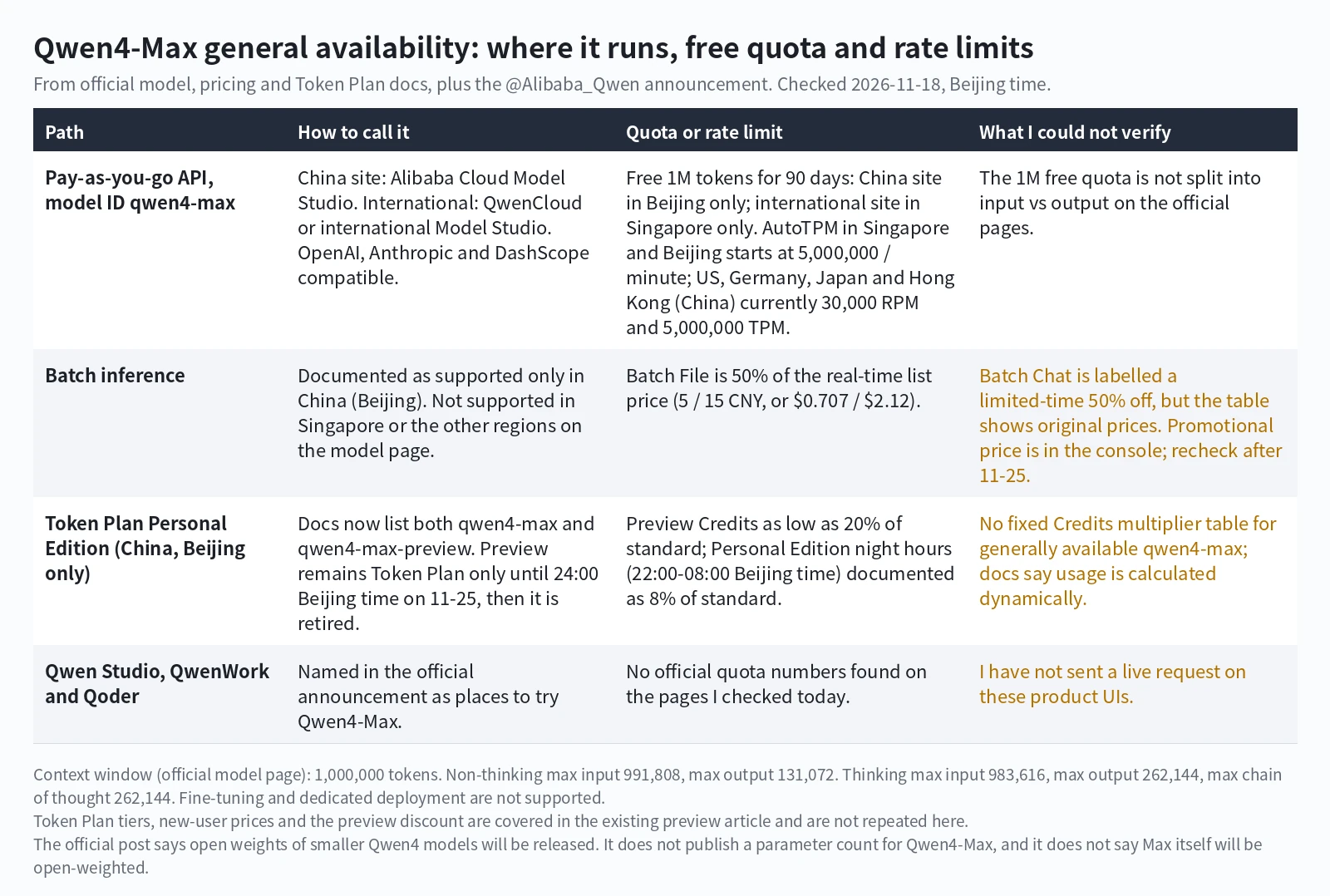
The model ID is qwen4-max. The official model page says it accepts text, image and video input and returns text; thinking is on by default, reasoning_effort defaults to high and can be low, high or xhigh; and it is compatible with OpenAI Chat Completions, Responses, Anthropic Messages and DashScope. Context length is 1,000,000 tokens. In non-thinking mode the maximum input is 991,808 and the maximum output is 131,072; in thinking mode the maximum input is 983,616 and the maximum output is 262,144, with a maximum chain-of-thought length of 262,144. Fine-tuning and dedicated model deployment are not supported. I have not sent a live request myself; follow the model page for the exact call format.
The free quota is valid for 90 days from the date of Model Studio activation, model release or application approval, whichever is later. The China-site page says a free quota of 1 million tokens is available only in China (Beijing). The international page says a free quota of 1 million tokens is available only in Singapore. Neither page splits that 1 million into input and output, and this article does not invent that split.
For rate limits, Singapore and Beijing use monthly-spend AutoTPM tiers of 5,000,000 / 10,000,000 / 20,000,000 tokens per minute. The China-site tiers are up to 100,000 CNY, 100,000 to 1,000,000 CNY, and above 1,000,000 CNY. The international page uses up to $8,000, $8,000 to $140,000, and above $140,000. In the United States, Germany, Japan and Hong Kong (China), the current figures are 30,000 calls per minute and 5,000,000 tokens per minute, including input and output.
There are three practical ways in. First, the pay-as-you-go API: the China site through Alibaba Cloud Model Studio, or internationally through QwenCloud or the international Model Studio, always with model ID qwen4-max. The QwenCloud model page gives this Singapore-compatible example base URL: https://ap-southeast-1.maas.qwencloudapi.com/compatible-mode/v1. Use an environment variable for the key, and do not put the key in a repository. Second, the product surfaces named in the official post: Qwen Studio, QwenWork and Qoder. I did not find official quota numbers for those product UIs. Third, Token Plan. The Personal Edition docs now list both qwen4-max and qwen4-max-preview. The preview model remains Token Plan only. Its preview window runs until 24:00 Beijing time on November 25 (08:00 PT that day), and the model is retired afterwards. During the preview, Credits consumption is as low as 20% of the standard rate; on the Personal Edition, calls between 22:00 and 08:00 Beijing time (06:00 to 16:00 PT) are documented as 8% of the standard rate. I did not find a fixed Credits multiplier table for generally available qwen4-max on Token Plan; the docs say consumption is calculated dynamically from the model, tokens, thinking mode and tool calls. Token Plan Personal Edition is currently available only in the China (Beijing) region. For the tiers, new-user prices and preview discounts, see the preview article. This page does not repeat that breakdown, so the two articles are not competing for the same keywords.
The official post ends with: “The open weights of smaller Qwen4 models will be released. Stay tuned.” It does not publish a parameter count for Qwen4-Max, and it does not say that Max itself will be open-weighted. This article does not fill those in.
Related reading
For where the preview runs, Token Plan tiers and the preview discount, see Qwen4-Max preview. For a wider list-price table, see LLM API pricing comparison. For official GPT-6.2 Astra and Sol rates, see GPT-6.2 Astra price.