
LLM API Cost Calculator: 12 Models, Cache Share, Batch and Two Price Cliffs (Nov 2026)
Enter requests, tokens and cache share and get the monthly bill for 12 models, with batch prices, DeepSeek off-peak and the two thresholds that re-price a whole request.
 bufferAbout the author9 min read

This LLM API cost calculator turns three numbers you already know, requests per month, tokens in and tokens out, into a monthly bill for 12 models from OpenAI, Anthropic, Google and DeepSeek. It also takes the things that move a bill most: how much of your input comes from the cache, whether you can use batch prices, and DeepSeek’s off-peak hours. Every rate comes from the vendor’s own pricing page, which we read on November 10, 2026. We checked the calculator against separate Python code in 36 runs, and the figures below are our arithmetic, not a real invoice.
The calculator
Start with the defaults and change them to your own traffic. The table re-sorts as you type, cheapest first. It shows the cost of one request and of one month, and how many times dearer each model is than the cheapest.
| Model | Provider | Per request | Per month | vs cheapest |
|---|
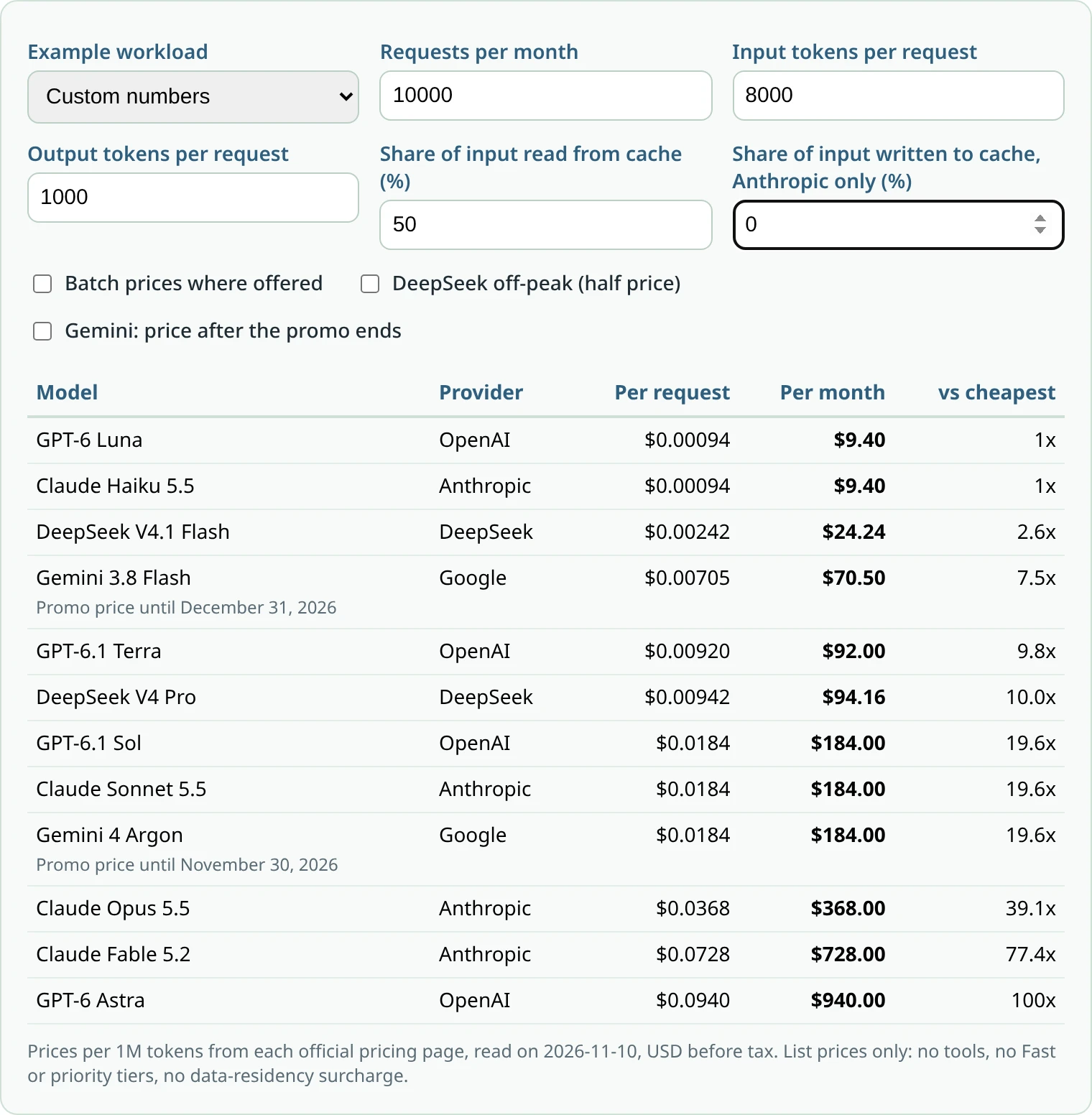
The picture below is the default state. For 10,000 requests a month with 8,000 input tokens and 1,000 output tokens each, half of the input read from the cache, the range runs from $9.40 (GPT-6 Luna and Claude Haiku 5.5) to $940 (GPT-6 Astra). DeepSeek V4.1 Flash comes to $24.24 and DeepSeek V4 Pro to $94.16. GPT-6.1 Sol, Claude Sonnet 5.5 and Gemini 4 Argon land on the same $184, because their list prices match at this mix. That is our arithmetic on list prices.
How it counts
For each model the calculator does this, per request:
- Uncached input tokens times the input price.
- Plus cached input tokens times the cache-read price.
- Plus output tokens times the output price.
- Divide by one million, then multiply by requests per month.
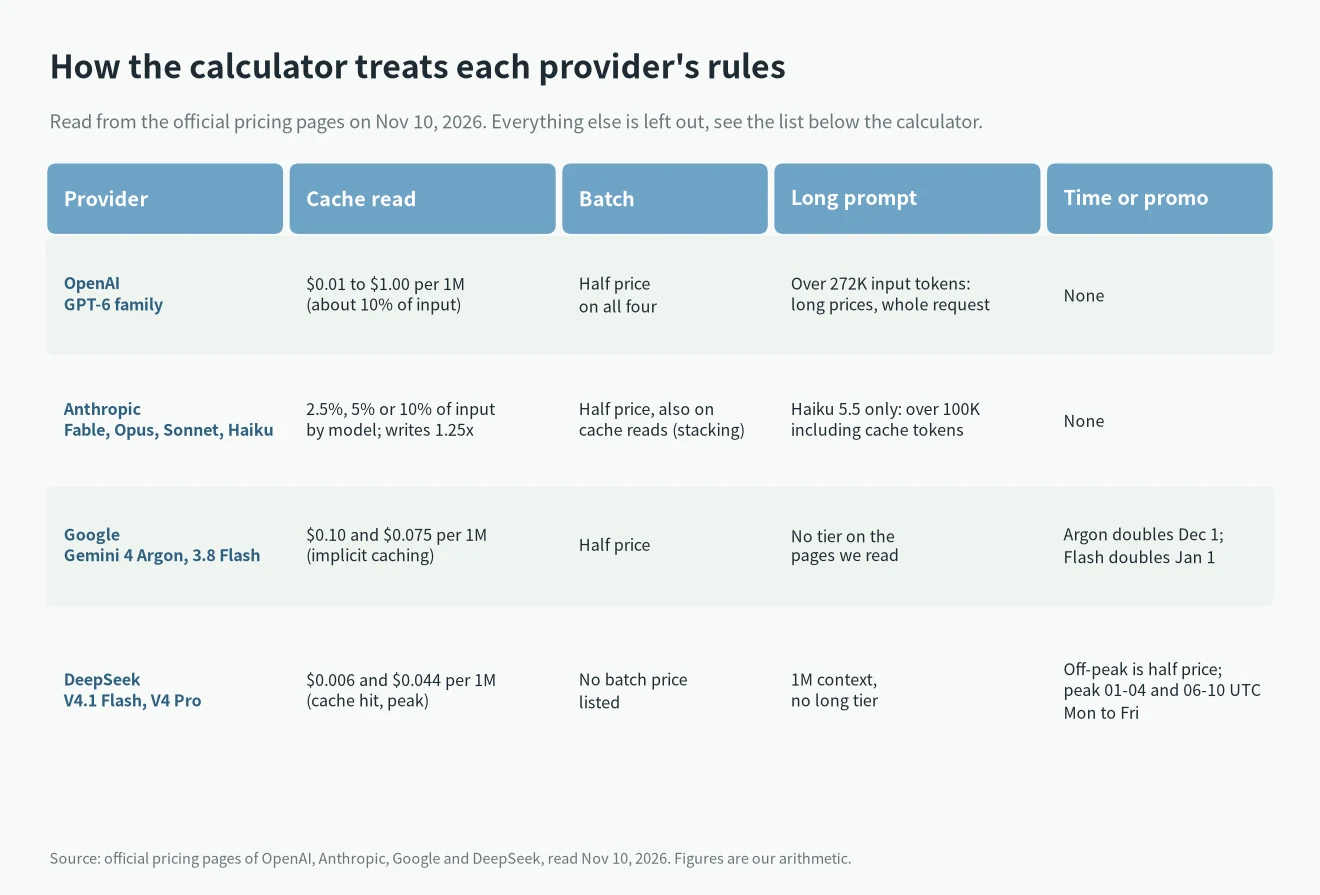
The cache share is the part of your input that the provider reads from its cache. The usage data in an API response reports cached input tokens (each provider’s docs name the field), so you can measure it from your own logs. Leave the 50% default if you do not know yet. Anthropic charges extra to write to the cache, 1.25 times the input price for the 5-minute kind, according to its pricing page. So the Anthropic rows have one more field: the share of input you write to the cache. It stays at 0 until you fill it in. Writing 10% on Claude Fable 5.2 moves the default month from $728 to $744.
Batch halves input and output at OpenAI, Anthropic and Google. The Anthropic page says its multipliers stack, so we halve the cache-read price too. By our math that is the only way to read it, but the page does not print a batch cache price, so treat that part as derived. DeepSeek’s pricing page lists no batch price, so those two rows stay at standard price when you tick batch, and say so.
Five example workloads
The Example workload menu fills the form with five patterns. They are our assumptions about typical traffic, not measurements of anyone’s usage. Each is requests per month, input tokens, output tokens and cached share.
- Chat assistant: 50,000 requests, 1,500 in, 400 out, 30% cached.
- Code completion: 300,000 requests, 800 in, 60 out, 60% cached.
- RAG question answering: 30,000 requests, 6,000 in, 500 out, 20% cached.
- Long document analysis: 2,000 requests, 150,000 in, 3,000 out, 0% cached.
- Coding agent steps: 5,000 requests, 40,000 in, 1,500 out, 85% cached.
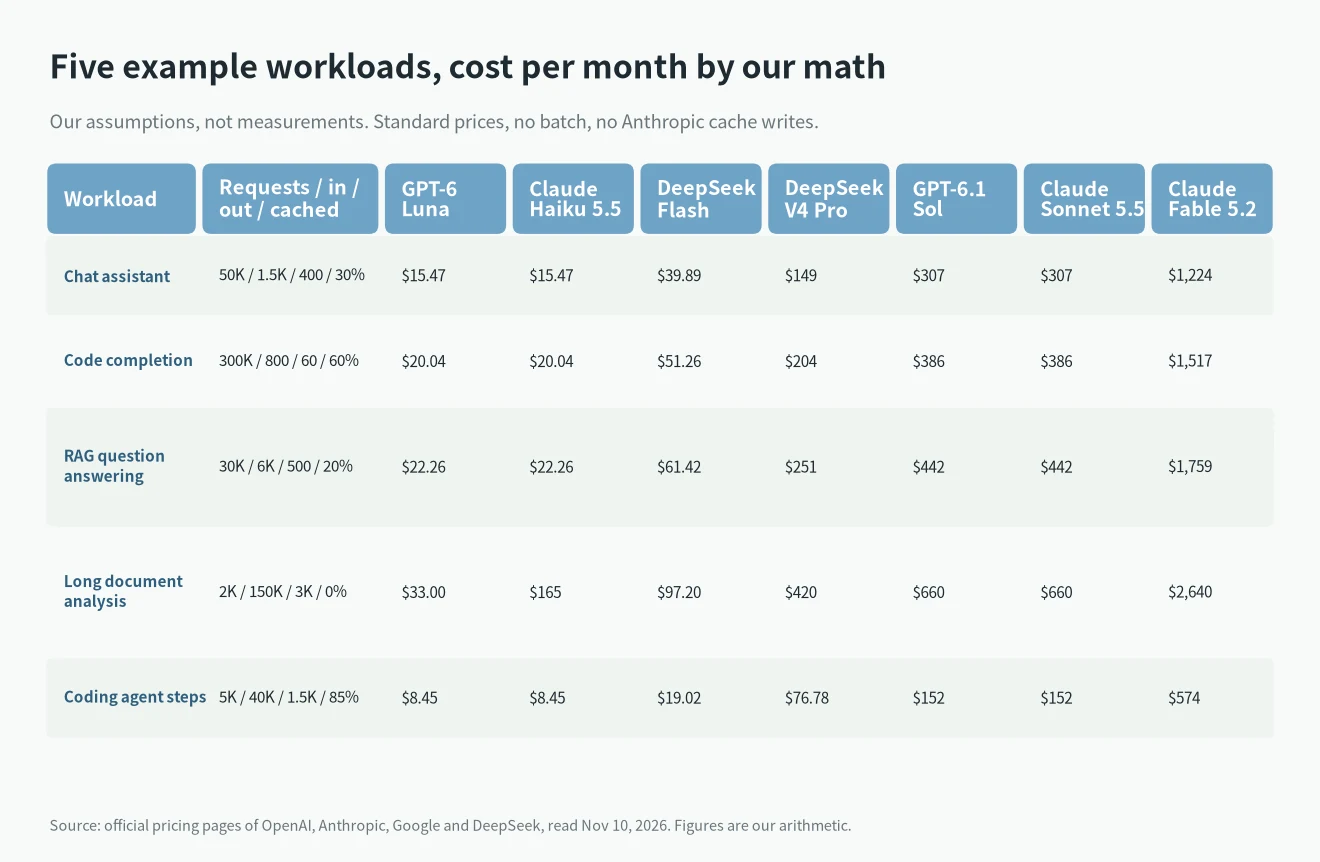
By our math the cheapest row stays between $8.45 and $33 a month across the five, while Claude Fable 5.2 runs from $574 to $2,640 and GPT-6 Astra from $845 to $3,300. The one place the ranking changes is long documents. At 150,000 input tokens, Claude Haiku 5.5 is past its 100K line and costs $165 a month, five times GPT-6 Luna’s $33, where on every other workload the two are level. Those are list prices for the workloads as we assumed them. Your traffic will differ, so use the menu as a starting point and then type your own numbers.
What the cache share does
Caching is the biggest lever in the table, and it is the one most people estimate worst. The next chart holds the traffic fixed and changes only the cached share of the input.
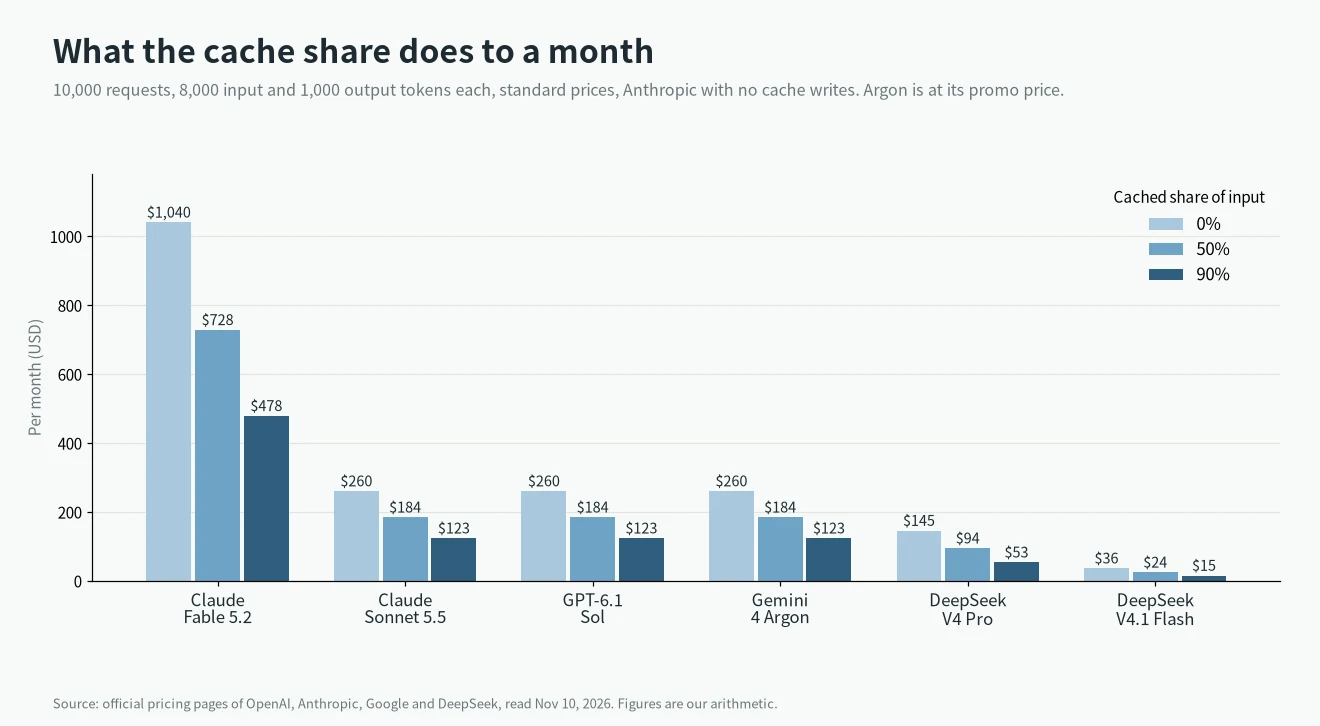
At 0% cached, Claude Fable 5.2 costs $1,040 a month on this traffic. At 50% it is $728 and at 90% it is $478. The $2 and $10 group (Claude Sonnet 5.5, GPT-6.1 Sol, Gemini 4 Argon at its promo price) goes from $260 to $184 to $123. DeepSeek V4 Pro goes from $145 to $94 to $53. A cache share of 90% is not unusual for an agent that resends a long, stable prefix, but it is a measured number, not a promise. If your prompts change early, the share falls.
Two cliffs the list price hides
Two price lists have a threshold that re-prices the whole request, not only the tokens above it.
- OpenAI, above 272K input tokens. Its model page says prompts over 272K input tokens are priced at 2x input and cache rates and 1.5x output for the full request (GPT-6.1 Sol model page). On the pricing page the GPT-6 family has a short-context and a long-context column.
- Claude Haiku 5.5, above 100K prompt tokens. The price is $0.10 in and $0.50 out up to 100,000 tokens and $0.50 and $2.50 above. Anthropic says the prompt length counts all input tokens including cache reads and writes, and that a request over the line pays the higher price even when part of it is a cache hit.
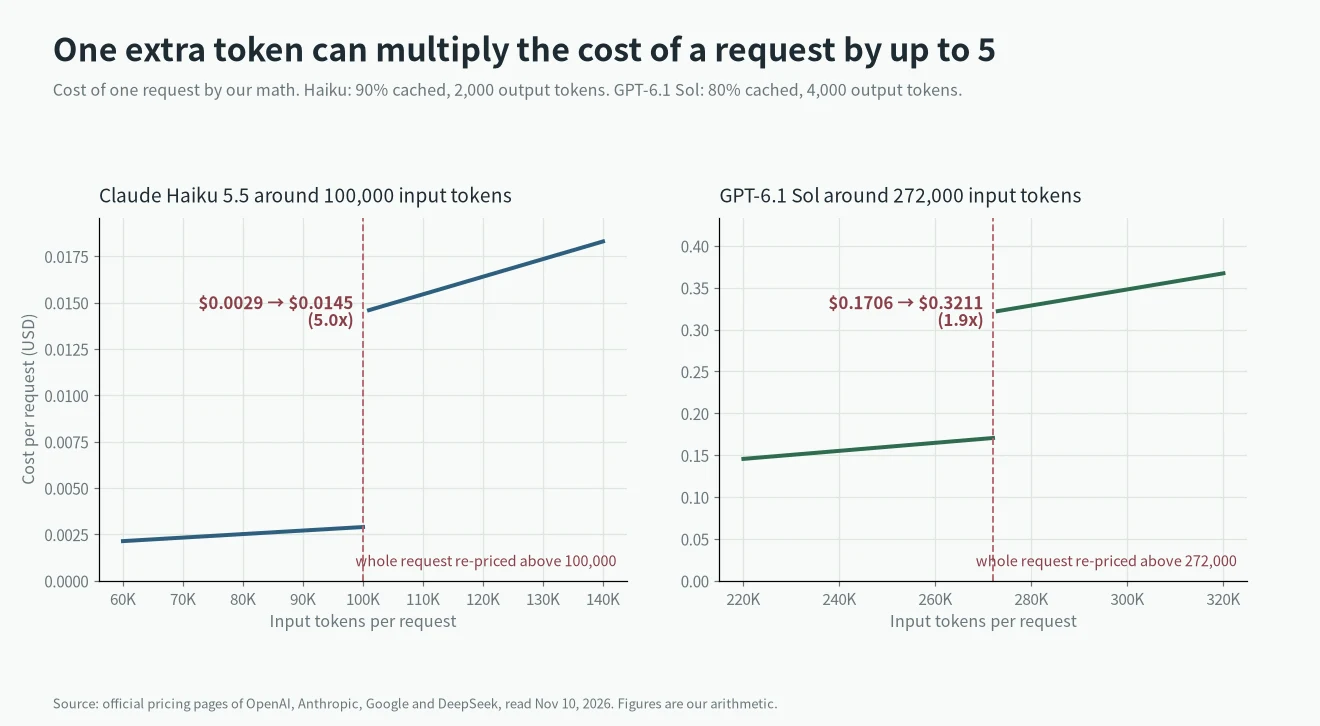
By our math, one Haiku 5.5 request with 90% of its input cached and 2,000 output tokens costs $0.0029 at 100,000 input tokens and $0.0145 at 100,001, five times as much for one more token. A GPT-6.1 Sol request with 80% cached and 4,000 output tokens goes from $0.1706 to $0.3211 across 272,000. The calculator applies both rules and tells you in the Note line when it did. If your prompts sit near 100K or 272K, test a trimmed version before you pick a model.
Prices that change on a date
Two of the 12 rows are promotional on Google’s page, and the calculator marks them.
- Gemini 4 Argon: $2 input and $10 output through November 30, 2026, then $4 and $20 from December 1. In the default month that is $184 now and $368 after.
- Gemini 3.8 Flash: $0.75 and $3.75 through December 31, 2026, then $1.50 and $7.50 from January 1. The default month goes from $70.50 to $141.
Tick “Gemini: price after the promo ends” to see the later numbers. Both come from Google’s Gemini API pricing page. When we checked again on November 11, the page also listed Gemini 4 Carbon, described as Google’s most capable reasoning model, at the same prices and promo dates as Argon. The calculator has no Carbon row, so read the Argon row as the price for either.
DeepSeek runs the other way. Its pricing page says off-peak rates are half of peak rates, and peak is 01:00 to 04:00 and 06:00 to 10:00 UTC, Monday to Friday, excluding Chinese public holidays. Everything else, including weekends, is off-peak. Tick the off-peak box and V4 Pro drops from $94.16 to $47.08 and V4.1 Flash from $24.24 to $12.12 on the default traffic. That only helps if your jobs can wait for the cheap window.
What the calculator leaves out
- Tools. Web search and similar tools bill per call, and the calculator does not count them. The pricing hub lists them next to each provider: LLM API pricing comparison.
- Fast, priority and Flex tiers, and data-residency surcharges. The calculator uses standard and batch list prices only. Anthropic’s 1.1x for US-only inference is not in it.
- Different token counts. Anthropic says Claude 4.7 and later models use a tokenizer that produces about 30% more tokens for the same text. Enter token counts from each vendor’s own counter, or the Claude rows will look cheaper than they are.
- Thinking tokens. Google’s page says output price includes thinking tokens. Check how each provider counts reasoning tokens before you trust your output estimate.
- Cache write and storage fees other than Anthropic’s write multiplier, such as Gemini 3.8 Flash’s per-hour storage price.
- Other providers. xAI, Moonshot, Mistral and others are not in the table. The hub above covers some of them.
- Subscriptions. This is pay-per-token only. For plans, use the AI subscription calculator.
What we tested and what comes from the pages
- Tested: the calculator code. We drove the page in a browser with 12 input sets (default, batch, a 300K prompt, a Haiku prompt over 100K with batch and cache writes, off-peak with post-promo prices, a 10% cache-write case, zero requests, and the five example workloads) in all three languages, 36 runs, and compared every model’s per-request and monthly figure with independent Python code. All 36 matched. Rounding is half-up.
- From the pages, not tested: every price, threshold and date. We have no API keys on the box and did not run a metered bill.
- Derived, not printed: Anthropic’s batch cache-read price (half of the cache-read price, from the stacking sentence) and every cost shown in this article.
- Sources, all read on November 10, 2026 and checked again on November 11: OpenAI API pricing, Anthropic pricing, Gemini API pricing, DeepSeek pricing. Prices change, so read the page before you commit a budget.
For what each provider gives away before you pay, see is the Claude API free and Gemini API free tier limits. To plug DeepSeek into a coding agent, see DeepSeek API for Claude Code. For the OpenAI side with a worked task, see Codex pricing.
FAQ
Which LLM API is cheapest in this calculator?
On the default traffic, GPT-6 Luna and Claude Haiku 5.5 tie at $9.40 a month, then DeepSeek V4.1 Flash at $24.24. The order changes with your numbers: with 300K-token prompts and 80% cached, Haiku 5.5 moves above Luna and DeepSeek Flash because of its 100K threshold.
How do I find my cache share?
Look at the usage data in your API responses, which reports cached input tokens (check the field name in each provider’s docs). Add them up over a day and divide by total input tokens. Until you have that, 50% is a placeholder.
Does this include ChatGPT Plus or Claude Pro?
No. Subscriptions are flat prices with their own limits. The API figures here do not tell you what a plan includes.
Is there a batch price for DeepSeek?
Not on the pricing page we read. The calculator keeps DeepSeek at standard price when you tick batch. Its off-peak half price is a separate switch.
Why did my Claude Haiku 5.5 cost jump?
Probably the 100K threshold. When the prompt, counting cache tokens, passes 100,000 tokens, the whole request bills at $0.50 input and $2.50 output instead of $0.10 and $0.50.