
Artificial Analysis Intelligence Index v5 Explained: 9 Tests, 4 Equal Categories, and What the Score Really Means (2026)
The Artificial Analysis Intelligence Index is one score built from nine independent tests. Version 5.0, live since October 2026, splits them into Knowledge Work, Coding, Science and General at 25% each. Claude Opus 5.5 (Max) leads with 58. Here is what goes into it, what changed in v5, and how to use it without being fooled. Checked October 28, 2026.
 bufferAbout the author4 min read

Short answer: the Artificial Analysis Intelligence Index is one score that Artificial Analysis, an independent benchmarking firm, builds by running nine hard evaluations itself and weighting them. Version 5.0 has been live since October 2026. It splits the tests into four categories, Knowledge Work, Coding, Science and General, at 25% each. On October 28, 2026 the official page shows Claude Opus 5.5 (Max) on top with 58, followed by Claude Opus 5.5 (Xhigh) and GPT-6 Astra (Max) at 57. Every number here comes from the methodology page and the Intelligence Index v5.0 page.
What the Artificial Analysis Intelligence Index is
Artificial Analysis tests models and APIs. It runs a set of hard evaluations on every model under the same conditions, then takes a weighted average. That average is the Artificial Analysis Intelligence Index. The company calls it a helpful synthesis of overall model intelligence and says plainly that, like any metric, it has limits and may not fit every use case.
Two things to keep in mind. All evaluations are run independently by Artificial Analysis, not reported by the labs. And it is mainly an English, text-only suite. Image input, speech and multilingual skills are measured separately and do not count toward the score.
The nine evaluations and their weights
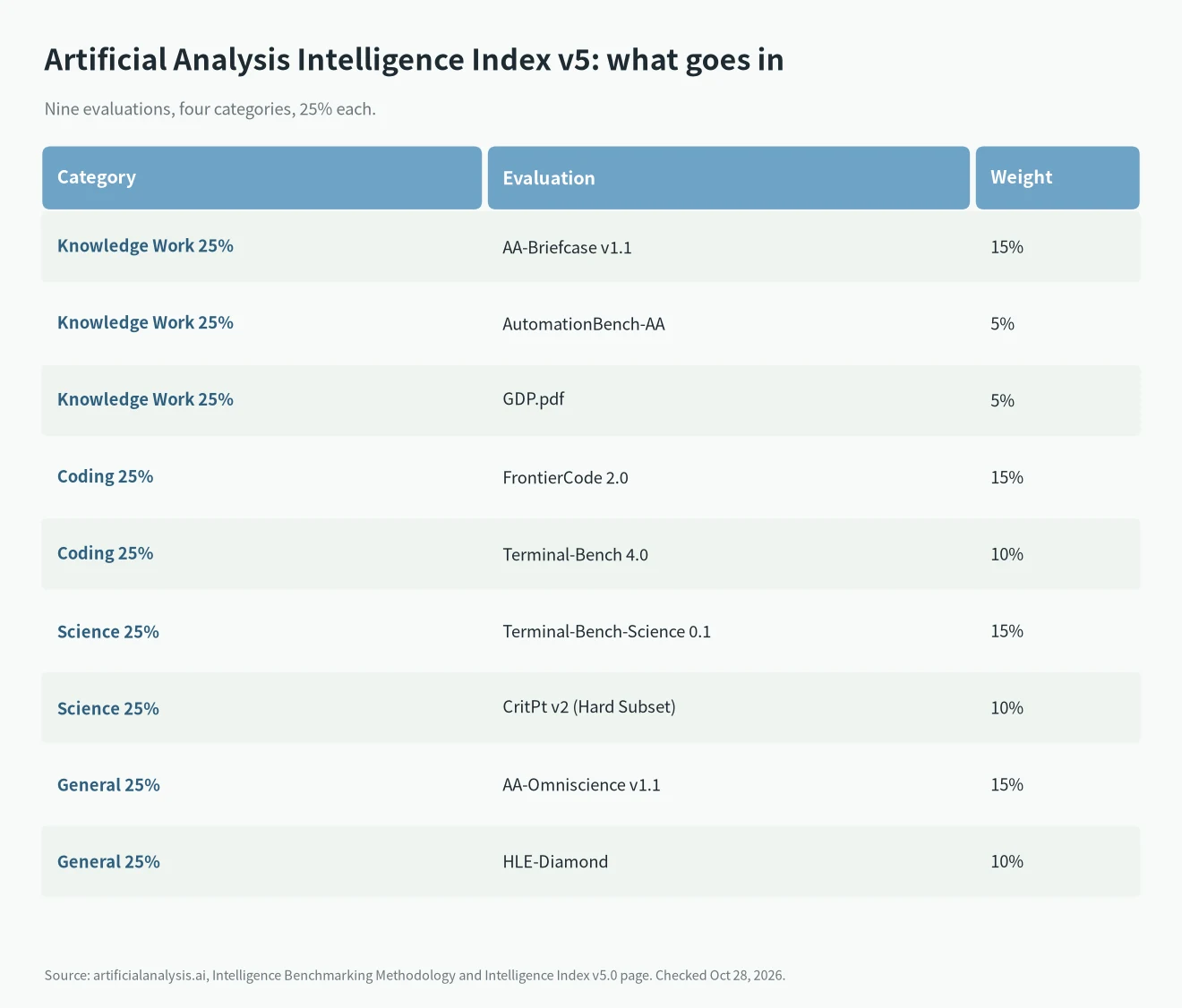
| Category | Evaluation | Weight | What it tests |
|---|---|---|---|
| Knowledge Work | AA-Briefcase v1.1 | 15% | 91 agentic tasks with file outputs |
| Knowledge Work | AutomationBench-AA | 5% | 657 SaaS workflow tasks over REST APIs |
| Knowledge Work | GDP.pdf | 5% | 100 tasks answered from long PDFs |
| Coding | FrontierCode 2.0 | 15% | 132 code changes to open-source repos |
| Coding | Terminal-Bench 4.0 | 10% | 66 terminal tasks |
| Science | Terminal-Bench-Science 0.1 | 15% | 70 terminal tasks across 5 science domains |
| Science | CritPt v2 (Hard Subset) | 10% | 40 hard physics reasoning problems |
| General | AA-Omniscience v1.1 | 15% | 3,000 questions: accuracy 10%, non-hallucination 5% |
| General | HLE-Diamond | 10% | 1,000 questions, half reasoning, half knowledge |
The part I like most is the non-hallucination component. AA-Omniscience gives 5% to one minus the hallucination rate, so a model that admits it doesn’t know scores better than one that bluffs.
What changed in v5
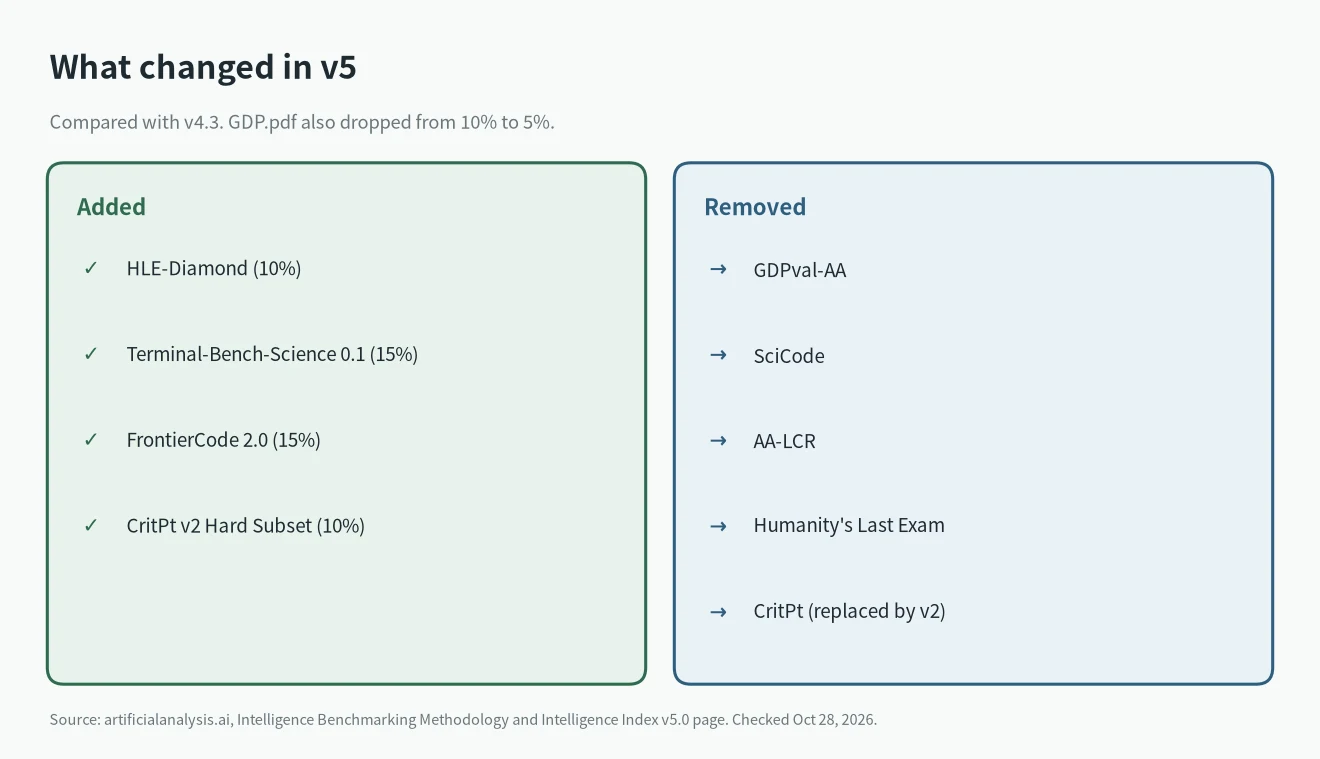
Per the official version history, v5.0 added HLE-Diamond, Terminal-Bench-Science and FrontierCode 2.0. GDP.pdf dropped from 10% to 5%. CritPt became CritPt v2 (Hard Subset) at the same 10%. GDPval-AA, SciCode, AA-LCR and the full Humanity’s Last Exam left the index. The Agents category was renamed Knowledge Work, and Scientific Reasoning became Science.
The practical upshot: v5 scores come from a different test set than v4 scores, so don’t compare them directly. If a model seems to have dropped from the 70s to the 50s, the version probably changed, not the model. That’s my reading; Artificial Analysis doesn’t publish a conversion.
Who leads right now
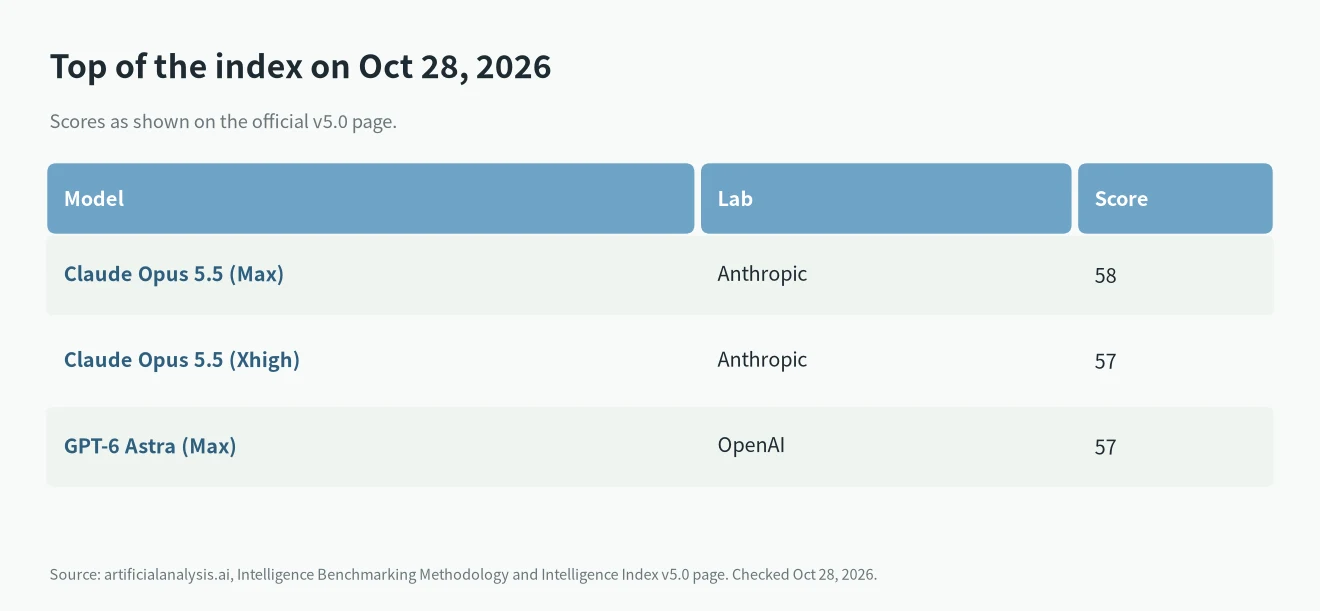
On October 28, 2026 the official v5.0 page says Claude Opus 5.5 (Max) scores highest at 58, with Claude Opus 5.5 (Xhigh) and GPT-6 Astra (Max) at 57. The charts show 28 of 77 models.
In the page data, the best open-weights model is DeepSeek V4.1 Flash at about 32.5, and Kimi K3.1 Pro sits around 46. For a closer look at the top two labs, see Opus 5.5 vs GPT-6.1 Sol. For Kimi pricing, see Kimi K3.1 Pro API pricing.
How the tests are run
- Same conditions for every model: same prompts and grading. Temperature is 0 for non-reasoning models and 0.6 for reasoning models, unless the lab recommends otherwise.
- Zero-shot: clear instructions, no examples.
- Mostly pass@1, averaged across repeats where an evaluation is run more than once.
- Failed API calls are retried up to 30 times; results hit by persistent failures are not published.
How to read the score without being fooled
Treat the Artificial Analysis Intelligence Index as a first filter, not a verdict.
- A 1–2 point gap is basically a tie. You probably won’t feel 58 vs 57 on your own work.
- One model often appears several times by reasoning effort, such as Max and Xhigh. Check which setting you are comparing; higher settings usually cost more and run slower.
- The same page shows cost per task, output tokens and time per task. When scores are close, a several-fold cost gap matters more.
- If you want to run models locally, the open-weights rows are the useful ones. Pair them with my best local LLM guide.
Artificial Analysis Intelligence Index FAQ
What is the maximum score?
Artificial Analysis doesn’t describe a ceiling. It is a weighted average of evaluation scores, and today’s best is 58, so even top models are far from acing it.
How often does it change?
New models are added after testing. The evaluation mix changes by version: it went from v4.0 to v5.0 within 2026. The version history sits at the bottom of the methodology page.
How is it different from vote-based leaderboards?
It scores fixed tasks that Artificial Analysis runs itself. There’s no user voting, so it measures something different. Use both.