
Opus 5.5 vs GPT-6.1 Sol: Opus Wins by 3 Points but Costs 8x More per Task (Honest 2026 Test Data)
Opus 5.5 vs GPT-6.1 Sol: Claude Opus 5.5 scores 58 and GPT-6.1 Sol 55 on the Artificial Analysis Intelligence Index v5, but Opus costs $10.04 per task against $1.27. Use Sol by default and Opus for the hardest jobs. Checked October 28, 2026.
 bufferAbout the author4 min read

Short answer: in the Opus 5.5 vs GPT-6.1 Sol matchup, Claude Opus 5.5 scores 58 on the Artificial Analysis Intelligence Index v5 and GPT-6.1 Sol scores 55, so Opus is slightly smarter. But on the same task set, Opus costs $10.04 per task and Sol costs $1.27, almost 8x less. My advice: use Sol for everyday coding and most API work, and save Opus for the hardest, longest jobs. Both were tested at max reasoning effort; I checked the numbers on October 28, 2026. For every provider’s prices in one place, see my LLM API pricing comparison.
Benchmarks: Opus wins 7, Sol wins 2
Artificial Analysis is an independent benchmarking firm, so these are not vendor-reported numbers. Its Intelligence Index v5 combines 9 evaluations covering knowledge work, coding, terminal use, scientific reasoning and hallucination. The full breakdown is on the Artificial Analysis comparison page.
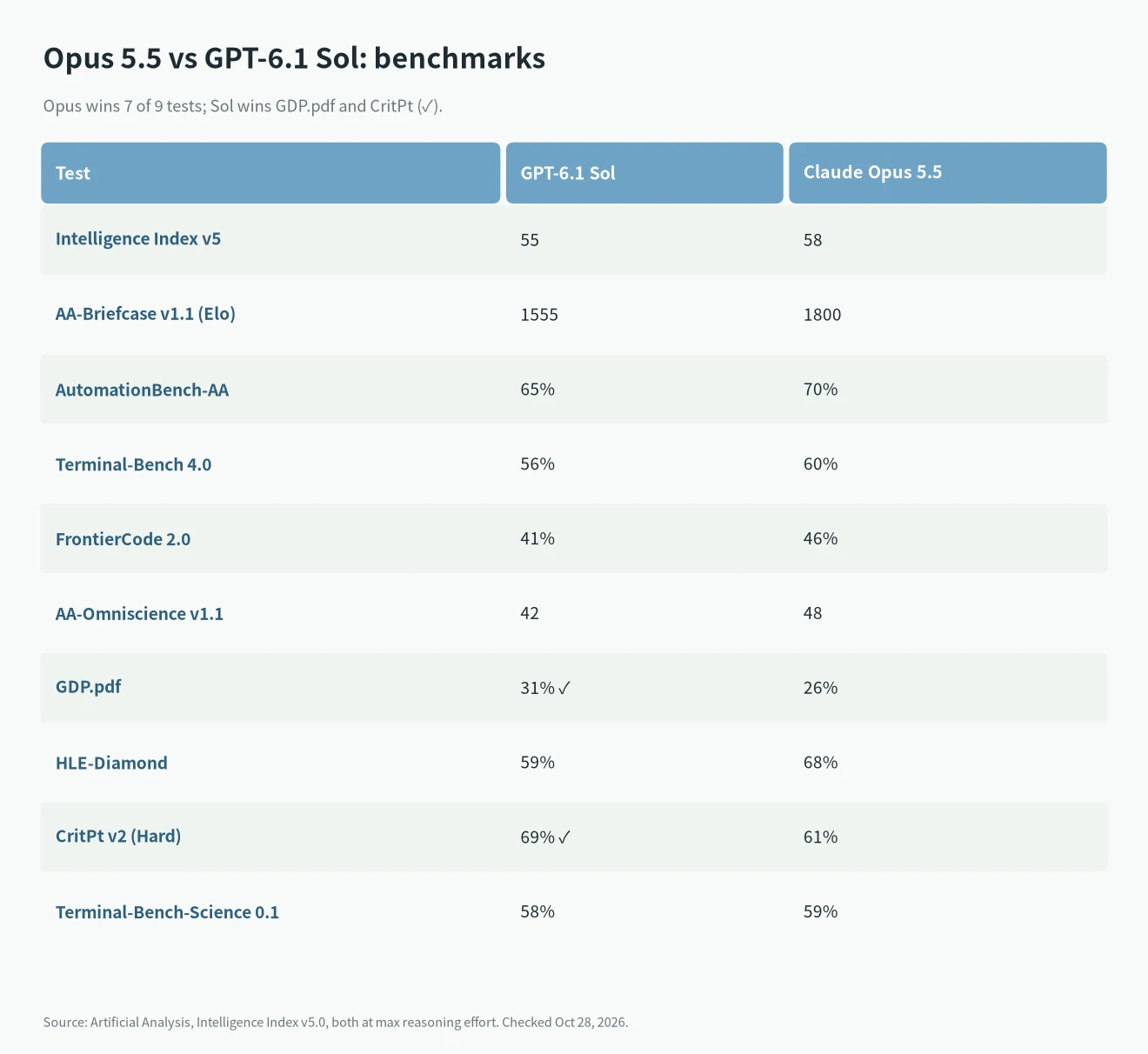
Opus 5.5 wins 7 of the 9. The biggest gaps are HLE-Diamond (68% vs 59%) and AA-Omniscience (48 vs 42). Omniscience punishes wrong answers more than refusals, so a higher score means fewer made-up answers. On the coding tests, Terminal-Bench 4.0 and FrontierCode 2.0, Opus leads by 4 to 5 points each.
Sol’s two wins are not small. It scores 69% vs 61% on CritPt v2, a physics research test, and 31% vs 26% on GDP.pdf, a document reasoning test. Terminal-Bench-Science is a 1-point gap, which I’d call a tie.
So in Opus 5.5 vs GPT-6.1 Sol, 58 vs 55 is a real gap, but not a “you must pay for Opus” gap.
Price: 2x per token, 8x per task
Official list prices per million tokens: Claude Opus 5.5 is $4 input, $20 output and $0.20 cache hits (Anthropic pricing). GPT-6.1 Sol is $2 input, $10 output and $0.10 cached input (OpenAI model page). Per token, Opus costs exactly twice as much.
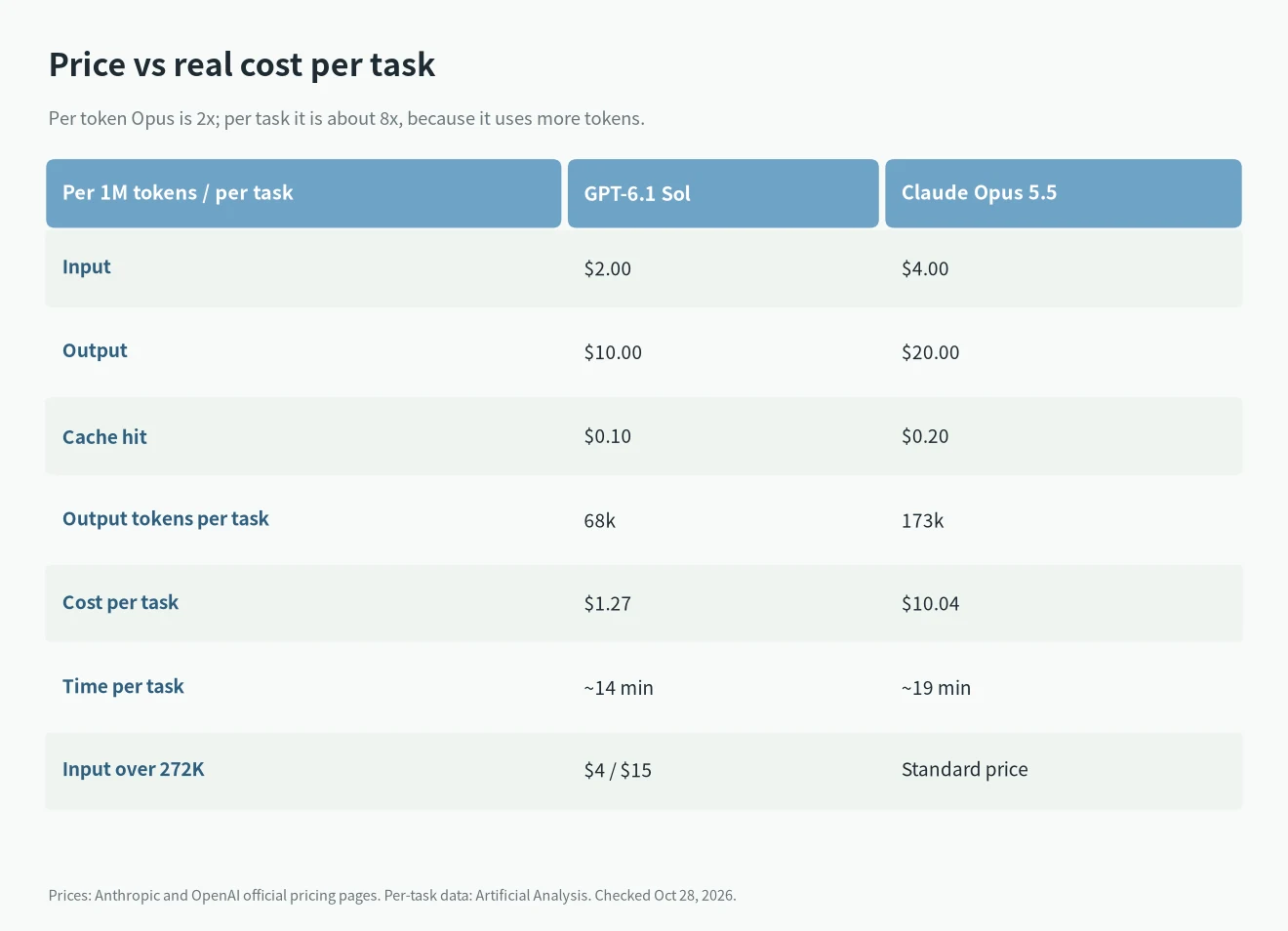
In Opus 5.5 vs GPT-6.1 Sol, the real cost gap comes from token use. Artificial Analysis measured an average of 173k output tokens per task for Opus, 120k of them reasoning. Sol used 68k, 49k of them reasoning. Twice the price times about 2.5x the tokens gives $10.04 vs $1.27 per task. Running the whole index cost $8,910 on Opus and $1,124 on Sol.
One catch: when a GPT-6.1 Sol prompt goes over 272K input tokens, the whole request is billed at 2x input and 1.5x output, so $4 and $15. Opus 5.5 bills its full 1M context at standard rates. If you feed whole codebases or very long documents, the gap shrinks. Batch cuts both by 50%.
Speed and context: Opus types faster, Sol finishes first
Opus 5.5 streams about 98 tokens per second against Sol’s 81. But Opus thinks longer: at max effort its first token arrives after about 700 seconds on average, versus 278 for Sol. Per task, Sol finishes in about 14 minutes and Opus in about 19.
Context is close. Opus 5.5 has 1M tokens and Sol has 1.05M. Both cap output at 128K tokens.
Opus 5.5 vs GPT-6.1 Sol: which one to use
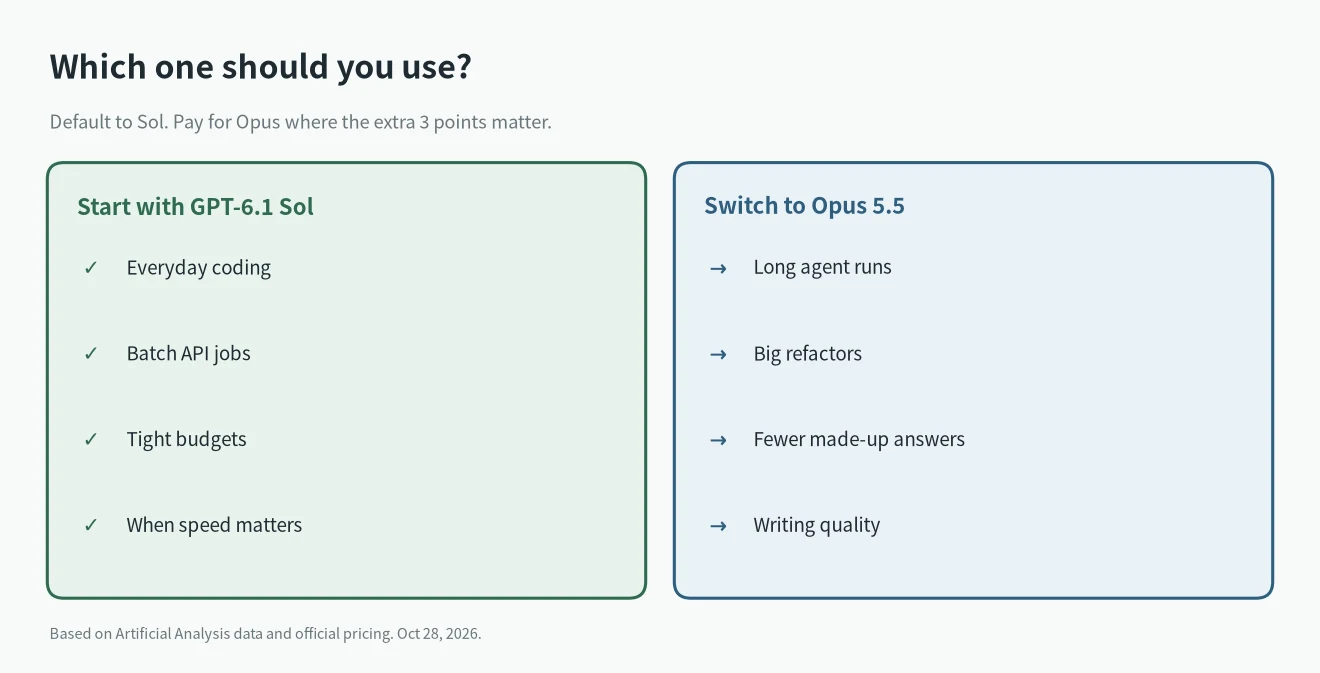
- Start with Sol for everyday coding, batch API jobs, tight budgets and anything where speed matters.
- Switch to Opus for long autonomous agent runs, big refactors, and work where accuracy and writing quality matter most.
- Test both if your work looks like CritPt or GDP.pdf, meaning research reasoning or document analysis. Sol may win there.
The simplest Opus 5.5 vs GPT-6.1 Sol test: run 10 of your own real tasks on each, then compare the results and the bill.
FAQ
I’m on a subscription. Which should I pick?
Claude Code on Claude Pro and Max uses Opus 5.5 by default. Codex recommends GPT-6.1 Sol for most coding. Subscriptions charge by usage limits, not tokens; I compare the limits and prices in Claude Code vs Codex.
These scores differ from the launch posts. Which should I trust?
Launch benchmarks are run by each vendor with their own settings. Artificial Analysis runs every model the same way, so it is better for side-by-side comparison. It is still only 9 tests, so try your own tasks too.
Claude Sonnet 5.5 costs the same as Sol. Should I consider it?
Yes. Sonnet 5.5 is also $2 input and $10 output. If you want to stay with Claude but Opus is too pricey, try Sonnet 5.5 first and compare it with Sol.
Related reading
For six providers’ prices in one table, see the LLM API pricing comparison. For what higher thinking effort costs in Claude Code, see Claude Code ultrathink.
Artificial Analysis updates its scores as tests change. I’ll update this page when they do.