
Anthropic IPO: How to Buy ANT Stock and 5 Essential Things to Watch
The Anthropic IPO S-1 is out. What it confirms, where the $80.7 billion loss really comes from, why Class A shares carry almost no vote, how US IPO shares reach regular investors, and what is still to be updated. Not investment advice.
 bufferAbout the author8 min read

This is not investment advice.
Anthropic filed its S-1 with the SEC on October 26, so the Anthropic IPO is now officially on the calendar. The first number I saw was an $80.7 billion net loss for the first half of 2026, and I honestly thought something had gone badly wrong. After reading the filing, I changed my mind. Most of that loss is an accounting charge that comes from the company’s valuation going up. The question I’d actually ask is a different one. The Class A shares you can buy come with almost no say in how the company is run. Below I only use numbers I could check in the S-1, and I flag media reports separately.
Anthropic IPO: what the S-1 already confirms
Let’s start with what’s settled. The company is Anthropic, PBC, a Delaware public benefit corporation.
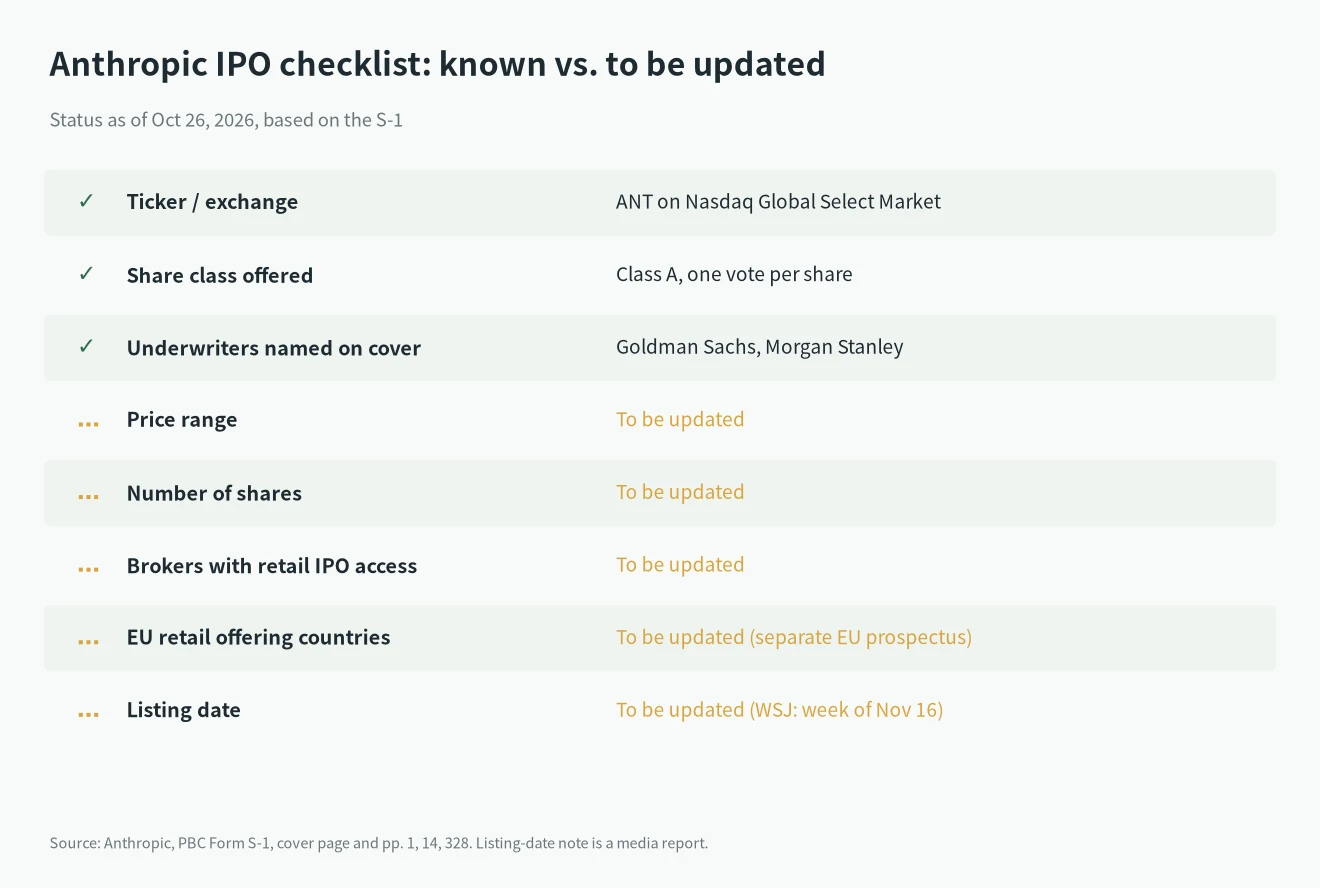
It is selling Class A common stock and has applied to list on the Nasdaq Global Select Market under the ticker ANT.
The cover page names Goldman Sachs & Co. LLC and Morgan Stanley & Co. LLC as underwriters.
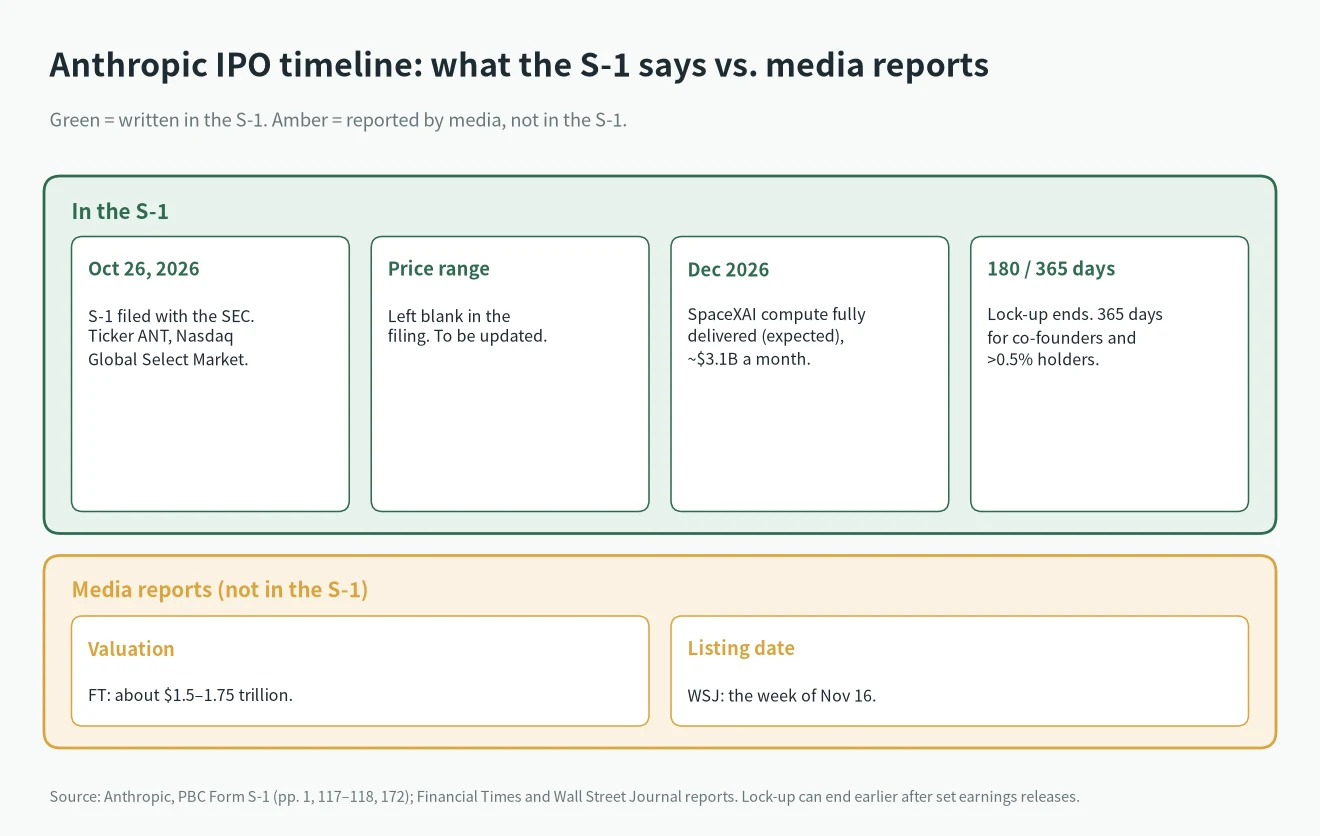
The price range and the number of shares are still blank in the filing, so both are to be updated.
Revenue has grown very fast. It was $16.29 billion in the first half of 2026, up from $1.16 billion a year earlier. The S-1 puts that growth at 1,300%.
An $80.7 billion loss sounds scary, so where did it come from?
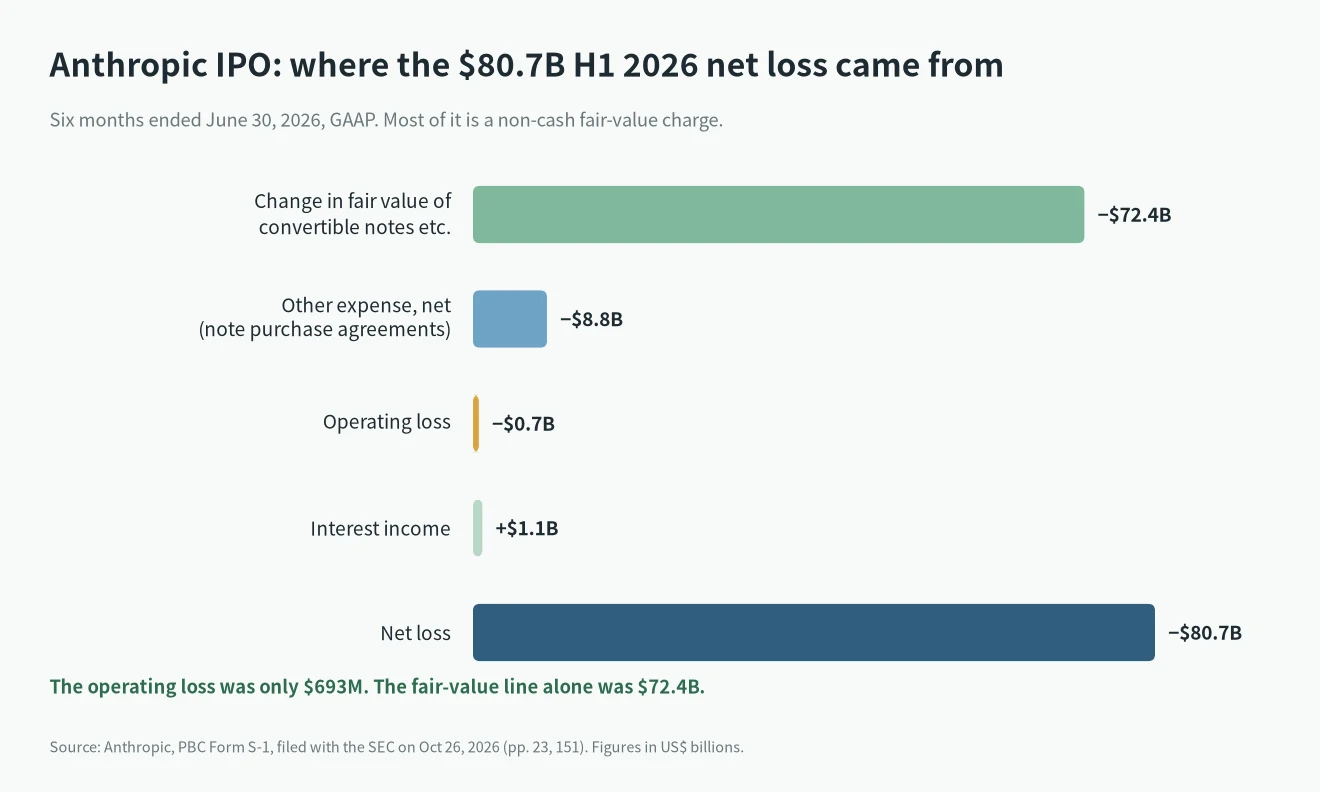
That number scared me too. Page 23 of the S-1 shows a net loss of $80,748 million for the six months ended June 30, 2026.
When you break it down, the picture changes. $72,388 million of it is the “change in fair value of convertible notes, derivative liabilities, and SAFEs.” Page 151 says this was mainly driven by a higher fair value of the company’s convertible notes, because its enterprise valuation went up from 2025 to 2026.
The company became worth more, so the notes it owes investors were revalued higher, and that shows up as a loss. No cash left the company for this line.
Another $8,757 million sits in “other income (expense), net.” The S-1 says this mostly comes from recognizing assets and liabilities under note purchase agreements at fair value, and from later changes in that value.
The operating loss, which reflects the actual business, was only $693 million. The company also earned $1,111 million in interest income and booked $21 million in income tax.
Add those up and you get exactly $80,748 million. So it isn’t “$72.4 billion plus $0.7 billion.” The $8.8 billion of note-agreement items and the $1.1 billion of interest income are part of the math too.
You may have seen headlines saying Anthropic is already making an operating profit. I wouldn’t repeat that. For the first half of 2026 as a whole, the S-1 still shows an operating loss of $693 million.
The bigger issue: your shares carry almost no voting power
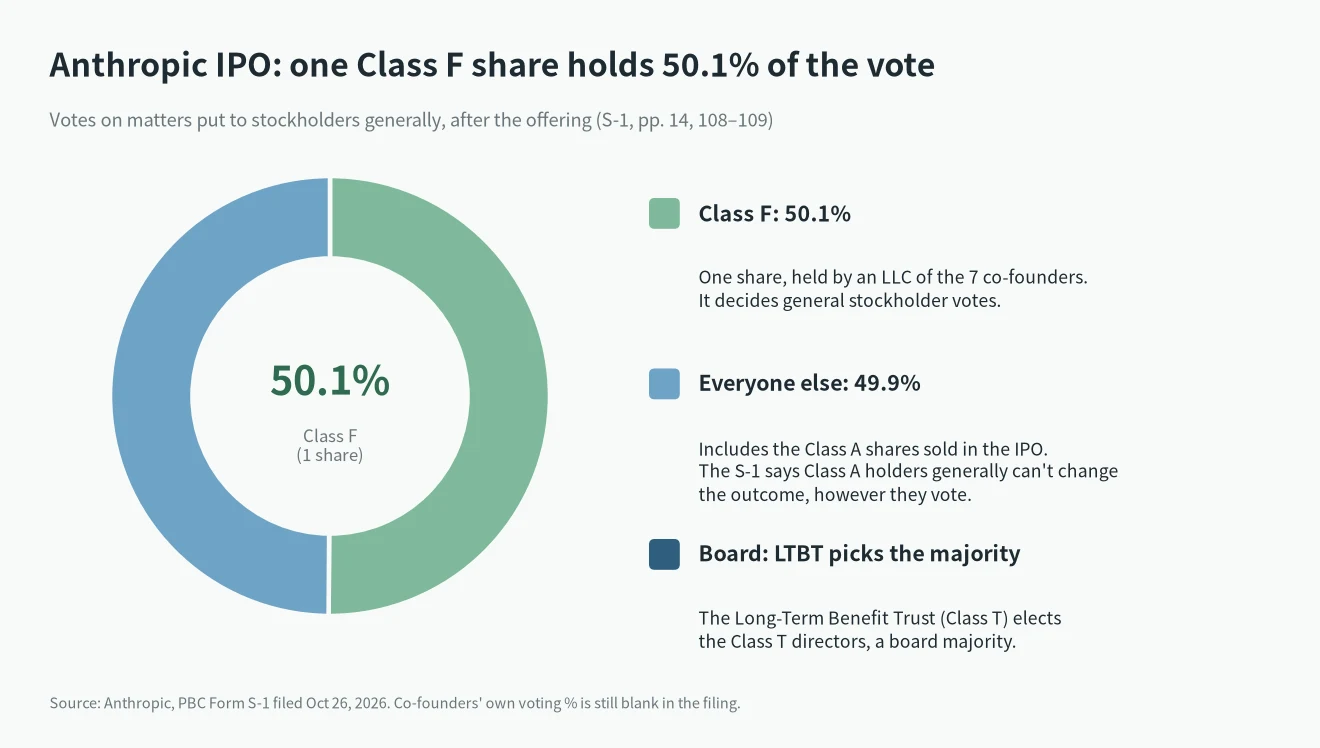
This is the part of the filing I keep coming back to. Right before the IPO, Anthropic will issue a single share of Class F stock to an LLC owned by its seven co-founders, which the S-1 calls the Founder LLC.
That one share carries 50.1% of the total voting power on matters put to stockholders generally. That includes electing every director except the Class T directors.
Then there’s the Long-Term Benefit Trust, or LTBT. It holds Class T stock and elects the Class T directors, and those directors make up a majority of the board.
What you can buy in the Anthropic IPO is Class A stock, with one vote per share. The risk factors on pages 108–109 say it directly. Class A holders “generally will not be able to affect the outcome of any matter submitted to a vote of our stockholders or the election of our directors, regardless of how they vote.”
There is one exception. If a majority of the continuing co-founders can’t agree on how to vote the Class F share, it generally votes in proportion to the Class A votes cast.
The S-1 also says that after the Anthropic IPO the company will be a “controlled company” under Nasdaq rules, which lets it skip some governance requirements. The co-founders’ own voting percentage is still blank in the filing.
If you care about shareholders being able to check management, think this through before you decide anything.
A big cost to keep an eye on: the SpaceXAI compute deals
Page 172 covers something else I’d watch. Between May and October 2026, Anthropic signed and amended several compute agreements with SpaceXAI, a SpaceX subsidiary, for capacity powered by NVIDIA GPUs.
Under these deals, Anthropic agreed to spend up to $120.5 billion over terms that run into 2029.
Once all the capacity is delivered, that works out to about $3.1 billion a month. The company expects full delivery in December 2026.
The initial non-cancelable periods end in January 2027 and March 2027. After that, either side can cancel with 90 days’ written notice.
That’s a lot of money, so compute costs are the first thing I’ll check in future quarterly reports.
How to buy Anthropic stock as a regular investor
To be clear, there’s no public list yet of which brokers will offer ANT shares at the IPO price in the Anthropic IPO. That part is to be updated.
In general, there are two ways US IPO shares reach individual investors.
- The first is an IPO allocation. Some brokers run IPO access programs where you can put in an order before the stock starts trading. For a popular deal, allocations are often small, and there’s no guarantee you’ll get any shares.
- The second is buying after the listing. Once ANT starts trading, you can buy it like any other US stock. Prices can swing a lot on a hot stock’s first days. A limit order lets you set the most you’re willing to pay.
The S-1 also says part of the offering will go to retail investors in certain European Economic Area countries through a separate EU prospectus. It doesn’t name the countries yet, so that’s to be updated too.
Be careful with anyone selling “pre-IPO shares” or similar deals through unofficial channels. If you can’t verify where the shares come from, the risk is very high.
What’s a media report, not a fact from the S-1
Two numbers about the Anthropic IPO are getting shared everywhere, and neither one is in the S-1.
- Valuation: the Financial Times reported a valuation of about $1.5 trillion to $1.75 trillion. This is a media report. The S-1 has no valuation figure.
- Timing: the Wall Street Journal reported that the listing could happen the week of November 16. This is also a media report. The S-1 gives no date.
The price range and final pricing from the company are what count.
What to watch out for before the Anthropic IPO
Here’s what I’m going to look at myself.
- Wait for the price range. Price and share count are both blank, and the valuation is only a media report so far.
- Understand the voting setup. Class A holders have very little say in how the company is run.
- Know the lock-up dates. Pages 117–118 say most existing holders are locked up for 180 days, and the co-founders and holders of more than 0.5% are locked up for 365 days. Both periods can end earlier after certain quarterly results come out. More shares may hit the market once they end.
- Read the loss correctly. Most of the $80.7 billion is a fair-value change, and future results can still swing with the valuation.
- Watch the compute bill. The SpaceXAI deals are worth up to $120.5 billion, about $3.1 billion a month.
Update, Oct 26, 2026: a reported security incident at Anthropic
I didn’t expect to add a security story to an IPO guide, but this one is worth knowing about. On October 26, 2026, The Washington Post reported in an exclusive that Cathedral, a security startup founded by former DOGE staffers, took part in Anthropic’s bug bounty program. Using AI agents, it got into Anthropic’s internal systems in under 12 hours. It got in through a flaw in third-party software used for sales and admin work. The software vendor wasn’t named. Cathedral says it reached meeting notes, compensation data and Slack channels where Anthropic’s most capable models are discussed.
Anthropic says the access covered only a “limited” set of sales, HR and IT systems. It says customer conversations, source code and model weights were not reached. It also says it cut off the access the same day. Anthropic adds that Cathedral overstated what the findings mean and didn’t fully follow the bounty program’s rules. In my view, the thing to watch is whether this shows up in the risk factors of a later S-1 amendment. In these reports, the weak spot was the third-party SaaS back office that almost every company uses, not Claude itself.
Anthropic IPO: what’s still to be updated
I’ll update these once the company publishes them.
| Item | Status |
|---|---|
| Price range | To be updated |
| Number of shares | To be updated |
| Brokers offering ANT at the IPO price | To be updated |
| EU retail offering countries | To be updated |
| Co-founders’ voting percentage | To be updated (blank in the S-1) |
| Listing date | To be updated (WSJ reported the week of Nov 16) |
You can read the full filing here: Anthropic, PBC Form S-1 on SEC EDGAR. Every document in the filing is on the SEC filing index page.
If you’re here as a Claude user and care more about your plan, I compared Claude Pro vs Max. If your account got suspended, see my guide on a banned Claude account.
One more time: this is not investment advice. Whether you buy, and how much, is your own call.