

RAM Prices Stay High as Memory Stocks Crash: Micron -50%, SanDisk -75%, HP Parts Bill Near 40%
Why are RAM prices still near $20/GB after Micron fell 50.4% and SanDisk 74.8%? HP says memory is near 40% of PC BOM and Xiaomi profit dropped 56.8%.
 bufferAbout the author8 min read
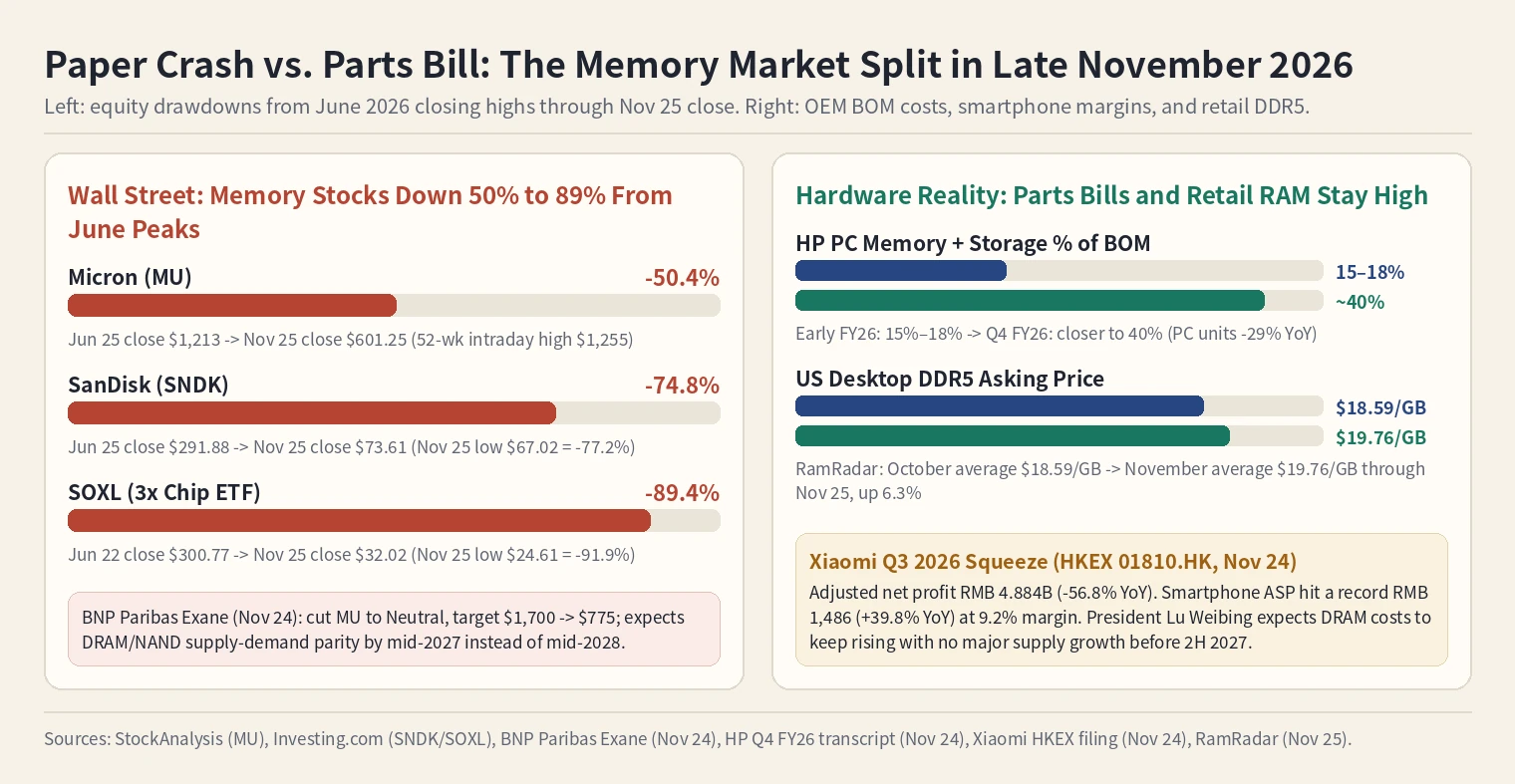
Look at the market today, November 26, 2026, and two numbers refuse to line up. On Wall Street, Micron Technology (MU) is down 50.4% from its June closing high, SanDisk (SNDK) has shed 74.8%, and the 3x leveraged chip ETF SOXL is down 89.4%. Yet when I checked retail memory trackers and the earnings calls HP Inc. and Xiaomi both held on November 24, desktop RAM prices are still near $20 per gigabyte and PC makers say memory and storage now eat up nearly 40% of a computer’s parts bill.
If you are trying to build a PC or upgrade a laptop, the obvious question is whether that stock crash means cheaper sticks next week. I pulled the exchange price histories, read through the November 24 transcripts for HP and Xiaomi, checked BNP Paribas Exane’s downgrade note, and compared them with November 25 spot and retail quotes. The short version is that equity traders are already pricing in a 2027–2028 supply turn, while hardware makers and shoppers are still paying through 2026’s squeeze.
For our ongoing monthly price tracker and institutional forecasts, see RAM Price Trend 2026: Dated DDR4, DDR5 and SSD Prices Plus the Memory Price Forecast. Here is what actually changed in the past 48 hours.
How far memory stocks actually fell (check the close, not just social posts)
Posts circulating on X over the past day rounded the damage to “Micron -50%, SanDisk -80%, SOXL -90%.” Checking verified exchange closing records through November 25, 2026 puts Micron and SOXL almost spot-on, while SanDisk sits closer to -75% close-to-close (and -77.2% intraday peak-to-trough):
| Ticker | June 2026 Peak (Close / 52-Wk Intraday) | Nov 25, 2026 Close (Intraday Low) | Drawdown (Close-to-Close) | Source |
|---|---|---|---|---|
| Micron (MU) | $1,213 (Jun 25) / $1,255 (52-wk high) | $601.25 (low $548.13) | -50.4% (-52.1% vs. intraday high) | StockAnalysis MU History |
| SanDisk (SNDK) | $291.88 (Jun 25) / $294.30 (52-wk high) | $73.61 (low $67.02) | -74.8% (-77.2% peak-to-trough) | Investing.com SNDK History |
| SOXL (3x Chip ETF) | $300.77 (Jun 22) / $302.00 (52-wk high) | $32.02 (low $24.61) | -89.4% (-91.9% peak-to-trough) | Investing.com SOXL History |
The latest blow landed on Tuesday morning, November 24, when BNP Paribas Exane analyst Karl Ackerman downgraded Micron from Outperform to Neutral and more than halved his price target, from $1,700 to $775. Micron fell 11.01% that day to $629.79, then dropped another 4.53% on November 25 to $601.25.
According to Investing.com and the Seoul Economic Daily, Ackerman argued that DRAM and NAND supply and demand could hit parity by mid-2027, a full year earlier than BNP’s prior mid-2028 estimate, kicking off average selling price (ASP) declines from there. He pointed to four drivers:
- Growing uncertainty around hyperscaler data center buildout plans for 2028, including permit delays.
- Lower high-bandwidth memory (HBM) content in Nvidia’s upcoming Vera Rubin Ultra platform.
- Projected declines in global PC and mobile unit shipments in both 2026 and 2027.
- Additional memory wafer capacity coming online.
Ackerman also noted that year-on-year DRAM and NAND price growth already peaked in August, and historically memory stocks top out when YoY ASP growth peaks. Even so, Wall Street is far from unanimous: Seoul Economic Daily noted that Goldman Sachs and Bank of America still expect the memory upcycle to run through at least 2027.
Why hardware bills and RAM prices are still painful on the ground
If you only looked at MU and SNDK charts, you would assume memory modules are piling up unsold at steep discounts. HP Inc. released its results after the U.S. market close on November 24, with the press release timestamped 4:15 p.m. ET and the earnings call at 5:00 p.m. ET (5:15 a.m. and 6:00 a.m. HKT on November 25). Xiaomi filed its third-quarter results with the Hong Kong exchange on November 24 and held its call at 7:30 p.m. HKT the same day. Both tell the opposite story.
HP Inc.: memory and storage climbed from 15%–18% to nearly 40% of PC BOM
In the HP Inc. Q4 FY2026 earnings call transcript (for the quarter ended October 31, 2026), CFO Karen Parkhill gave a blunt accounting of what memory inflation did inside HP’s laptops and desktops:
“At the beginning of last year, we did say that memory and storage costs represented 15%-18% of the bill of material at the beginning of the year, and we expected that to double in the year. That did hold true for last year. By FQ4, our memory and storage was closer to 40% of the bill of material.”
Think about what 40% means for a PC maker. Out of every dollar HP spends on components for a machine, nearly forty cents now goes to DRAM and NAND alone, leaving the CPU, display, motherboard, battery, and chassis to split the rest. Parkhill added that HP expects memory and storage costs “to continue to increase, but at a lesser rate than what we saw last fiscal year,” alongside rising CPU costs. HP has already locked in 100% of the components it needs for fiscal 2027 and treats retail price hikes as “the last lever.”
HP's official Q4 release shows how that cost shock warped shipments. Personal Systems revenue rose 14% year over year to $11.8 billion, yet total PC unit volume dropped 29% (consumer units down 31%, commercial down 28%) and segment operating margin compressed to 3.0% from 5.8% a year earlier. Fewer PCs shipped, higher prices per box, thinner margins.
Xiaomi: adjusted profit down 56.8% as DRAM keeps climbing
On November 24 in Hong Kong, Xiaomi Corporation (01810.HK) posted its third-quarter results. Per Xiaomi's official HKEX filing:
- Q3 2026 revenue reached RMB 107.24 billion (RMB 107,239.5 million), down 5.2% year over year.
- Non-IFRS adjusted net profit fell 56.8% year over year to RMB 4.884 billion (down 21.5% quarter over quarter).
- Smartphone shipments hit 30.7 million units, with smartphone gross margin at 9.2% and smartphone average selling price hitting a record RMB 1,486, up 39.8% year over year.
On Xiaomi's Q3 earnings call, President Lu Weibing drew a sharp line between NAND and DRAM. He described NAND as roughly flat to slightly up, while DRAM costs are likely to keep rising, with no major supply increase expected before the second half of 2027. Because handset makers and retail channels carry component and finished-goods inventory, Lu noted that retail phone prices lag memory cost spikes, and he expects memory costs overall to remain elevated through Q1 and Q2 2027.
Retail vs. spot: DDR5 sticks sit near $20/GB while DDR4 and NAND spots just began to soften
On the retail shelf, buyers have seen zero relief yet. According to the RamRadar November 2026 RAM Price Index (through November 25, 2026):
- US desktop DDR5 kits averaged $19.94/GB on November 25, up 1.5% since November 1, with a November monthly average of $19.76/GB (+6.3% compared with October’s $18.59/GB).
- Desktop DDR4 averaged $8.48/GB on November 25, up 4.7% on a monthly-average basis from October.
One layer deeper, though, the chip spot market is finally showing small cracks. In its November 25 spot price update, TrendForce reported that weak consumer electronics demand has buyers cutting inventory, pushing mainstream DDR4 1Gx8 3200MT/s spot prices down 1.61% week over week to $43.32 (as of Nov 24) and 512Gb TLC NAND flash wafers down 3.18% to $13.786 (as of Nov 16). Branded DDR5 spot inquiries, however, remain mostly cautious price checks rather than aggressive discounting.
Why memory stocks crashed months before retail RAM prices move
Put those four data points side by side and the gap makes sense:
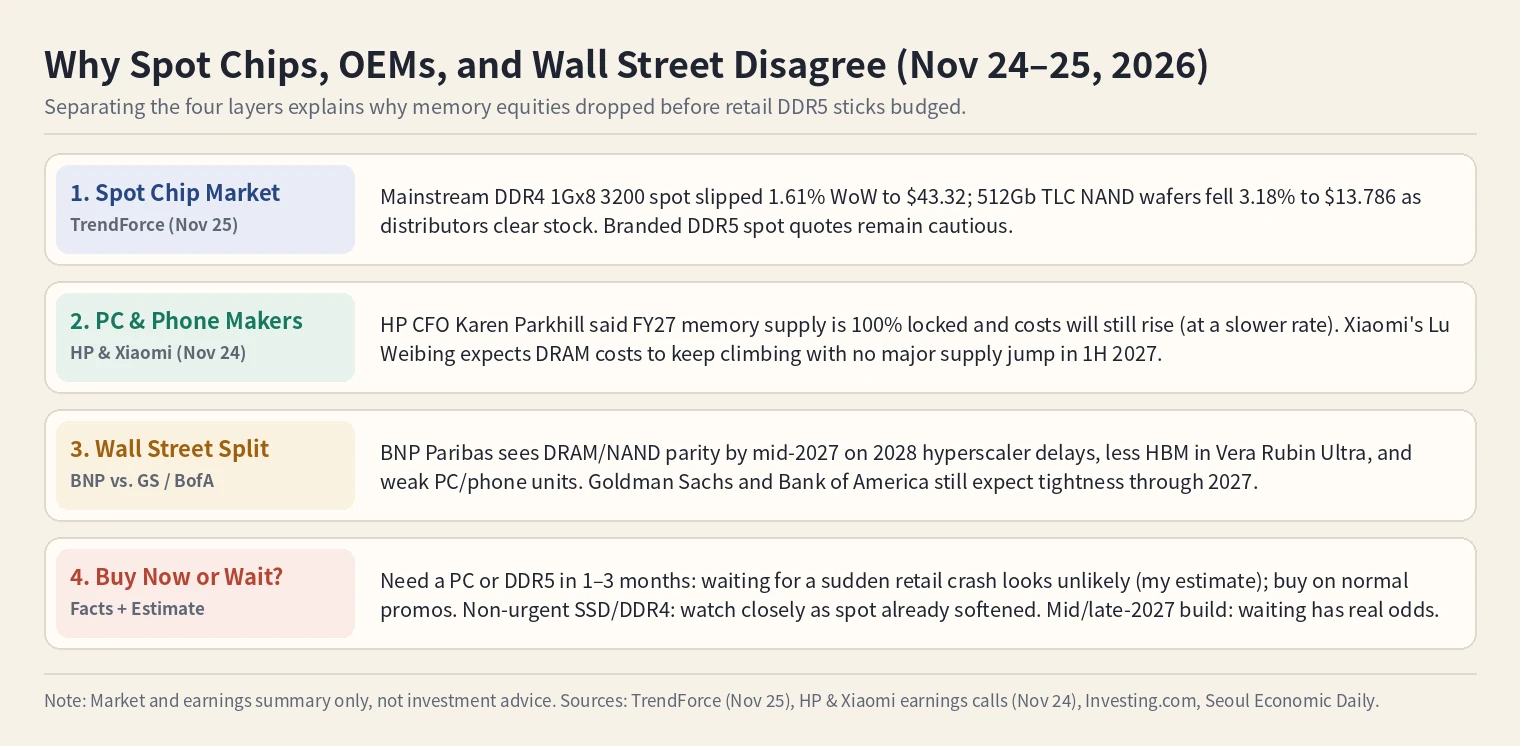
- Stocks price in the 2027–2028 turn early. Memory equities are cyclical; they drop when year-over-year price acceleration peaks and 2028 data-center visibility wobbles, long before memory makers start losing money.
- OEMs and module makers are working through locked contracts and inventory. HP already secured its FY27 supply, and Xiaomi is cushioning margins with earlier inventory and higher-end phone launches. High-cost chips already paid for do not get marked down overnight at Best Buy or Newegg.
- AI server demand still pins down DDR5 and HBM wafers. Consumer-grade DDR4, DDR3, and TLC NAND wafers are the first pieces wobbling on weak PC and phone demand, whereas BNP itself does not expect overall DRAM and NAND supply-demand parity until mid-2027.
Should you buy RAM or build a PC now, or wait?
To be clear, this is a hardware-buying look based on public numbers, not stock or investment advice on Micron, SanDisk, or SOXL. Based on the data above, my estimate splits into three clear cases:
- If you need a PC or DDR5 RAM in the next 1 to 3 months: I estimate waiting for a stock-crash discount on retail DDR5 is a losing bet. Retail DDR5 is still averaging $19.94/GB as of November 25, and both HP and Xiaomi expect memory costs to stay high through the first half of 2027. Grab a normal holiday or seasonal promo if you see one and build when you need the machine.
- If you want an SSD or a DDR4 upgrade and are not in a rush: I estimate watching for a few weeks to a quarter is worth it. TrendForce’s November 25 spot data shows 512Gb TLC NAND wafers already down 3.18% and DDR4 chips down 1.61% as distributors clear stock, and Lu Weibing noted NAND is already flat compared with rising DRAM. Consumer storage and DDR4 almost always soften ahead of DDR5.
- If you can hold off a full build until mid-to-late 2027: I estimate waiting carries real upside. If BNP Paribas is right about mid-2027 supply-demand parity and two straight years of softer PC and phone shipments, pricing leverage could swing back toward buyers by next summer or fall, though Goldman Sachs and Bank of America still bet against an early cooldown.
We will keep tracking monthly retail DDR4, DDR5, and SSD moves on our main RAM Price Trend 2026 tracker as new spot and earnings data land.