

T3 Code Telemetry: Site Said “No Telemetry,” Code Shipped It On by Default
T3 Code telemetry vs. its own homepage: on by default since Mar 6, 2026, while the site said “No telemetry” in May. Codex and Claude IDs hashed without salt. How to opt out.
 bufferAbout the author10 min read

T3 Code is the open-source AI coding app from Theo (@theo) and his team. The repository is pingdotgg/t3code. On November 24, 2026, X user @realchendahuang posted a long thread about its telemetry. I checked each claim against the PRs, issues, commits and source code on GitHub, plus Wayback Machine copies of the homepage. This piece covers only what the original links can prove. Line numbers refer to main at commit a326dea2 (November 24, 2026). All dates are UTC.
The short version comes down to three contrasts:
- In May 2026 the homepage said “No telemetry / Unless you opt in. Full stop.” The code had shipped telemetry switched on by default since March 6.
- The telemetry docs arrived on September 4, and the in-app notice on October 6. As of today, the app’s settings still have no switch to turn telemetry off.
- Product telemetry does not upload prompts, model responses, file contents or login credentials, but it does upload token usage counts and model names. It also reads account IDs from the local Codex and Claude config files, hashes each one with unsalted SHA-256 and uploads the hash.
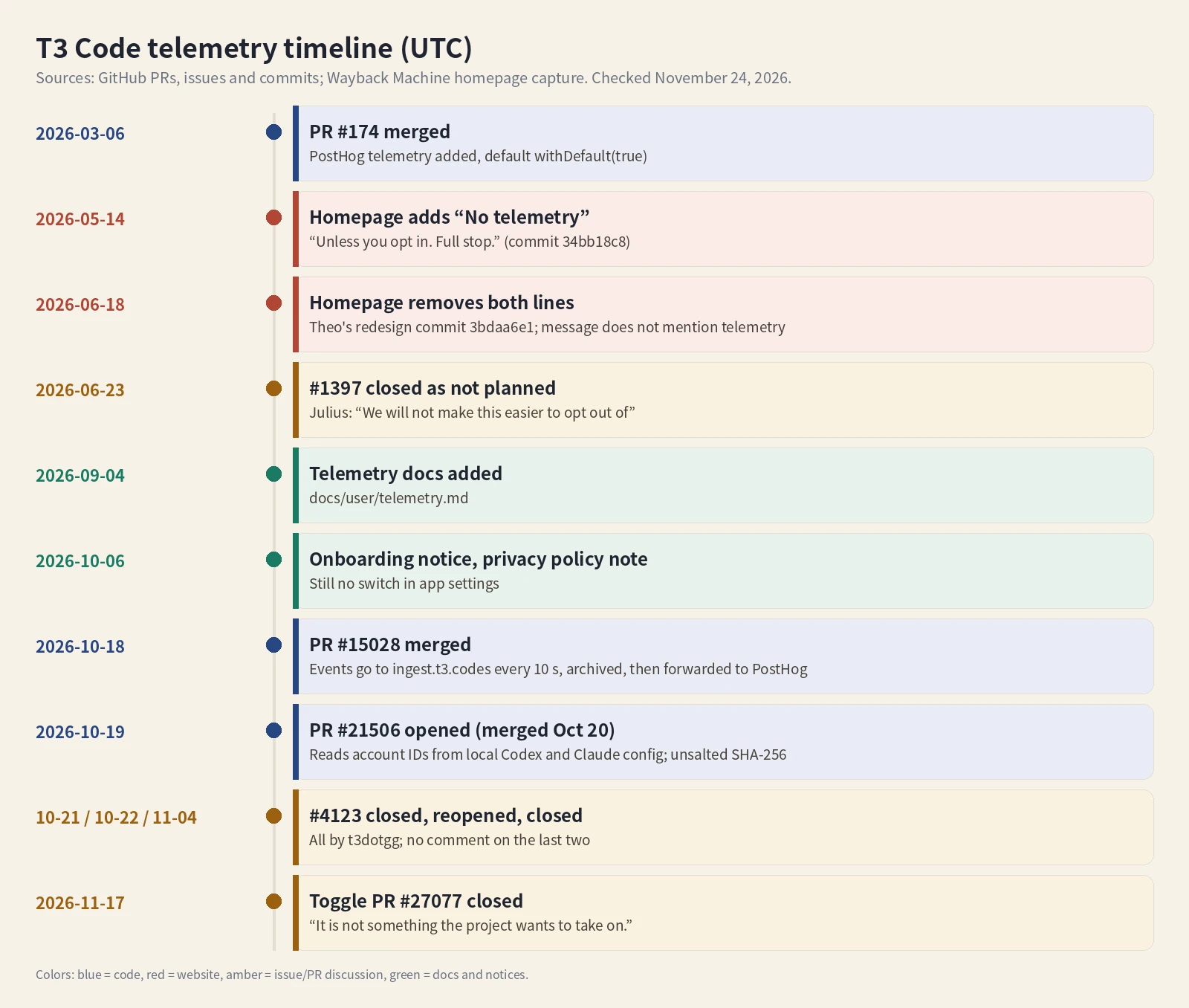
Timeline (UTC)
| Date (UTC) | Event | Source |
|---|---|---|
| 2026-03-06 | PR #174 merged: PostHog telemetry added, on by default in code | PR #174 |
| 2026-05-14 | Homepage adds “No telemetry / Unless you opt in. Full stop.” (commit stamped May 13, 18:31 US Pacific) | commit 34bb18c8 |
| 2026-06-18 | Theo’s homepage redesign commit removes both lines | commit 3bdaa6e1 |
| 2026-06-23 | Maintainer Julius closes Issue #1397 (request for an opt-out) as not planned | #1397 comment |
| 2026-09-04 | docs/user/telemetry.md added | commit 1587f248 |
| 2026-10-06 | Onboarding notice and privacy policy disclosure added | commit 115640ae, commit 3b44698d |
| 2026-10-18 | PR #15028 merged: events go to T3’s own ingest.t3.codes every 10 seconds | PR #15028 |
| 2026-10-19 | PR #21506 opened (merged Oct 20): reads account IDs from local Codex and Claude config files | PR #21506 |
| 2026-10-21 / 10-22 / 11-04 | Issue #4123 closed, reopened and closed again from Theo’s account | #4123 |
| 2026-11-17 | Settings-toggle PR #27077 closed by Julius | #27077 comment |
The homepage line: added in May, removed in June
The Wayback Machine’s May 14, 2026 capture of the homepage has a tile that reads:
No telemetry Unless you opt in. Full stop.
Theo added those lines in commit 34bb18c8 (#2681, “Made marketing site less cringe”). By then, telemetry had been on by default for more than two months. On June 18, Theo’s commit 3bdaa6e1 deleted both lines from apps/marketing/src/pages/index.astro. The commit is titled “Polish marketing homepage: nav, hero, and endorsements (#3137)”, and its description does not mention telemetry.
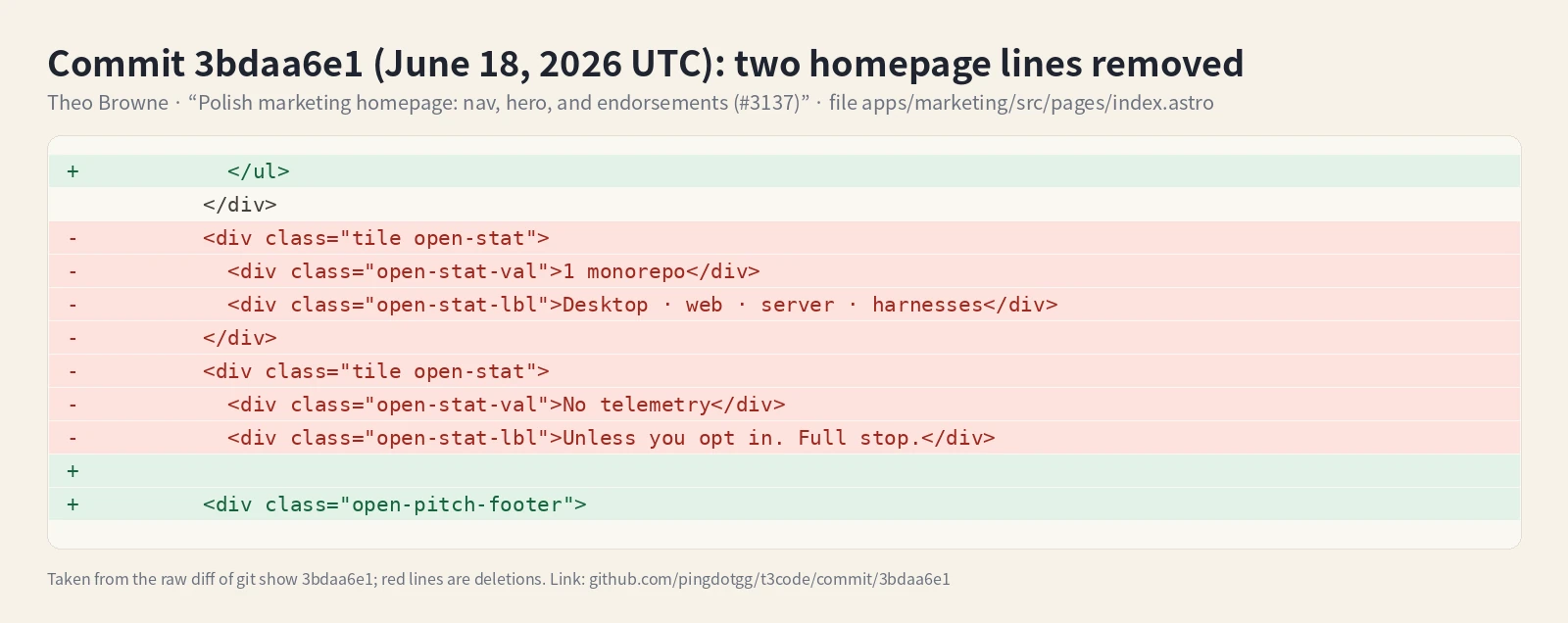
The line stayed on the homepage for about five weeks.
The default in code: on since PR #174
Maintainer Julius Marminge opened PR #174 and merged it on March 6. Its title is “Add anonymous PostHog telemetry for provider lifecycle events”. In the merged AnalyticsService.ts, line 31 reads:
enabled: Config.boolean(“T3CODE_TELEMETRY_ENABLED”).pipe(Config.withDefault(true)),
If you set nothing, it reports, and at the time events went straight to us.i.posthog.com. The same line on main still defaults to true.
At that point the repository had no telemetry docs, the app showed no notice, and settings had no switch. The docs came on September 4. The onboarding line “T3 Code collects anonymous usage data to improve the app” came on October 6. As of November 24, main still has no telemetry setting.
What is uploaded and what is not
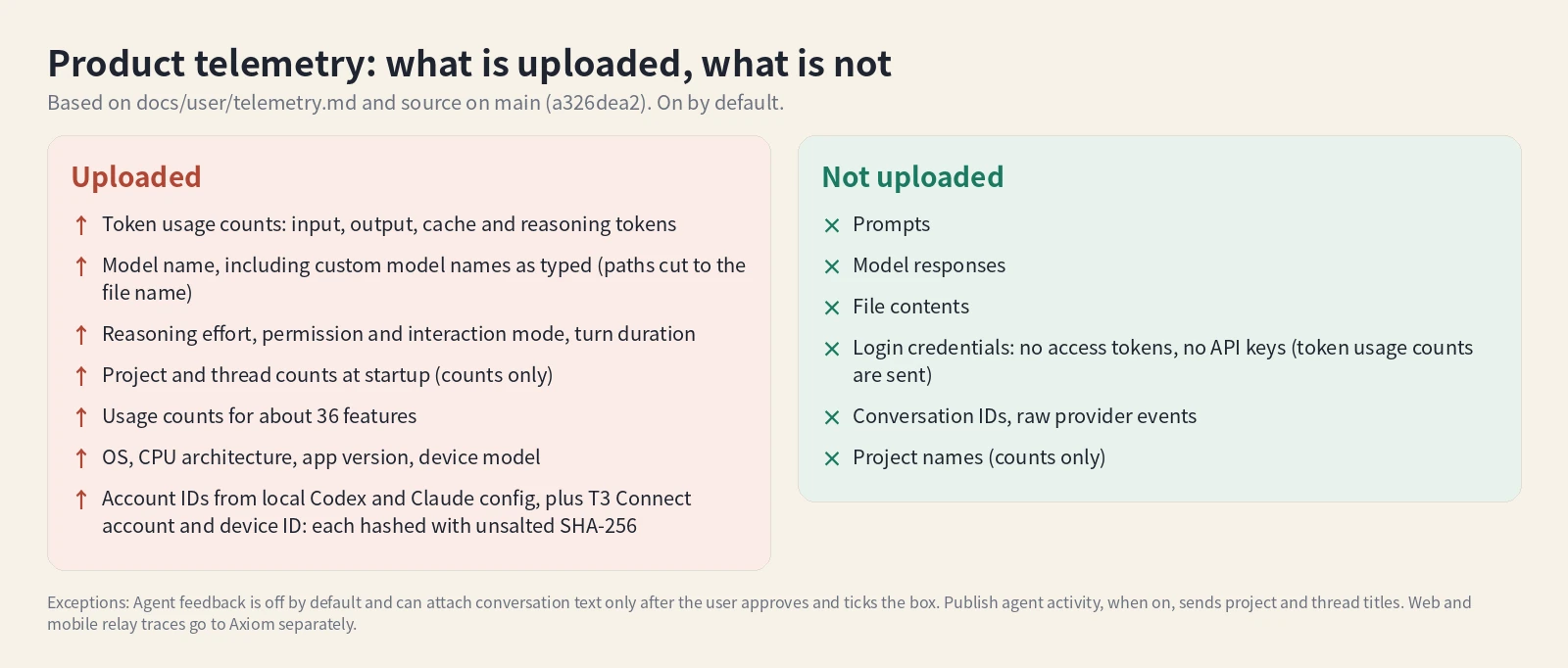
According to T3 Code’s own docs and source code, product telemetry does not upload prompts, model responses, file contents or login credentials (no access tokens, no API keys). It does upload per-turn token usage counts (input, output, cache and reasoning tokens) and the model name, including custom model names you set yourself.
The official docs say: “Product events do not include prompts, responses, file contents, authentication tokens, conversation IDs, raw provider events, or child-agent output.” The same page says: “Events include the model ID the provider used, including custom models and models served by a custom endpoint.”
The source shows these fields going out:
- Model name. Names that match the bundled catalog are normalized, and anything else is sent as typed. If it looks like a file path, only the file name is kept (ProviderDimensions.ts).
- Token usage:
inputTokens,cachedInputTokens,cacheCreationTokens,outputTokens,reasoningTokensand related fields (ProviderUsageAnalytics.ts). - Reasoning effort, permission and interaction mode, and how long each turn took.
- Project and thread counts at startup (counts only, no project names).
- Usage counts for about 36 features, such as opening a terminal, creating a worktree or forking a thread.
- Operating system, CPU architecture, app version and device model.
There are three exceptions. Agent feedback is off by default, and when a user approves a report and ticks the box, it can attach conversation text. Publish agent activity, when turned on, sends project and thread titles to the T3 Connect relay for phone notifications. Diagnostic traces sent to Axiom are the third: error messages and stack traces can carry a value or path being processed, and the docs themselves say “error text can quote a value”.
Account IDs read from local Codex and Claude config files
Theo opened PR #21506 on October 19, and it was merged on October 20. Its description states the goal: “We cannot count installs reliably or tell how many installs one person runs.”
The current Identify.ts reads account IDs from two local config files:
~/.codex/auth.json:tokens.account_id, plus the OpenAIuser_id, which it decodes locally from theid_token.~/.claude.json:userIDandoauthAccount.accountUuid.
Each of these IDs, along with the T3 Connect account and a device ID, is hashed on its own with SHA-256 and then uploaded. The hash function uses no salt. Only the hashes leave the machine. The tokens themselves are not uploaded.
Reading the Codex file started in March: the first Identify.ts in PR #174 already read tokens.account_id and used its hash as the PostHog user ID.
The privacy risk: an unsalted hash can, in principle, be matched by anyone who holds the original ID.
T3’s own ingest keeps a copy, then forwards to PostHog
Theo opened PR #15028, and it was merged on October 18. It changed the default endpoint from PostHog to https://ingest.t3.codes and changed the send interval from 1 second to 10 seconds. The comment at the top of AnalyticsService.ts in that merge reads:
Events go to the T3 Code ingest endpoint, which keeps a copy and forwards them to PostHog.
The PR description says: “That endpoint takes the same /batch/ body, archives every event, and forwards a filtered set to PostHog.” The ingest server code is not in the public repository, so those two passages are the only source for how the archive works.
How maintainers answered in issues and PRs
Issue #1397 was opened by sbansal1999 on March 25 to ask for a way to opt out. On June 23, Julius closed it as not planned, with this comment:
We only collect data so we know what platforms people are using and how many users we have. There is no personal data, agent runs etc captured. We will not make this easier to opt out of, it is crucial for us to know how many users we have
Issue #4123 was opened by salixhost on July 18. It cites the homepage capture and commit 3bdaa6e1.
- October 21: the t3dotgg account replied with a note at the top, “Claude Opus 5.5 responding on behalf of Theo”. The reply said “One part of this is fixed on main in #14413” (#14413 makes relay tracing respect the opt-out). It also said that default-on telemetry, in-app consent and control were still open, and asked for a new issue on those. The account then closed #4123.
- October 22: t3dotgg reopened it without a comment.
- November 4: t3dotgg closed it again, also without a comment.
Four PRs that added a toggle. None was merged:
- #13458: closed by its own author on September 25, with no reason given.
- #16763: closed by maintainer maria-rcks on October 14. The reason given was that it changed 535 lines, over the 500-line review limit for unvouched contributors.
- #21248: closed by its own author on October 18, “closing due to #1397 discussion”.
- #27077: maintainer maria-rcks verified it in a real dev environment on November 1, and her comment says “147 focused existing tests passed”. On November 17, Julius closed it with this comment: “Thanks for this. It is not something the project wants to take on.”
What Theo and the maintainers say the data is for
Julius wrote in #1397 that the data shows which platforms people use and how many users there are (quoted above).
On November 4, Theo replied to the author of #16763 on X:
To be VERY clear, you can absolutely disable our anonymous telemetry. It is an env var you can set, preventing us from even being informed of the initial boot (literally nobody else does this afaik). We even detail this during the onboarding now!
In the same post he gave the reasons:
We use it to steer product, gain credibility, better understand how people use T3 Code, and to let us get enough funding to continue giving it out for free.
On November 7, Theo posted:
I gave Adam access to the T3 Code anonymized telemetry data to make more posts like this 🙂
Adam is @AdamHoltererer, who used the data for a post on how often Opus 5.5 fails at different reasoning levels.
The original thread goes further and speculates about commercial uses of the data. I found nothing that could be checked, so I leave that out. Readers can weigh the quotes above for themselves.
How to turn it off
Before you start the T3 Code server or desktop app, set:
export T3CODE_TELEMETRY_ENABLED=false
On current main, this stops product events (the path to ingest.t3.codes and then PostHog). It also stops the relay connection traces that the local server and desktop window send to Axiom.
- Desktop app: on macOS and Linux, put the variable in your shell profile (for example
~/.zshrc) and restart the app. On Windows, set it as a user environment variable. - Administrators can get the same effect with the managed policy setting
telemetry: false.
The second variable, T3CODE_OTEL_SDK_DISABLED=true, only turns off OpenTelemetry export and relay tracing. It does not stop product events. If you set only this one, usage data is still sent.
The web and mobile apps cannot be switched off this way. The official docs say the browser app, when its build has relay tracing configured, “sends its own connection traces even if the server has opted out. The browser app has no relay tracing toggle.” The mobile app “has no separate relay tracing toggle. Server environment variables and managed policy do not disable mobile tracing.” Crash reports on the phone can be turned off under Settings > About T3 Code > Diagnostics > Send crash reports.
How I checked
I used the GitHub API to pull the open, close and reopen history and the comment text for every issue and PR above. I looked up each commit with git log and git show in a local clone. I read Theo’s two X posts directly on X. For the uploaded fields, I first had Codex CLI audit the code in read-only mode, then opened each file and line cited here and checked it myself.
I did not inspect the ingest.t3.codes server, because it is not in the public repository, and I did not capture live network traffic. The upload list above is based on the source code and the official docs.