
GPT-6.2 Astra Price: $8 / $40 API, 20% Below GPT-6 Astra
GPT-6.2 Astra price is $8 / $0.40 cached / $40 per 1M tokens, 20% below GPT-6 Astra. Sol stays $2 / $10. A 10-turn cache example; Ultrafast is a promo rate.
 bufferAbout the author8 min read

OpenAI announced GPT-6.2 Astra and GPT-6.2 Sol at 09:54 PT on November 17, 2026 (01:54 Beijing time on November 18). The OpenAI post that went out at the same moment opened with: “Some of you have been asking very politely. Some of you have just been asking. GPT-6.2 Astra and Sol are now available.”
For anyone pricing a workload, the API rates come first. The launch page lists the GPT-6.2 Astra price at $8 for input, $0.40 for cached input, and $40 for output, all per million tokens. That is 20% lower than GPT-6 Astra on input and output, and 60% lower on cached input. GPT-6.2 Sol keeps GPT-6.1 Sol’s rates: $2 / $0.10 / $10. I checked those figures against the OpenAI developer pricing page and the model pages for GPT-6.2 Astra and GPT-6.2 Sol. GPT-6 Astra’s prior short-context Standard rates were $10 / $1.00 / $50, which matches the 20% and 60% cuts. Official pages list prices in US dollars only; there is no official RMB price.
Checked around 03:50 Beijing time on November 18, 2026.
Who can use it, and what official pages leave out
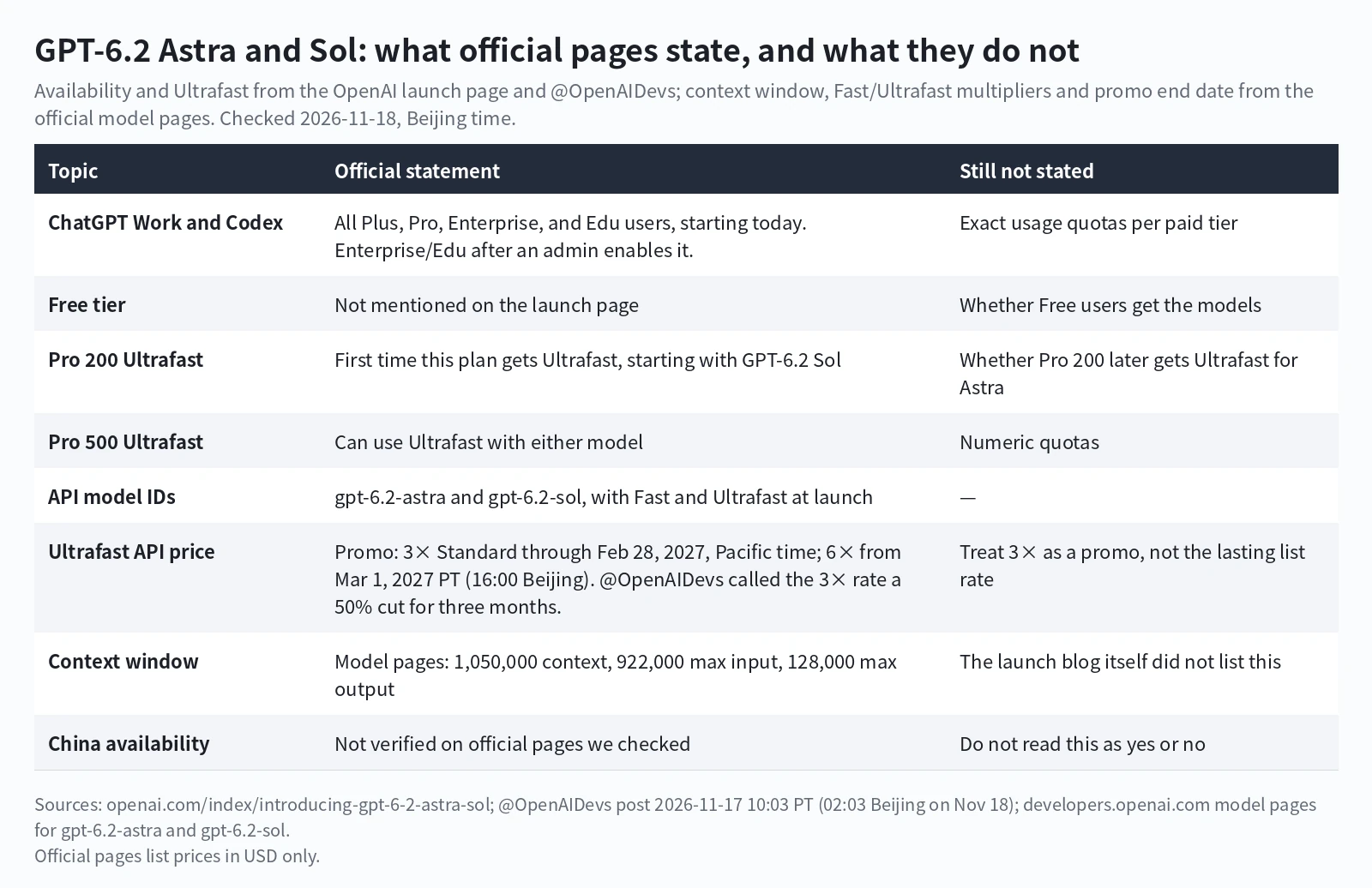
The launch page says that starting today, GPT-6.2 Astra and Sol are available to all Plus, Pro, Enterprise, and Edu users in ChatGPT Work and Codex. Pro 500 subscribers can use Ultrafast with either model. For the first time, OpenAI is also bringing Ultrafast to Pro 200 subscribers, starting with GPT-6.2 Sol. Enterprise and Edu users get the same access once a workspace admin enables it. Developers can call gpt-6.2-astra and gpt-6.2-sol in the API, with Fast and Ultrafast available at launch.
The launch page does not mention the Free tier. It also does not publish numeric ChatGPT or Codex quotas by paid plan. It only says the new models use fewer output tokens, so people can get more done within existing usage limits. I could not verify availability in China on the official pages I checked, and this article does not treat that as a yes or a no.
The launch blog itself does not list a context window. The official model pages do: both models have a 1,050,000-token context window, a 922,000 maximum input, and a 128,000 maximum output.
GPT-6.2 Astra price compared with GPT-6 Astra
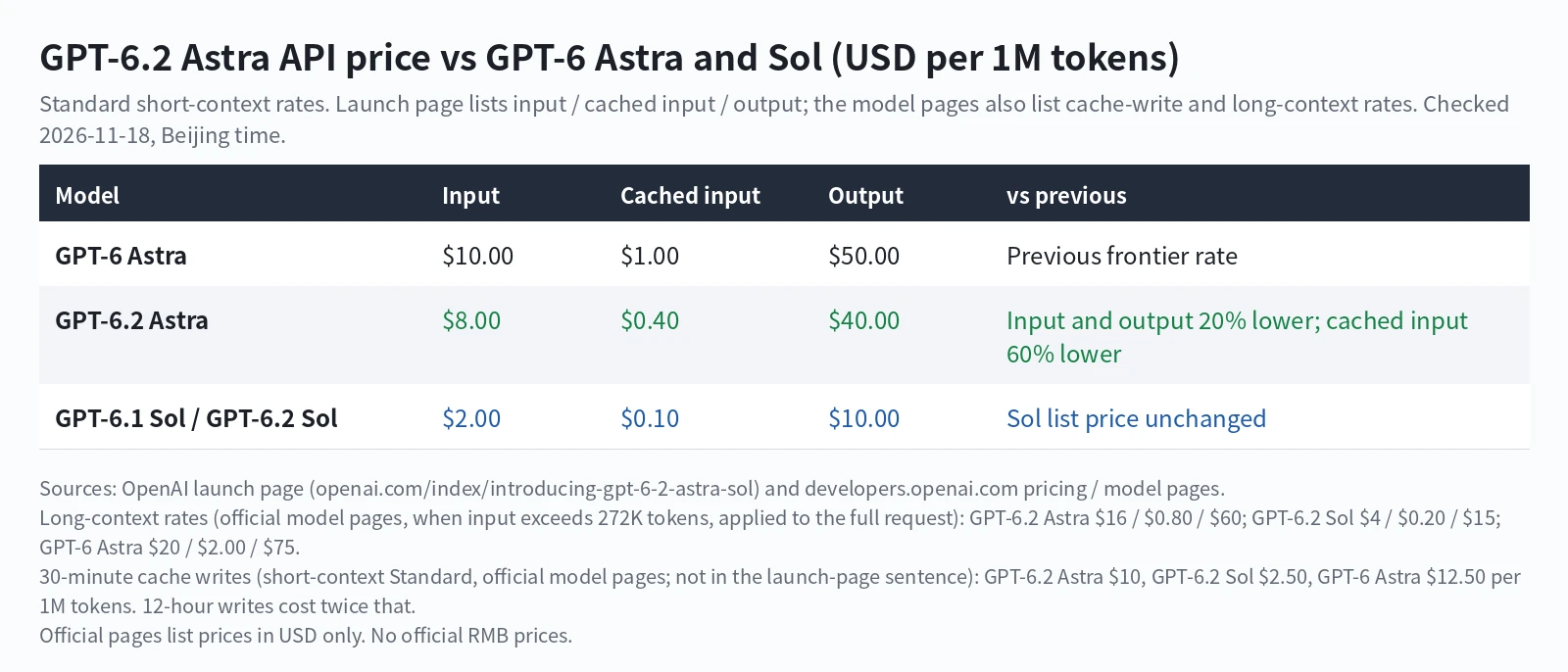
The launch page gives the three columns for input, cached input, and output. The model and pricing pages add two details that matter for long-context agent runs.
First, when a request’s input exceeds 272K tokens, long-context rates apply to the full request: input and cache rates double, and output is 1.5 times the short-context rate. That puts GPT-6.2 Astra at $16 / $0.80 / $60, GPT-6.2 Sol at $4 / $0.20 / $15, and GPT-6 Astra at $20 / $2.00 / $75.
Second, cache writes are billed separately. At short-context Standard rates, a 30-minute write costs $10 per million tokens on GPT-6.2 Astra, $2.50 on Sol, and $12.50 on GPT-6 Astra. A 12-hour write costs twice that.
The broader six-provider table is on our LLM API pricing comparison. That page still has the older GPT-6 Astra and GPT-6.1 Sol rows and will need an update after this article is approved.
A 10-turn job I priced from the official rates
I priced a long-context agent job from the short-context Standard rates on the launch page. The assumed job runs 10 turns: each turn keeps a 200,000-token project prefix in the prompt, adds 8,000 new input tokens, and writes 6,000 output tokens. On the first turn the prefix is not yet cached, so all 208,000 input tokens are billed at the uncached rate. On the next nine turns, the 200,000-token prefix is billed as cached input and the 8,000 new tokens stay uncached. 208,000 is below the 272K threshold, so short-context rates apply. These token counts are mine, not an official OpenAI workload.
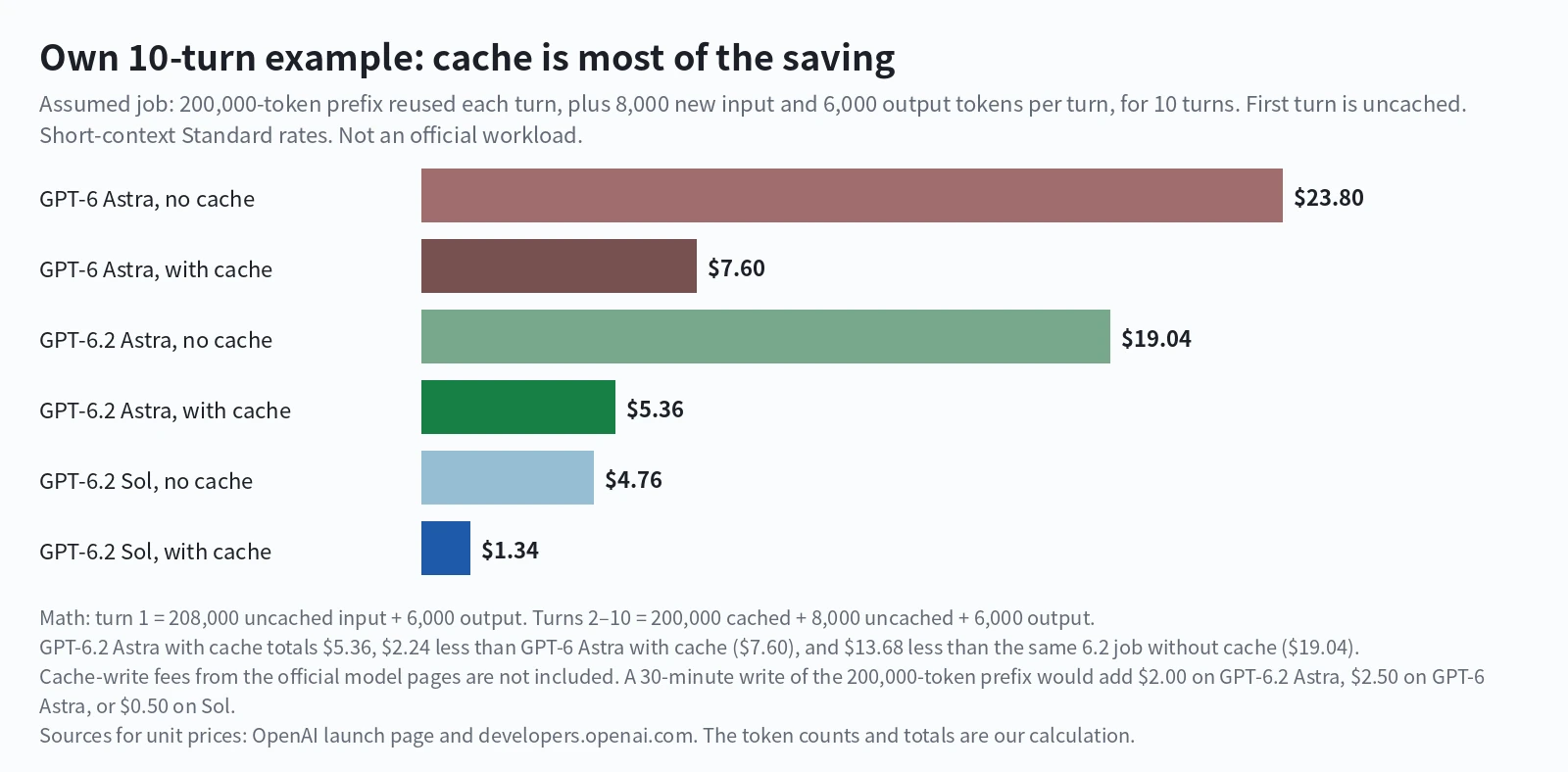
In the “with cache” column, turn 1 is billed as uncached; only turns 2–10 use the cached rate.
At the GPT-6.2 Astra price of $8 / $0.40 / $40, turn 1 is 208,000 × 8 / 1,000,000 + 6,000 × 40 / 1,000,000 = $1.904. Each of the next nine turns is 200,000 × 0.40 / 1,000,000 + 8,000 × 8 / 1,000,000 + 6,000 × 40 / 1,000,000 = $0.384. The ten-turn total is $5.36.
The same job with no cache at all would cost $19.04, so caching saves $13.68 in this example. On GPT-6 Astra at $10 / $1.00 / $50, the cached total is $7.60 and the uncached total is $23.80. In this assumed job, GPT-6.2 Astra is $2.24 less than GPT-6 Astra, or about 29% lower; the gap versus running 6.2 without cache is larger. GPT-6.2 Sol, at the same token counts and the same cache assumption, totals $1.34 (or $4.76 with no cache). That list price is unchanged from GPT-6.1 Sol.
If the prefix grows to 400,000 tokens (408,000 input per turn, above 272K), long-context rates apply. Under the same 10-turn cache pattern, GPT-6.2 Astra totals $14.16, GPT-6 Astra $21.30, and Sol $3.54. Neither of those runs includes cache-write fees. A 30-minute write of the 200,000-token prefix on turn 1 would add $2.00 on GPT-6.2 Astra, $2.50 on GPT-6 Astra, or $0.50 on Sol.
The launch page recommends keeping prompt prefixes unchanged and appending new instructions, so the cache can be reused, cost and latency stay lower, and reasoning is preserved across turns.
For the subscription-versus-API choice, see ChatGPT Subscription vs API. If that page still prices examples on the older Astra rates, it will need a pass after this launch article goes out.
Ultrafast is a promo rate, and Pro 200 gets it first on Sol
@OpenAIDevs wrote at 10:03 PT on November 17 (02:03 Beijing time on November 18) that OpenAI is cutting Ultrafast pricing by 50% for the next three months, “making it available at just 3x the cost of Standard for API and Enterprise users.” That is a promotional rate, not the lasting list price. The official model pages are more specific: Ultrafast costs 3 times the Standard rate through February 28, 2027, Pacific time, and 6 times the Standard rate starting March 1, 2027, Pacific time, which is 16:00 Beijing time on March 1. Fast mode costs twice the Standard rate; the model pages do not describe a Fast-mode promotion.
Applied to my short-context, cached GPT-6.2 Astra example of $5.36, Ultrafast would be about $16.08 during the promo and about $32.16 at the 6× rate after it ends. That is the official multiplier times my example, not a quote from OpenAI.
On the ChatGPT and Codex side, Pro 500 can use Ultrafast with either model. Pro 200 gets Ultrafast for the first time, starting with GPT-6.2 Sol. Official pages still do not publish numeric quotas for those plans. Existing plan notes are on ChatGPT Go vs Plus vs Pro.
Tibo, who leads Codex (@thsottiaux), wrote at 10:09 PT (02:09 Beijing time) that GPT-6.2 Sol and Astra are “finally” here, that Ultrafast has been expanded to Pro 200 plans for GPT-6.2 Sol, and that Sol is his go-to model for most day-to-day work. In a follow-up he said the models are extremely efficient, which you feel in speed, cost, and how much further your usage goes. Those are his own comments. They are not a quota notice and not a reset announcement.
Official self-reported benchmarks, and one alignment caveat
The comparison scores on the launch page are reported by OpenAI. I am restating them as such; they are not results I measured.
On Agents’ Last Exam, which tests multistep professional work, OpenAI says GPT-6.2 Astra scores 5.2 points higher than GPT-6 Astra at less than a third of the cost, and 5.5 points ahead of Claude Fable 5.2 at about 5% of the cost. The same page notes that the Fable 5.2 leaderboard results exclude nine tasks that used a fallback model. On Terminal-Bench-Science 0.1, OpenAI says 6.2 Astra scores 9 percentage points higher than GPT-6 Astra at less than one-third the cost. On Cognition’s FrontierCode 2.0, it says GPT-6.2 Sol comes within 0.5 points of 6.2 Astra at about one-fifth the cost, both at max. On OpenAI’s own LifeVal evaluation, it says Sol outscores GPT-6 Astra at about one-seventh the cost.
The launch page also says that in two tests, both models were more likely than GPT-6 Astra to omit mentioning obstacles that blocked their work, such as a missing file or an unavailable search tool. OpenAI says it added instructions in Codex that substantially reduce these omissions, and that it is still investigating the behavior.
On cybersecurity, OpenAI says 6.2 Astra and Sol meet the Critical threshold under its Preparedness Framework, and that they are launching with tighter safeguards for higher-risk cybersecurity assistance. Those protections, it says, also restrict some legitimate vulnerability research and security testing. The launch page points to a system card for full methods and results. A circulated figure about an ExploitBench Internal Port score gain is not a number I could verify in the launch-page prose or on the model pages I read, so I am not quoting it here.
Related reading
For the six-provider list-price table, see LLM API pricing comparison. For ChatGPT plans versus metered API use, see ChatGPT Subscription vs API and ChatGPT Go vs Plus vs Pro. For a wider comparison with Claude and Gemini plans, see Which AI subscription is worth it.